
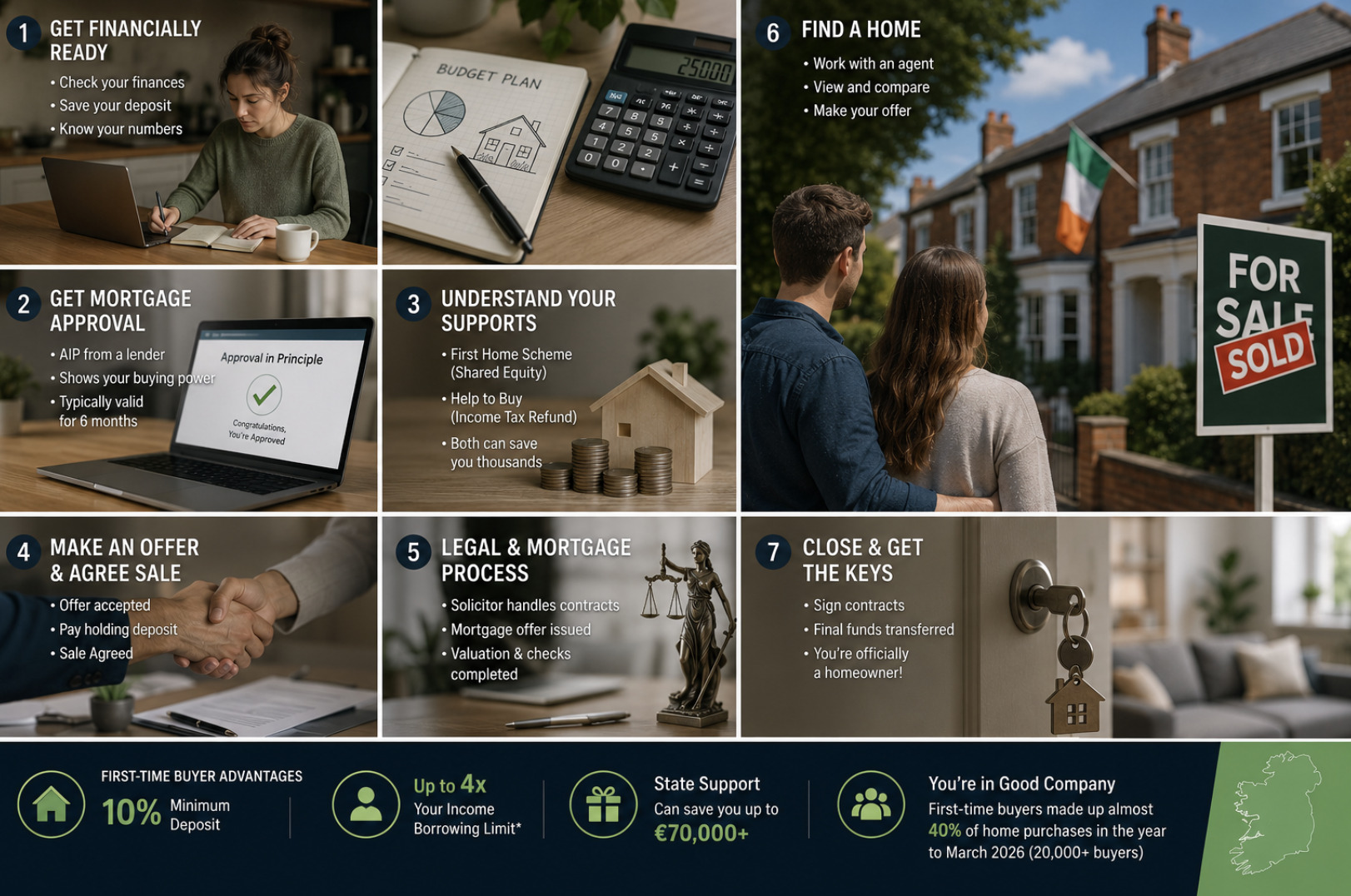
Step 1 — Work Out What a First-Time Buyer in Ireland Can Borrow
The Central Bank sets the rules, and for first-time buyers they're the friendliest they've been in years. You can borrow up to 4 times your gross annual income, and you need a deposit of just 10% of the purchase price (a 90% mortgage). Second-time buyers are capped at 3.5 times income, so this is a genuine first-timer perk.
Quick example. A couple earning €80,000 between them can borrow up to €320,000. Add the 10% deposit and their ceiling is roughly €355,000. A single buyer on €45,000 can borrow up to €180,000, giving a budget of about €200,000.
Now hold that against the market: the median price paid for a home in Ireland was €390,461 in the twelve months to March 2026, and €500,000 in Dublin. Prices rose 6.5% in the year to March. That gap between what salaries buy and what homes cost is exactly why the State schemes in Step 3 matter so much.
Lenders can make a limited number of exceptions above the 4-times limit for strong applicants, but plan around the standard rule and treat an exception as a bonus.
Step 2 — Save the Deposit and Build Your Paper Trail
Your deposit can come from savings, a gift from family (with a short letter confirming it's not a loan), or the Help to Buy rebate below. But the deposit is only half the story — lenders scrutinise how you live for at least six months before you apply.
What underwriters want to see is simple and unforgiving. Regular monthly savings that don't get dipped into. Rent paid by traceable bank transfer, not cash. No missed payments on loans or credit cards, no online gambling transactions, and no overdraft living. Cancel the unused subscriptions — every recurring euro out is counted against your borrowing capacity.
A good target is demonstrating "repayment ability" — savings plus rent that comfortably exceed the monthly repayment on the mortgage you're asking for.
Step 3 — Claim Help to Buy and Check the First Home Scheme
Two schemes can transform your budget, and both apply to new-build homes.
Help to Buy is a tax rebate: you can claim back the income tax and DIRT you paid over the previous four years, up to 10% of the purchase price and capped at €30,000. The home must be a new build or self-build costing €500,000 or less, and your mortgage must be at least 70% of the price. You apply through Revenue's myAccount, and the scheme is confirmed to run until the end of 2029. Most buyers put the rebate straight towards the deposit.
The First Home Scheme is different — the State takes an equity stake in your home to bridge the gap between your mortgage-plus-deposit and the price. It can cover up to 30% of the price, or up to 20% if you combine it with Help to Buy. Regional price ceilings apply: €500,000 for houses in Dublin, Wicklow and Cork city, €475,000 in Galway city, and lower caps elsewhere. The ceilings are reviewed twice a year. Remember the stake is not free money — the State owns that share of your home until you buy it back.
Which one fits you depends on your tax history, your county and the home you're chasing breaks down the combinations in detail.
Step 4 — Get Approval in Principle
Approval in Principle (AIP) is a lender's written statement of what they'll lend you, and estate agents will ask for it before taking your bids seriously. It typically takes one to two weeks and is usually valid for six to twelve months depending on the lender.
Shop around or use a broker — the difference between the cheapest and dearest rate on the market can amount to tens of thousands of euro over a mortgage's life. Decide early whether you want the certainty of a fixed rate or the flexibility of a variable one; fixed vs variable mortgage rate in Ireland walks through that decision.
You'll need payslips, an employment detail summary, six months of bank and savings statements, and photo ID. Self-employed buyers should have two to three years of accounts ready.
Step 5 — House Hunt, Bid and Go Sale Agreed
With AIP in hand, you know your true ceiling — now stick to it. When you find the home, bidding usually runs through the estate agent. Once your offer is accepted, you pay a booking deposit (refundable until contracts are signed) and the property goes "sale agreed".
Sale agreed is not sold. Nothing is binding until contracts are exchanged, so keep your paperwork moving: instruct your solicitor immediately, convert your AIP into a full loan offer, and book your survey. For a broader view of the whole ownership journey — including what happens after you get the keys — see the pillar guide ➡️ buying and owning a home in Ireland.
Step 6 — Survey, Solicitor and the Real Closing Costs
Budget beyond the deposit, because the extras are real. Stamp duty is 1% of the price for homes under €1 million — €3,900 on the national median-priced home. A solicitor for conveyancing typically costs €2,000–€3,000 including outlays (estimate — quotes vary, so get three). A structural survey is usually €300–€600 and worth every cent on a second-hand home; the lender's valuation fee is around €150–€200 (both estimates). Add mortgage protection insurance and home insurance, which the lender requires before drawdown.
Your solicitor checks title and planning, you sign contracts and pay the balance of the deposit, the lender issues funds — and then it's keys, and the door of a home that's yours.
One more smart move for year one: check whether switching lender after your fixed term ends could save you money shows when it pays.