
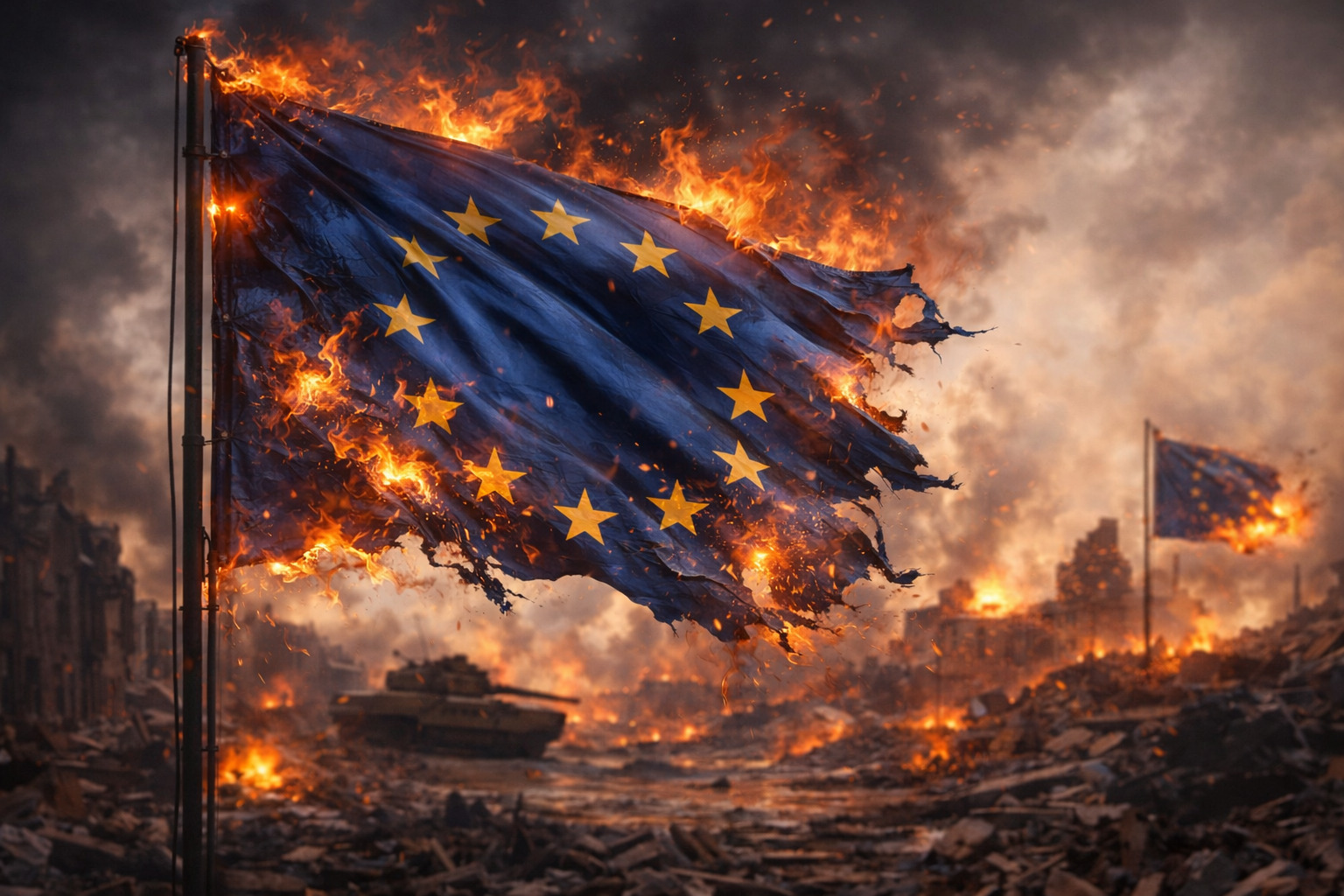
Europe’s vulnerability today is not primarily military. It is structural. It lies in the gap between responsibility and capability — between the expectation that Europe should matter and the reality that it increasingly lacks the means to enforce consequences. What is disappearing is not safety, but certainty. Not peace, but autonomy. The illusion that sustained this order was simple: that threats would remain external, manageable, and distant. That instability would unfold elsewhere, while Europe retained the role of regulator, mediator, and beneficiary of stability produced by others. This illusion allowed Europe to invest in rules rather than force, in procedures rather than power projection. For a long time, it worked.
This exposure does not emerge in isolation. It follows the broader structural shift described in the return of unchecked power, where action increasingly replaces justification as the basis of influence.
What has changed is not the existence of threats, but the reliability of protection.
Europe has lived with external pressure for decades. That, in itself, is not new. What is new is the erosion of certainty — the growing doubt about whether protection, deterrence, and enforcement will function automatically when they are needed most.
This leads to the most uncomfortable and frequently misunderstood conclusion: Russia is no longer Europe’s central strategic problem. It remains a destabilising force, a persistent pressure point, and a source of regional disruption. But it is no longer the defining risk shaping Europe’s future.
The deeper danger lies elsewhere.
It lies in Europe’s diminishing capacity for strategic autonomy — its weakening ability to act independently, to set enforceable boundaries, and to guarantee outcomes without relying on external powers to underwrite them. The issue is no longer only who threatens Europe, but who ultimately decides how Europe responds.
This shift has profound implications for European security, foreign policy, and geopolitical credibility. A continent that cannot ensure protection on its own terms becomes structurally reactive, even when it appears economically strong or politically unified. Influence remains — but agency erodes. That erosion, more than any single adversary, now defines Europe’s strategic vulnerability.
Power that cannot be exercised autonomously becomes conditional.
Influence that depends on permission is, by definition, fragile. What Europe increasingly confronts is not a shortage of resources, institutions, or formal authority, but a narrowing margin of control over when and how that authority can be used.
Across security, foreign policy, and strategic regulation, Europe finds itself in a position where it can neither fully guarantee its own protection, nor consistently impose rules, nor reliably ensure that violations carry consequences. This is not a failure of capacity. Europe possesses economic weight, legal reach, and institutional depth. The weakness lies elsewhere — in the ability to convert those assets into decisive action without external enforcement.
The result is a condition best described as strategic exposure without collapse. Europe continues to function. Markets operate. Institutions endure. Legal frameworks remain intact. On the surface, stability persists. But when pressure intensifies, a pattern emerges. Decisions slow. Responses fragment. Authority disperses across processes designed to prevent unilateral action rather than enable timely intervention.
In moments that require clarity, Europe produces procedure.
In moments that demand presence, it offers coordination.
This gap between capability and control has become one of Europe’s defining strategic vulnerabilities.
How predictability replaced autonomy
The mismatch is not accidental. It is the outcome of a long historical trade-off in which autonomy was gradually exchanged for predictability. In the decades following the Cold War, Europe prioritised stability over sovereignty in action. Power was embedded in systems, rules, and consensus-driven frameworks designed to minimise conflict and maximise continuity.
This approach delivered real benefits. Europe became exceptionally effective at managing complex systems it did not ultimately command. It learned to regulate outcomes through standards, norms, and legal mechanisms rather than force. Governance became procedural, incremental, and deliberately depersonalised.
For a long time, this worked — because the environment allowed it to work.
When symmetry disappears
Consensus-based governance rests on a critical assumption: a relative symmetry of power, constraints, and risk tolerance among its participants. When that symmetry erodes — when external actors operate with fewer limitations, clearer chains of command, and a higher appetite for strategic risk — mechanisms designed to preserve balance begin to generate dependency instead. Decision-making gives way to coordination. Authority is displaced by procedure. The system continues to function, but no longer on its own terms. Direction becomes negotiated rather than chosen; outcomes shaped elsewhere rather than secured internally.
This is how strategic irrelevance takes form — not through exclusion, but through postponement. Europe remains at the table, but no longer sets the pace. Consulted, but rarely decisive. Included, but no longer central to the outcome. Its influence holds until it intersects with stronger geopolitical interests. At that point, it is channelled into extended negotiation, diluted by process, or quietly bypassed. Power persists, but it is conditional. Agency exists, but it operates within boundaries increasingly defined beyond Europe’s control.
The quiet erosion of agency
What makes this condition difficult to confront is that it does not resemble crisis. There is no institutional breakdown, no immediate collapse, no visible failure. Instead, there is a gradual narrowing of options — a growing reliance on external guarantees to secure outcomes that once could be shaped internally.
Europe’s challenge today is not the absence of strength, but the dilution of agency. The capacity to act exists. The authority to decide does not always follow.
That distinction — subtle but consequential — now defines the core of Europe’s strategic dilemma.
The absence of hard autonomy also reshapes perception. Actors who cannot enforce outcomes are tested. Boundaries are probed incrementally. Pressure is applied not to provoke confrontation, but to measure response. Silence becomes data. Delay becomes signal. Over time, restraint is no longer interpreted as stability, but as absence of will. This does not mean Europe must militarise its identity or abandon its regulatory foundations. The issue is not one of imitation, but of alignment. A system built on quiet power struggles in an environment where power is increasingly explicit. Rules without backing lose weight. Norms without enforcement fade. The real risk for Europe is not invasion, but irrelevance under pressure.
Irrelevance is quieter than defeat. It arrives without crisis. It does not announce itself as failure. It accumulates through missed moments, diluted positions, and decisions taken elsewhere. By the time it becomes visible, the structure remains — but the centre has shifted. Europe’s challenge, then, is not to become louder, but to become autonomous again. Not to abandon restraint, but to ensure that restraint is a choice rather than a condition. Protection that depends entirely on others eventually becomes leverage for those who provide it. Illusions persist longest where systems still function. Europe is not collapsing. It is adjusting to a reality in which its assumptions no longer hold. Whether it can do so without losing relevance will define its role in the order that is now emerging.