
This article includes gambling-related content. Irishblogs.ie is committed to providing accurate and responsible information. To ensure the highest standards of quality and safety, all gambling-related content is curated and verified by industry experts from search.casino. Please engage responsibly!
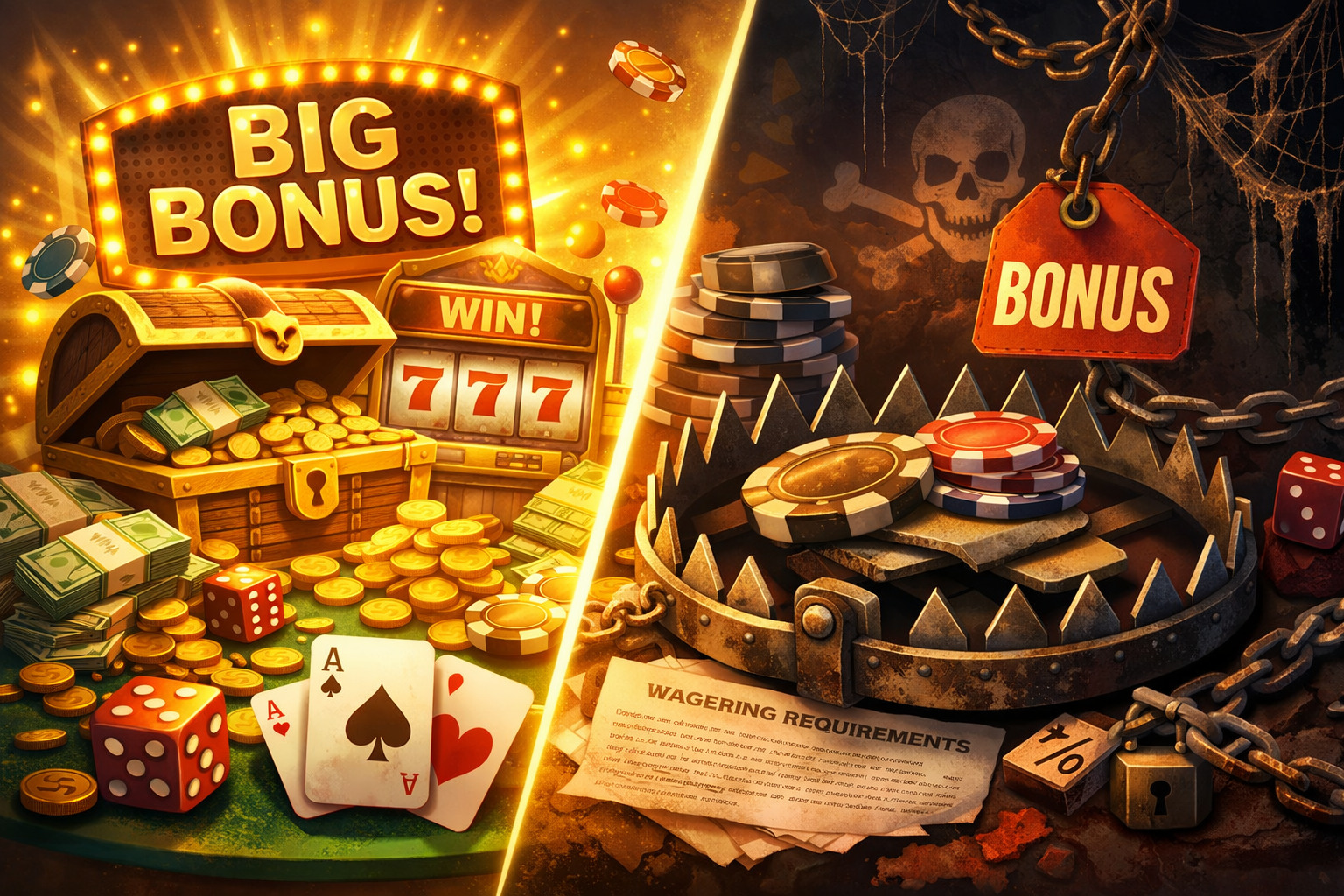
When comparing casino bonuses, the percentage is the least important number. A 50% bonus can be far better than a 200% one depending on the wagering requirement and the game RTP. What matters is not how much money you receive but how much action you are required to generate. In gambling, action is cost. Every spin carries a small expected loss, and wagering multiplies that loss until the bonus has effectively been repaid.
Understanding the Real Cost of Wagering Requirements
A wagering requirement defines how much betting volume must occur before withdrawal. A €100 bonus with 30× wagering on bonus only means €3,000 in total bets. If wagering applies to deposit + bonus, €100 deposit + €100 bonus becomes €200 × 30 = €6,000.
The important psychological detail is that players experience this as “playing longer,” while mathematically it is “paying gradually.” Casinos do not need you to lose immediately; they need you to remain in a negative expectation environment long enough. The longer the time horizon, the closer reality moves toward statistics.
To estimate the real cost, apply RTP (Return to Player). With a 96% RTP slot, the expected loss per €1,000 wagered is €40. So clearing €6,000 wagering costs statistically:
€6,000 × 4% = €240 expected loss
At that point the bonus stops being free money and becomes a discount on losses. The casino has effectively sold €240 of risk for €100 of visible credit, and most players accept the trade without realising they made one.
Good Casino Bonuses
Free spins with winnings-only wagering are often the closest thing to a genuine promotion. The reason is simple: the player risks time, not capital. If you win nothing, nothing changes. If you win something, only that amount is subject to wagering. The casino still benefits from engagement, but the mathematical pressure on the player is minimal. These offers feel relaxed because they actually are.
Cashback bonuses
Cashback works differently from traditional wagering bonuses because it compensates losses rather than demanding additional play. Instead of increasing required turnover, it returns a portion of what has already been wagered. A weekly 10% cashback does not create positive expectation, but it slows the rate at which the house edge is realised. Over time this materially changes the experience of play: sessions last longer, variance becomes softer, and losing streaks feel less abrupt. From a structural perspective, cashback is one of the few promotions aligned with player behaviour rather than against it. The casino still retains its mathematical advantage, yet it reduces volatility instead of amplifying it. For regular players this matters more than headline value — not because they expect profit, but because smoother bankroll movement allows more controlled decision-making and fewer forced deposits.
Low wagering deposit bonuses (10×–20×)
Low wagering match bonuses occupy a practical middle ground between marketing and value. They rarely generate long-term profit, but they do not significantly worsen expected loss either. With a 10×–20× wagering requirement, the additional turnover remains limited enough that the bonus functions as an extension of playing time rather than a multiplier of risk. Their effectiveness depends largely on how they are used. Applied to high RTP, low volatility games, they behave like additional session budget and preserve bankroll stability. Used for aggressive betting, they quickly lose their advantage because larger stakes accelerate exposure to the house edge. The promotion rewards consistency and patience — it is structured for sustained play, not short bursts of high risk.
Neutral Casino Bonuses
Medium wagering match bonuses (25×–35×)
These are the typical online casino welcome bonuses — the offers most players encounter first. They are not constructed as traps, but neither are they designed to deliver real monetary advantage. Their purpose is balance: attractive enough to encourage a deposit, yet calibrated so the expected loss remains close to the bonus value over time.
From a mathematical perspective, these bonuses convert money into session length. The wagering requirement increases turnover to the point where the house edge gradually absorbs the bonus while still allowing a reasonable chance of temporary profit. In other words, the player receives extended play rather than improved odds. The effect is largely psychological. Players remember the duration — hours of continuous activity — rather than the cost accumulated across thousands of spins. Because losses occur slowly and intermittently, the session feels productive even when the expected value remains negative. The bonus has effectively prepaid entertainment: it reduces short-term volatility while preserving the long-term house advantage.
Trap Bonuses
Large headline bonuses exist because they exploit perception rather than value. A 200% or 300% match looks generous, yet the wagering requirement usually scales total turnover to a level where statistical loss overtakes the bonus long before completion. What appears as extra balance is effectively a commitment to remain in play long enough for the house edge to materialise. The larger the bonus, the longer the required session and the more predictable the outcome becomes. These offers are designed to maximise activity, not to create favourable conditions for withdrawal.
Sticky bonuses are frequently misunderstood because they cannot be withdrawn, only the winnings above them. They look safe — after all, you cannot “lose” the bonus itself — but they subtly change behaviour. The inflated balance encourages higher stakes and more volatile games because the player perceives a cushion that does not truly exist. Mathematically, the bonus acts as leverage: it increases variance and prolongs exposure while adding no withdrawable equity. The player risks real funds under the impression of playing with house money, which is precisely the mechanism the promotion relies on.
Game-restricted bonuses
Bonuses restricted to specific low-RTP games are structurally disadvantageous. A difference of two or three percentage points in RTP appears minor, yet over required wagering volumes it determines the final result. For example, a 93% RTP slot doubles the expected loss compared with a 96% one across the same turnover. The gameplay feels identical — spins, animations and near-wins remain — but the mathematical environment changes completely. These offers are precise instruments: they preserve the appearance of value while quietly increasing the cost of clearing the bonus.
How to Evaluate Any Casino Bonus Quickly
Ignore the headline number and focus on what the bonus obliges you to do. Every promotion is essentially an agreement: the casino gives temporary balance, and in exchange you agree to generate a certain amount of mathematical exposure. Start by calculating the total wagering required. This is not just a condition — it defines how long you must remain inside a negative-expectation environment. The larger the turnover, the closer the outcome moves toward the house edge.
Next, apply the RTP of the games you realistically intend to play. RTP is not a theoretical statistic here; it is the speed at which cost accumulates. A 96% RTP means roughly €40 expected loss per €1,000 wagered. Multiply that by the required turnover and you approximate the real price of the bonus. If expected loss exceeds the bonus, the offer functions as a trap — the promotion increases activity while guaranteeing a higher long-term cost. If expected loss is close to the bonus value, the offer simply converts money into longer playtime — effectively prepaid entertainment. If expected loss is meaningfully lower than the bonus, the promotion has genuine value and reduces overall risk. With practice this calculation becomes instinctive. The objective is not to reject bonuses altogether, but to understand what they actually provide. Some sell extra time, some smooth volatility, and some only create the illusion of added money.
Why Casinos Offer Bonuses
Bonuses are retention tools. Without them, players would deposit, play briefly and leave. With them, sessions become longer and more predictable. The casino converts volatility into steady revenue while the player experiences continuity instead of abrupt endings. This is why the most aggressive bonuses appear on new accounts. They are not rewards for loyalty but incentives for habit formation. Once behaviour stabilises, cashback replaces wagering because the objective shifts from attraction to maintenance.
The best casino bonuses minimise forced turnover — free spins with winnings wagering and cashback offers. The worst maximise it — large percentage matches with high wagering or restricted games. Most offers sit somewhere between, trading a longer session for a hidden cost. Before claiming any online casino bonus, estimate what you must statistically lose to unlock it. The visible balance is not the value. The wagering requirement is the price.