
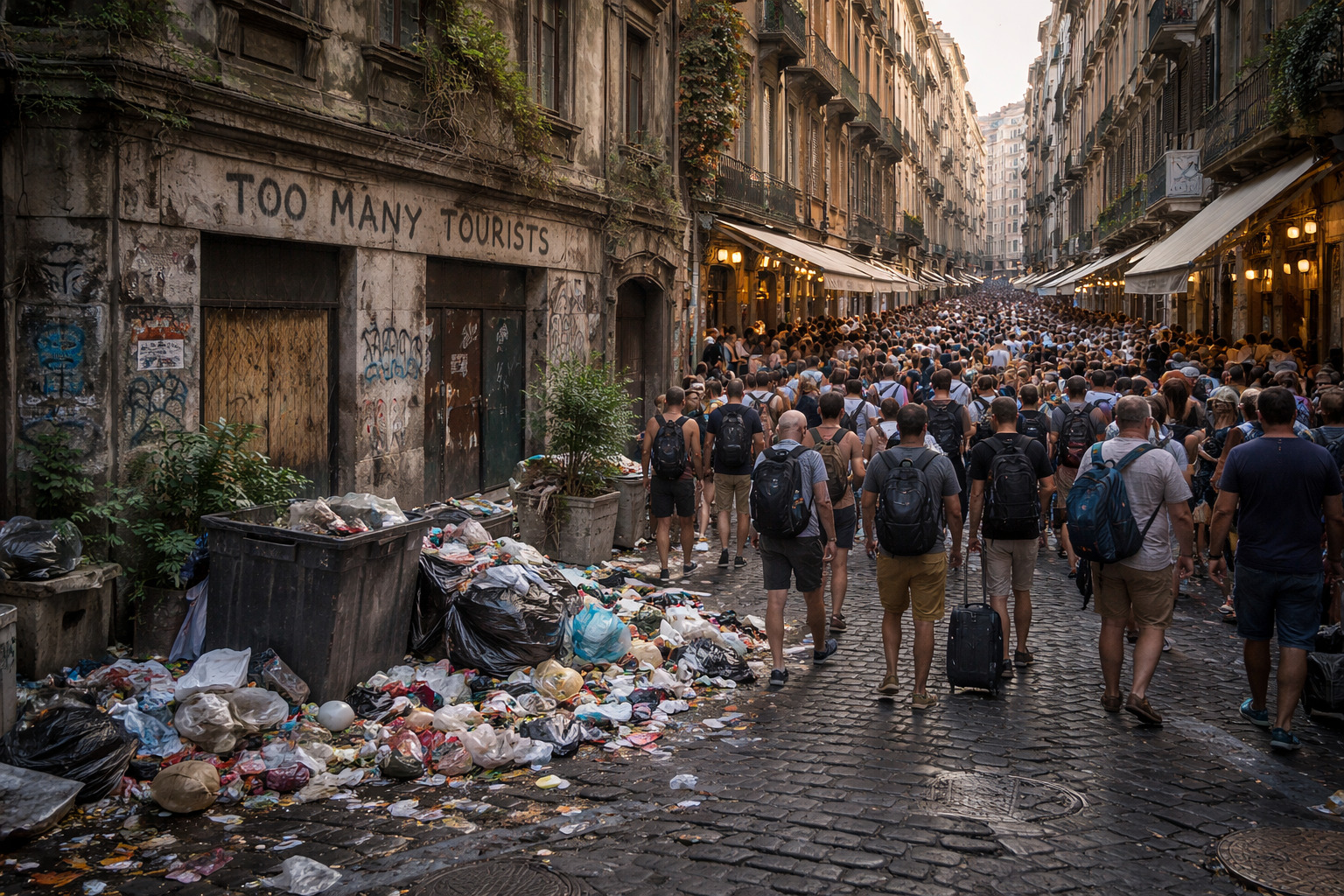
Protests against overtourism are no longer isolated events. In Spain, residents of Barcelona have repeatedly taken to the streets to oppose the dominance of short-term rentals and the erosion of neighbourhood life. In the Netherlands, Amsterdam has openly acknowledged that tourism growth became unsustainable, introducing restrictions on holiday lets and measures to curb party tourism. In France, Paris continues to struggle with overcrowding, rising rents and the strain placed on infrastructure and public services.
These developments are not the result of sudden hostility toward visitors. They are the outcome of long-term policies that prioritised visitor numbers over social capacity.
From an Irish perspective, this matters more than it may initially appear.
Ireland has so far avoided large-scale anti-tourism protests. Its tourism model is often described as softer and more dispersed, rooted in landscape, heritage and regional travel rather than dense urban concentration. Yet the underlying pressures seen elsewhere in Europe are increasingly visible, particularly in Dublin.
According to Eurostat, international tourist arrivals across the EU have now exceeded pre-pandemic levels, with major urban destinations experiencing the sharpest rebound. Ireland follows this trend. Data from Fáilte Ireland shows that overseas visitor numbers have continued to rise steadily, with Dublin remaining the primary entry point and destination for international tourists. While this recovery has been welcomed economically, it has also intensified existing structural issues.
One of the clearest parallels with cities like Barcelona is the expansion of short-term rental accommodation. In Dublin, the growth of short-term lets has reduced the availability of long-term housing, particularly in central and historic areas. While regulation exists, enforcement has proven inconsistent, allowing the gradual displacement of residents to continue.
This process rarely feels dramatic in its early stages. Streets do not empty overnight. Communities thin out slowly. Shops adapt their offerings. Services shift focus. Over time, however, neighbourhoods lose their everyday rhythm. They become functional spaces for visitors rather than lived environments for residents.
Cultural life is affected in similar ways. As visitor demand shapes urban centres, culture risks becoming performative. What was once organic starts to align with external expectations. Museums, venues and even public spaces increasingly cater to what tourists are assumed to want, rather than what local communities need. The result is a subtle but meaningful loss of authenticity.
Europe’s experience shows that these changes accumulate until resistance emerges. Rising tourist taxes across France, Spain and the Netherlands reflect an attempt to internalise the real costs of tourism: pressure on housing, transport, sanitation and public order. They also signal a broader recognition that tourism, while economically valuable, is not cost-free.
Ireland has begun to engage with this reality, but cautiously. The absence of large-scale protest should not be mistaken for the absence of risk. Irish cities operate with smaller margins than their continental counterparts. Housing shortages, infrastructure constraints and limited urban space make them particularly sensitive to unchecked growth.
The key question, then, is not whether Ireland should welcome visitors — it must. Tourism remains a vital part of the national economy and regional development. The question is whether Ireland can manage growth proactively rather than reactively.
European cities that now face overtourism backlash largely missed their window for early intervention. Regulation arrived after tensions hardened and trust eroded. Ireland still has the advantage of time, but that advantage is narrowing.
Effective responses do not require closing doors or rejecting tourism. They require clearer boundaries: enforceable limits on short-term rentals, stronger protections for residential housing, urban planning that prioritises livability, and cultural policy that supports communities rather than turning them into backdrops.
The lesson from Europe is straightforward. Cities are not infinite containers. Culture cannot be scaled endlessly without consequence. When success is measured solely in visitor numbers, social resilience becomes an afterthought.
Ireland stands at a familiar crossroads — one that other European cities recognise all too well. The choice is not between openness and protection, but between foresight and delay. Barcelona is now asking how to undo damage already done. Ireland still has the opportunity to ask a better question sooner: how to grow tourism without losing the city itself.
That question will shape not only Dublin’s future, but Ireland’s cultural credibility in a Europe increasingly wary of success without limits.