
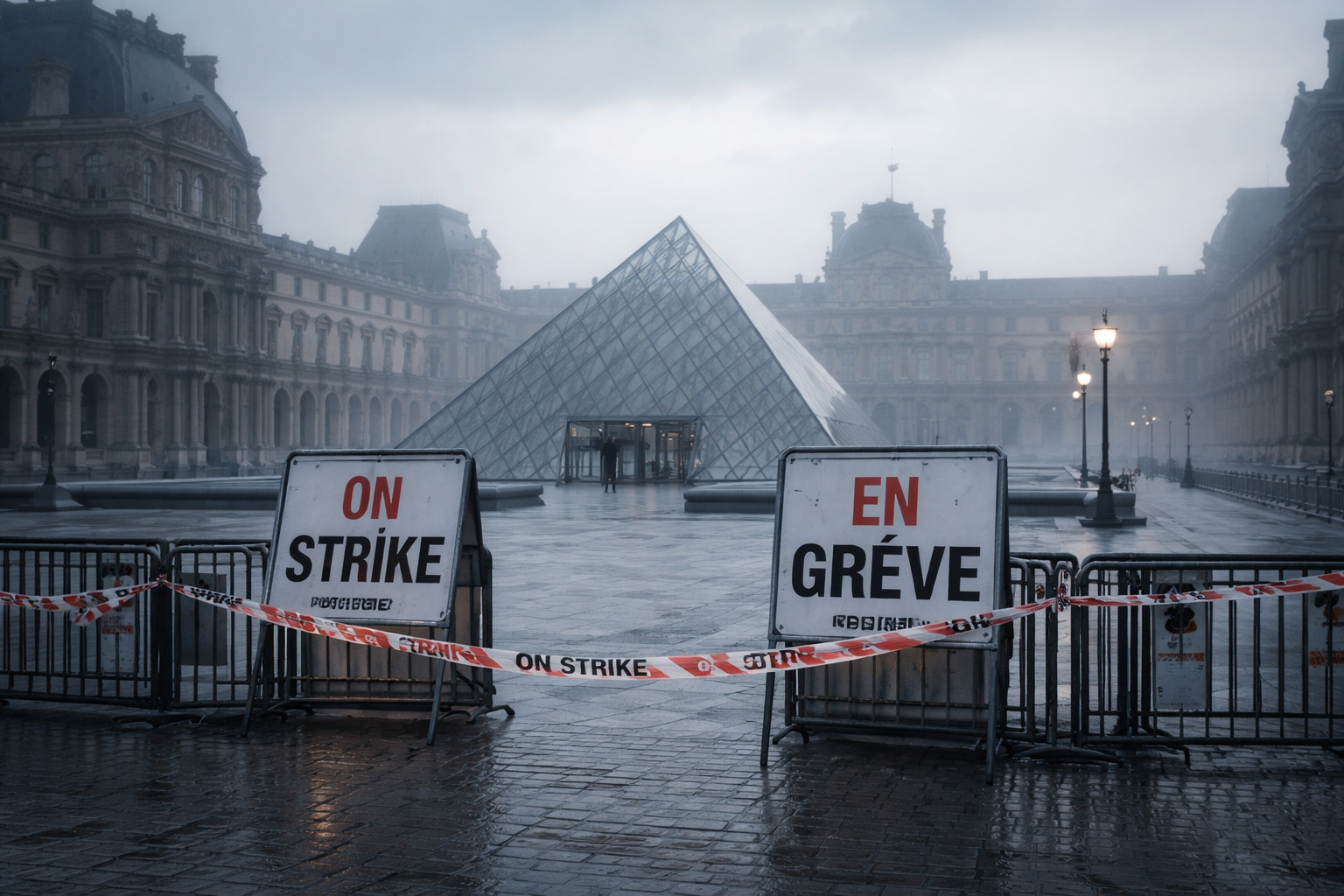
The Louvre welcomes tens of thousands of visitors every day. Its global reputation suggests stability, scale, and institutional strength. Yet behind that image, years of structural strain have accumulated. Museum guards, gallery attendants, security staff, and technical teams have raised the same concerns repeatedly: chronic understaffing, rising visitor numbers, increased security responsibilities, and working conditions no longer aligned with the reality of the site.
Seen from Ireland, these dynamics are uncomfortably familiar.
Across Europe, cultural institutions have been pushed to operate as engines of tourism growth. Success is measured in footfall, ticket revenue, and international visibility. But staffing levels, infrastructure investment, and long-term workforce planning have often failed to keep pace. The Louvre is not an exception; it is an extreme case of a broader trend.
According to unions representing Louvre employees, some staff members are now responsible for monitoring spaces designed for far larger teams. In an environment defined by constant queues, dense visitor flows, and heightened security expectations, this imbalance creates both human and operational risks. Burnout is no longer anecdotal; it is systemic.
Recent incidents — including technical failures, emergency situations, and the temporary closure of certain galleries due to infrastructure issues — have only reinforced staff concerns. The museum is operating at full capacity with resources calibrated for a different era. From a management perspective, this is a sustainability problem, not a temporary inconvenience.
What has intensified tensions further is the financial response. Discussions around increasing ticket prices, particularly for non-EU visitors, were presented as a solution to rising costs. For employees, this approach symbolised a deeper disconnect: generating more revenue without addressing the core issue of staffing and safety. From their perspective, it postpones the problem rather than resolving it.
The economic impact of the strike is immediate. Under normal conditions, the Louvre receives around 30,000 visitors per day. With average ticket prices exceeding €20, daily losses quickly reach hundreds of thousands of euros. But the ripple effects extend far beyond the museum itself. Hotels, restaurants, tour operators, transport services, and independent guides all feel the disruption — especially during peak holiday periods.
For Ireland, this matters. Not because Dublin faces an identical crisis tomorrow, but because the underlying pressures are already visible. Institutions such as the National Museum of Ireland, the National Gallery, and major heritage sites are experiencing growing visitor demand, often without proportionate increases in staffing or long-term funding security. The Irish cultural sector operates with tighter budgets and less margin for error than its French counterparts.
If a globally funded institution like the Louvre can reach a breaking point, smaller national museums across Europe are even more vulnerable.
Beyond economics, the symbolic cost is significant. The Louvre has long been viewed as a benchmark for cultural management. An unlimited strike undermines that perception and exposes the fragility behind institutional prestige. For international audiences, repeated closures and social conflict erode trust. Cultural authority, once questioned, is difficult to restore.
This raises a broader question for European cultural policy: how far can institutions be pushed as tourism assets before their human foundations give way?
In Ireland, cultural heritage is frequently framed as a pillar of national identity and soft power. Tourism strategies emphasise authenticity, history, and access. Yet the Louvre crisis highlights a risk embedded in this model. When museums are treated primarily as high-throughput attractions, the people who protect collections, guide visitors, and ensure safety become invisible — until they withdraw their labour.
The strike in Paris is not a marginal labour dispute. It is a structural signal. It suggests that the prevailing management model for large cultural institutions may no longer be viable in its current form. Success, defined purely by visitor numbers, creates pressures that cannot be absorbed indefinitely.
For neighbouring countries, including Ireland, the lesson is clear. Sustainable cultural tourism requires sustained investment in people, infrastructure, and working conditions — not only marketing budgets and pricing strategies. The long-term value of cultural institutions depends less on how many visitors they attract than on how resilient their internal systems are.
What is unfolding at the Louvre should prompt reflection well beyond France. It invites policymakers, cultural managers, and tourism authorities across Europe to reconsider their priorities. The question is no longer how many people a museum can welcome, but how many it can welcome without compromising safety, dignity, and institutional integrity.
From Dublin to Paris, the challenge is the same. Culture cannot be scaled indefinitely without consequences. And when those consequences surface, they do so not quietly, but publicly — in the form of closed doors at the very heart of Europe’s cultural landscape.