
The headline change: heat pumps up to €12,500
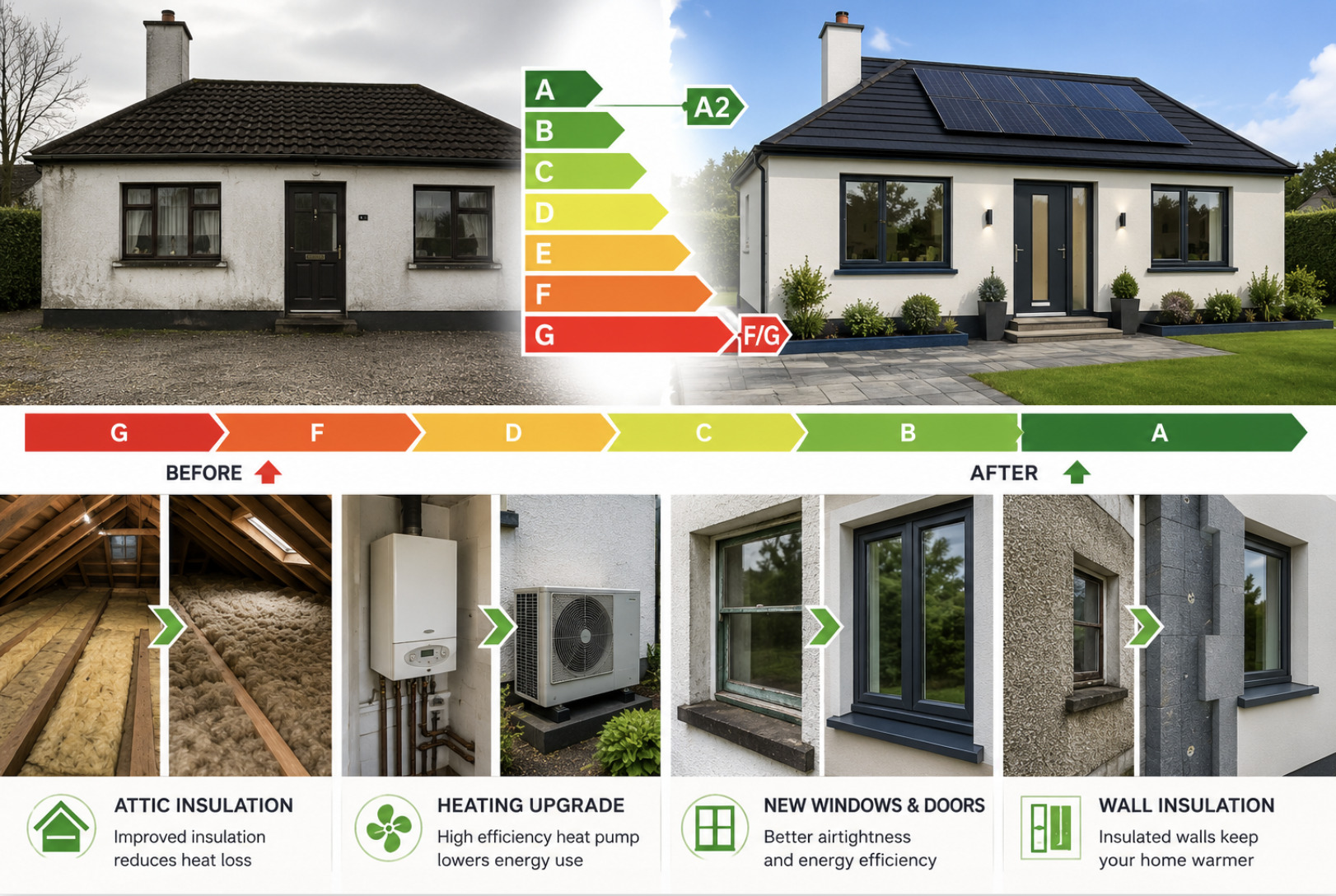
From February 2026, the heat-pump grant rose dramatically. Eligible homeowners switching away from fossil-fuel heating can now claim up to €12,500, made up of three parts:
- €6,500 toward the heat pump unit itself
- up to €2,000 toward central-heating upgrades needed to run it efficiently
- a €4,000 Renewable Heat Bonus for moving off oil or gas
For anyone replacing an old oil or gas boiler, this is the change of the year — it can cover a large share of a project that used to feel out of reach.
Insulation grants — the best value per euro
Insulation gives the fastest payback on your bills, and the grants scale with the size of your home:
Attic insulation
- Detached: €2,000
- Semi-detached: €1,500
- Mid-terrace: €1,400
- Apartment: €1,100
- (First-time buyers can claim a higher fixed grant of up to €2,500)
Cavity wall insulation
- Detached: €1,800
- Semi-detached: €1,300
- Mid-terrace: €850
- Apartment: €700
Attic and cavity-wall jobs are relatively cheap and quick, which is why they top most "where do I start" recommendations.
Solar PV
The grant toward solar electricity panels held steady for 2026 — notably the first year it has not been cut. It is paid per kilowatt-peak (kWp) of capacity:
- €700 per kWp up to 2 kWp
- then €200 per kWp up to 4 kWp
- capped at €1,800 total
A typical domestic array therefore lands near the €1,800 ceiling.
Windows and doors
New for 2026: from March, homeowners can claim up to €4,000 for windows and €1,600 for two external doors, with the exact amount depending on dwelling type.
Free upgrades: the Warmer Homes Scheme
If you receive certain welfare payments, you may qualify for the Warmer Homes Scheme, which delivers home energy upgrades completely free — SEAI manages the whole project end to end. The trade-off is the queue: SEAI currently estimates 24 to 26 months from application to completion, so apply as early as you can if you think you qualify.
One Stop Shop vs individual grants — which route?
There are two ways to claim:
Individual grants (Better Energy Homes). You apply for each measure yourself, arrange your own SEAI-registered contractor, and manage the project. More work, but you keep full control and the admin is straightforward. Written SEAI approval typically arrives within a few weeks of a complete application, and payment follows a few weeks after the work is signed off.
One Stop Shop. A registered provider manages a deeper, whole-home retrofit for you — surveys, contractors, grant paperwork, the lot — and nets the grant off your bill. Less hassle, ideal for a big renovation, but you pay for the convenience.
Rule of thumb: doing one or two measures yourself? Use individual grants. Planning a full deep retrofit? A One Stop Shop is usually worth it.
How to apply, step by step
- Get a BER assessment if you do not have a current one — it shows where your home loses energy and helps you prioritise.
- Pick your measure(s) and confirm the grant amount for your dwelling type from the SEAI list above.
- Apply to SEAI for approval before any work starts. This is critical — work done before written approval is not eligible.
- Use an SEAI-registered contractor. Only registered installers qualify for grant-supported work.
- Complete the work, submit the paperwork, get paid. Payment lands a few weeks after the job is signed off.
The order matters: approval first, work second. Get that backwards and you forfeit the grant.
Where to start in 2026
If you are not sure where to begin, the cost-effective sequence is usually: attic insulation → cavity walls → solar PV → heat pump. Insulate first so that whatever heating system you install afterwards has less work to do — and a smaller bill to match.