
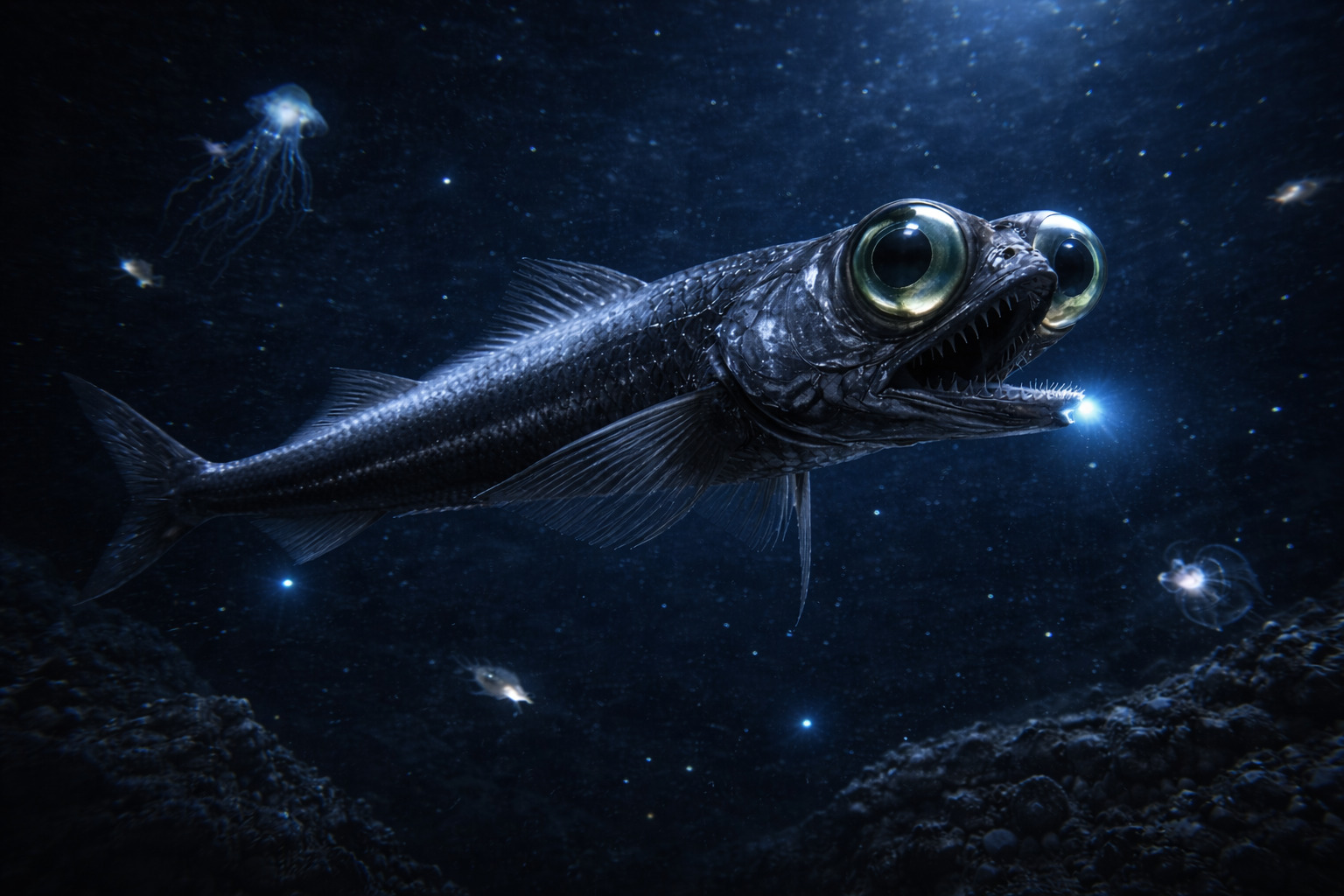
Known for their haunting appearance and forward-facing tubular eyes, telescopefish are not oddities of nature. They are highly efficient deep-sea predators, shaped by millions of years of adaptation to a lightless environment where vision, not speed, determines success.
What Is a Telescopefish?
Telescopefish is a common name for several species belonging to the family Giganturidae. These deep-sea bony fishes inhabit the mesopelagic and bathypelagic zones, typically at depths ranging from about 500 to 3,000 meters.
Their most distinctive feature is their tubular eyes, which protrude upward and forward, resembling a pair of telescopes. Unlike most fish, whose eyes are positioned on the sides of the head, telescopefish sacrifice wide peripheral vision in favor of extreme sensitivity to faint light.
This unusual anatomy is not accidental. It is the key to their survival.
Vision in a World Without Sunlight
At the depths where telescopefish live, sunlight is either extremely weak or completely absent. The primary source of illumination comes from bioluminescence—the light produced by other deep-sea organisms such as jellyfish, crustaceans, squid, and small fish.
The tubular shape of the eyes increases focal length and allows more light to reach the retina. Telescopefish retinas are dominated by rod cells, which are highly sensitive to low light. Cone cells, responsible for color vision, are largely absent. In the deep sea, detecting color is irrelevant; detecting light at all is what matters.
Their eyes are especially tuned to the blue-green wavelengths most commonly emitted by bioluminescent organisms. This specialization allows telescopefish to detect even the faintest flashes—often the only clue that prey is nearby.
The Cost of Extreme Specialization
This visual system comes with trade-offs. Telescopefish have very limited peripheral vision and poor awareness of what happens beside or behind them. In a shallow-water environment, this would be a fatal disadvantage.
In the deep sea, however, it works.
Telescopefish are slow-moving and energy-efficient. Rather than chasing prey, they rely on a sit-and-wait strategy, hovering motionless in the water column. When a flash of bioluminescence appears directly ahead, they move in quickly for a short-range strike.
In an ecosystem where food is scarce, conserving energy is as important as finding prey.
A Jaw Built for Opportunity
Another defining feature of telescopefish is their highly extendable jaw. Although their mouth appears small when closed, it can rapidly project forward, allowing the fish to engulf prey nearly its own size.
This adaptation reflects the reality of deep-sea life: meals are rare, and passing up a feeding opportunity is not an option. Telescopefish cannot afford to be selective.
Their teeth are long, thin, and angled inward, preventing captured prey from escaping. Every part of the head—from jaw structure to skull flexibility—is optimized for efficient feeding under extreme conditions.
Body Design and Camouflage
Telescopefish have long, slender bodies that are often semi-transparent or silvery. This coloration serves as a form of optical camouflage. In the dim, scattered light of the deep sea, reflective surfaces help break up the fish’s silhouette, making it harder to detect.
Rather than blending into a background, telescopefish blend into the light itself.
This subtle camouflage protects them not only from prey but also from larger predators that patrol the deep.
Life Under Pressure
At depths of several thousand meters, pressure can exceed 300 times atmospheric pressure. Telescopefish are adapted to these conditions through the absence of gas-filled cavities, which would collapse under pressure.
Their cellular structures, enzymes, and membranes are stable under extreme compression. Their metabolism is slow, conserving energy in an environment where food input is unpredictable.
Temperatures in these zones remain relatively constant, usually between 2 and 4°C, creating a stable but resource-poor ecosystem. Unlike surface environments, there are no seasons—only darkness and time.
Why Telescopefish Are Rarely Seen
Telescopefish are not necessarily rare, but they are rarely observed. Their habitat lies beyond the reach of conventional diving, and early deep-sea trawling often damaged specimens due to rapid pressure changes during ascent.
Most of what scientists know comes from deep-sea nets, submersible vehicles, and remotely operated cameras. Even today, direct observations of telescopefish behavior in their natural environment are limited.
As deep-sea exploration technology improves, new insights continue to emerge—but the deep ocean remains largely unknown.
What Telescopefish Teach Us About Evolution
Telescopefish demonstrate that evolution does not aim for versatility. It aims for precision.
Every aspect of their anatomy represents a compromise optimized for a specific environment. They are not fast. They are not aggressive. They are not adaptable outside their niche. But within it, they are remarkably efficient.
Their existence challenges our surface-world assumptions about what makes a successful predator. In the deep sea, sensitivity matters more than strength, and patience matters more than speed.
A Window Into the Deep Ocean
Studying telescopefish helps scientists understand not only visual evolution, but also the limits of life under extreme conditions. These fish show how complex predatory strategies can emerge even where light is almost nonexistent.
They remind us that the ocean is not an empty abyss, but a layered ecosystem filled with organisms perfectly adapted to environments humans can barely imagine.
The more we learn about creatures like telescopefish, the clearer it becomes: the strangest life forms on Earth are not products of fantasy—but of deep time, darkness, and relentless evolutionary refinement.