
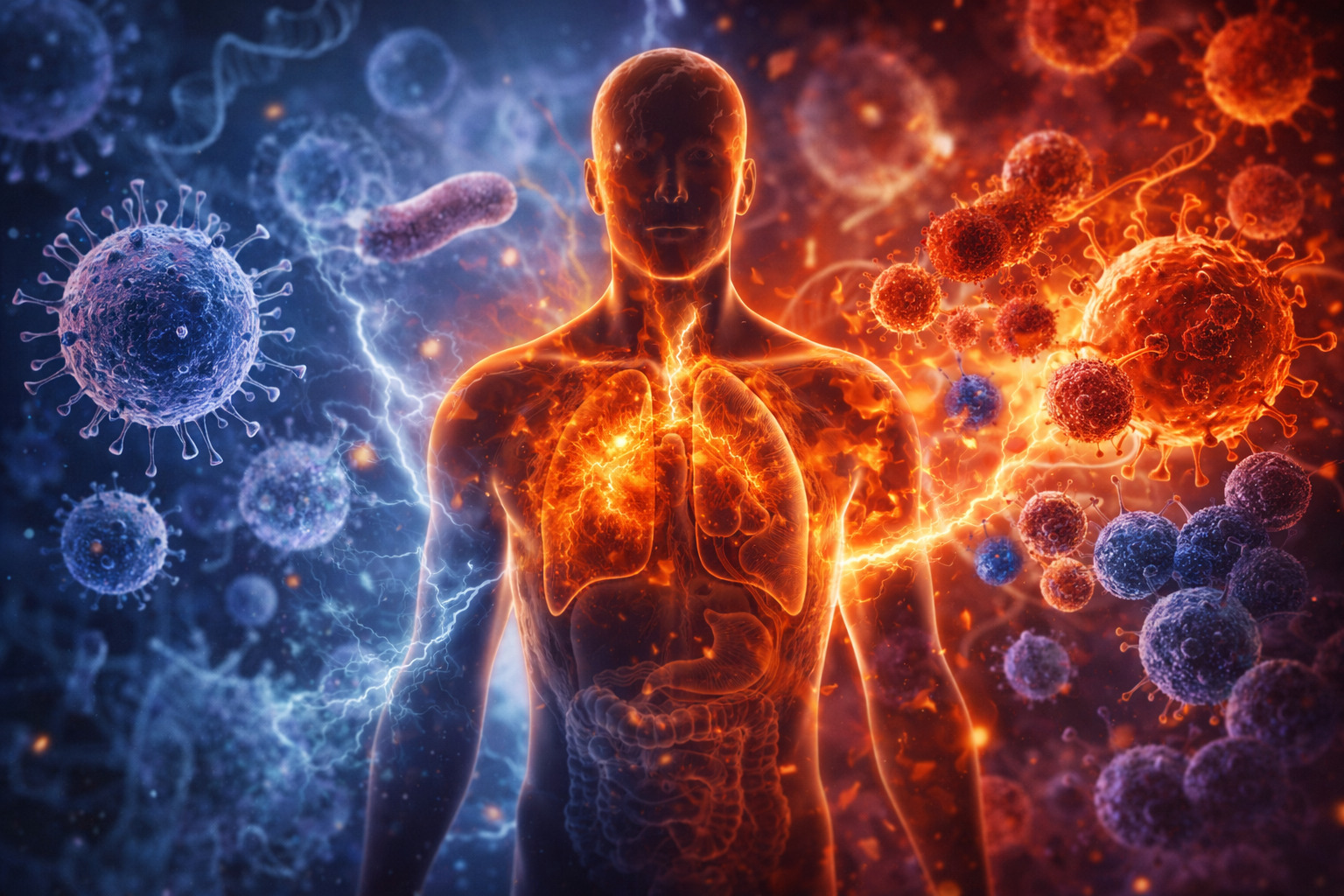
The 2025 Nobel Prize in Physiology or Medicine was awarded for solving a central part of this paradox. Not by discovering a new drug or a revolutionary device, but by revealing the internal logic that allows the immune system to recognize what belongs to the body — and what does not. At first glance, the official citation sounded modest. In reality, it marks one of the most consequential shifts in modern medicine.
The long-standing mystery of immune self-control
For much of the twentieth century, immunology focused on aggression: how immune cells detect pathogens, multiply rapidly, and destroy threats. This “attack-first” model explained infections well, but it failed to explain why the immune system usually does not turn against its host.
Autoimmune diseases — type 1 diabetes, multiple sclerosis, rheumatoid arthritis, lupus — exposed this blind spot. The immune system was not merely overactive; it was misinformed. It no longer understood the difference between “self” and “foreign.” Researchers suspected that some form of internal braking system must exist. But for years, evidence remained fragmented, controversial, and incomplete.
The discovery that changed the framework
The work recognized by the Nobel Committee demonstrated that immune tolerance is not accidental. It is actively enforced by a specific class of immune cells known as regulatory T cells, often described as the immune system’s internal moderators. These cells do not fight infections directly. Instead, they prevent other immune cells from becoming destructive. Their role is subtle but essential: without them, immune defense turns into immune chaos. At the heart of this system lies a single genetic regulator — a master switch that determines whether these regulatory cells develop and function correctly. When this switch operates normally, immune balance is maintained. When it fails, the immune system loses its internal discipline. This insight reframed autoimmunity not as excessive strength, but as failed regulation.
From suppression to precision
Before this breakthrough, most treatments for autoimmune diseases relied on blunt force. Doctors suppressed immune activity broadly, hoping to reduce damage. While effective in some cases, this approach came at a cost: increased infections, higher cancer risk, and long-term systemic weakness. The new understanding introduced a radically different idea. Instead of silencing the immune system, it might be possible to re-educate it. If regulatory T cells could be restored, enhanced, or guided, immune responses could be recalibrated rather than shut down. This concept opened the door to therapies that aim for balance instead of suppression. It also created a bridge between immunology and precision medicine — an approach increasingly central to modern healthcare.
Clinical implications already underway
The impact of this discovery is not theoretical. It underpins a growing number of experimental and clinical strategies across several fields. In autoimmune disease, researchers are developing therapies designed to increase regulatory T-cell activity selectively, reducing tissue damage while preserving immune defense. In transplantation medicine, the same principles offer a path toward long-term graft acceptance without lifelong immunosuppression — a goal once considered unrealistic. In oncology, the picture is more complex. Cancer often exploits immune tolerance to survive. Understanding how immune regulation works allows doctors to fine-tune treatments that temporarily lift immune brakes in tumors while preserving systemic balance elsewhere. What unites these fields is a shift in mindset: immune responses are no longer treated as binary — on or off — but as systems that can be tuned with increasing precision.
Personalization becomes unavoidable
One of the most profound consequences of this research is the recognition that immune systems are deeply individual.
Genetic background, early infections, microbiome composition, and environmental exposure all influence how immune regulation develops. The discovery honored in 2025 provided the conceptual foundation for personalized immune profiling — an approach where treatment is based on how a specific immune system behaves, not on population averages. This is particularly important for diseases that show wildly different trajectories between patients. Two people with the same diagnosis may require entirely different immune strategies. Modern medicine has long promised personalization. Immunology is now delivering the tools to make it real.
The scientists behind the shift
The Nobel Prize recognized the combined contributions of Mary Brunkow, Fred Ramsdell, and Shimon Sakaguchi — researchers whose work, across different institutions and decades, converged on the same core insight. This convergence is significant. It reflects how modern breakthroughs often emerge not from single experiments, but from cumulative evidence that eventually forces a field to reorganize its assumptions.
Why this Nobel matters beyond medicine
The 2025 Nobel Prize resonates beyond laboratories and clinics because it addresses a broader question: how complex systems avoid self-destruction. The immune system is one of the most sophisticated regulatory networks in biology. Understanding how it maintains restraint while remaining effective has implications for systems biology, artificial intelligence, and even social theory. In a world increasingly focused on control, feedback, and regulation, the immune system offers a powerful biological analogy: strength without restraint is not resilience — it is fragility.
A quiet revolution, not a miracle cure
It is important to be clear about what this breakthrough does not represent. It is not a single cure, nor an immediate solution to all immune-related diseases. Progress will be incremental, uneven, and sometimes frustrating. But history shows that conceptual breakthroughs often matter more than immediate applications. Antibiotics followed germ theory. Transplants followed immunological tolerance. Precision oncology followed molecular genetics.
The 2025 Nobel Prize belongs to this category: a foundational shift that will shape medical thinking for decades.
The discovery of how the immune system distinguishes “self” from “non-self” rewrote one of biology’s most fundamental rules. It transformed autoimmune disease from an inexplicable failure into a problem of regulation. It replaced suppression with calibration, and generalization with precision. In honoring this work, the Nobel Committee highlighted a deeper truth about progress in medicine: the most powerful advances are often those that teach us not how to fight harder, but how to control ourselves better. As medicine moves further into the era of personalization, immune regulation may prove to be one of its most enduring pillars — not because it promises miracles, but because it finally explains balance.