
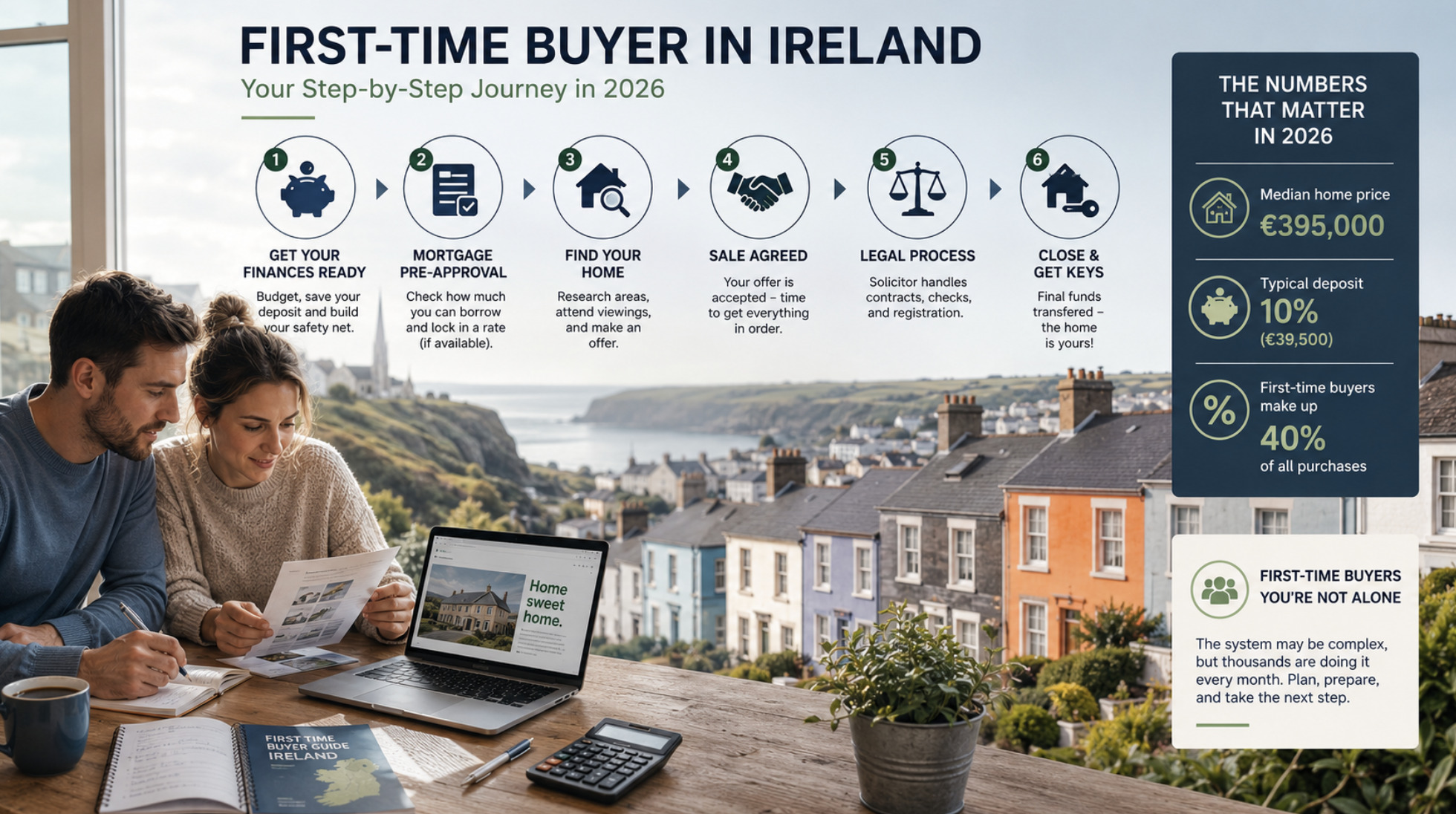
How Much Can a First-Time Buyer Borrow
Start with the two Central Bank rules, because they define your budget before you ever look at a listing.
The loan-to-income (LTI) limit lets first-time buyers borrow up to 4 times gross household income. Two people earning €45,000 each can borrow up to €360,000. Lenders can breach this for a limited share of their lending each year (so-called exceptions), but treat 4x as your planning number.
The loan-to-value (LTV) limit means the bank lends a maximum of 90% of the property price. You fund the remaining 10% as a deposit — €39,500 on a €395,000 home.
Your realistic maximum budget is therefore: (4 × household income) + your deposit. Work this out first; everything else flows from it.
Save the Deposit and Clean Up Your Accounts
Lenders look back through at least six months of statements, so start preparing well before you apply. Show consistent savings or rent payments at or above your future monthly repayment, clear or reduce short-term debt (car loans and credit card balances directly cut your borrowing capacity), and avoid gambling transactions and missed payments on your statements.
A gift from family can count toward your deposit, but the lender will want a signed letter confirming it is not a loan.
Use Help to Buy and the First Home Scheme
These two schemes are the difference between buying this year and buying in three years, and they can be combined.
Help to Buy (HTB) refunds income tax and DIRT you paid over the previous four years, up to €30,000 or 10% of the price, whichever is lower. It applies only to new builds and self-builds priced at €500,000 or less, you must take a mortgage of at least 70% of the price, and you must be tax-compliant for the previous four years. You apply through Revenue's myAccount, and the refund goes toward your deposit. The current €30,000 limit runs to the end of 2029.
The First Home Scheme (FHS) is a shared-equity scheme: the State and participating banks put up to 30% of the price of a new home (up to 20% if you also use HTB) in exchange for an equity stake in the property. Price ceilings vary by local authority — €500,000 in Dublin city, Dún Laoghaire-Rathdown, Fingal, South Dublin, Cork city and Wicklow, with lower caps elsewhere — and are reviewed every six months. You can buy back the equity share later; a service charge applies from year six onward.
Worked example: a €400,000 new build in Kildare. HTB contributes up to €30,000, FHS can bridge up to 20% (€80,000), and your mortgage plus a smaller cash deposit covers the rest. That combination puts a €400,000 home within reach of a household income around €72,500 — versus roughly €90,000 without the schemes (estimates; your lender's assessment will vary).
➡️ Help to Buy vs First Home Scheme — which suits you
Get Mortgage Approval in Principle
Approval in Principle (AIP) is a lender's statement of what it will likely lend you, usually valid for 6–12 months. Estate agents in Ireland generally won't take a bid seriously without it.
Apply to more than one lender or use a broker — rate differences between banks routinely amount to tens of thousands of euro over a mortgage's life. You'll need payslips, an employment detail summary from Revenue, six months of bank and savings statements, and photo ID. AIP is not a guarantee: final loan offer comes later, after a valuation of the specific property.
Find a Home and Make an Offer
With AIP in hand, bid through the estate agent. In the current market expect competition — homes frequently sell above asking, especially in Dublin, where the median price has reached €500,000. Set a hard ceiling based on your AIP plus deposit and stick to it. When your offer is accepted, you pay a refundable booking deposit (typically €5,000–€10,000) and the agent issues a sales advice notice to both solicitors.
From Sale Agreed to Getting the Keys
This stage takes eight to twelve weeks for a second-hand home, longer for new builds still under construction. In order: hire a solicitor for conveyancing (budget roughly €2,000–€3,500 including outlays, an estimate that varies by firm); commission an independent surveyor's report (typically €400–€800) — not optional on a second-hand home; the lender's valuer inspects the property; you sign the loan offer and put mortgage protection insurance and home insurance in place, both required before drawdown; contracts are signed and you pay the balance of the 10% deposit; on closing, the mortgage funds are drawn down and you collect the keys.
Stamp Duty and the Other Closing Costs
Stamp duty on residential property is 1% of the price up to €1 million. On a new build it is charged on the VAT-exclusive price, which lowers the bill slightly. On a €395,000 second-hand home that is €3,950.
Budget realistically for the full closing package: stamp duty, legal fees, survey, valuation fee (around €150–€250), and first insurance premiums. A sensible buffer is €7,000–€10,000 on top of your deposit — first-time buyers are caught out by this more than by anything else.
Your First-Time Buyer Checklist
Work out your budget under the 4x income and 90% LTV rules; build six months of clean bank statements; apply for Help to Buy through Revenue and check FHS ceilings for your county; get Approval in Principle from at least two lenders or a broker; bid with a hard ceiling; then move through solicitor, survey, insurance and signing to drawdown.
The buyers who do this in order — budget first, schemes second, house hunt last — consistently spend less and close faster than those who fall in love with a property and reverse-engineer the finance.