
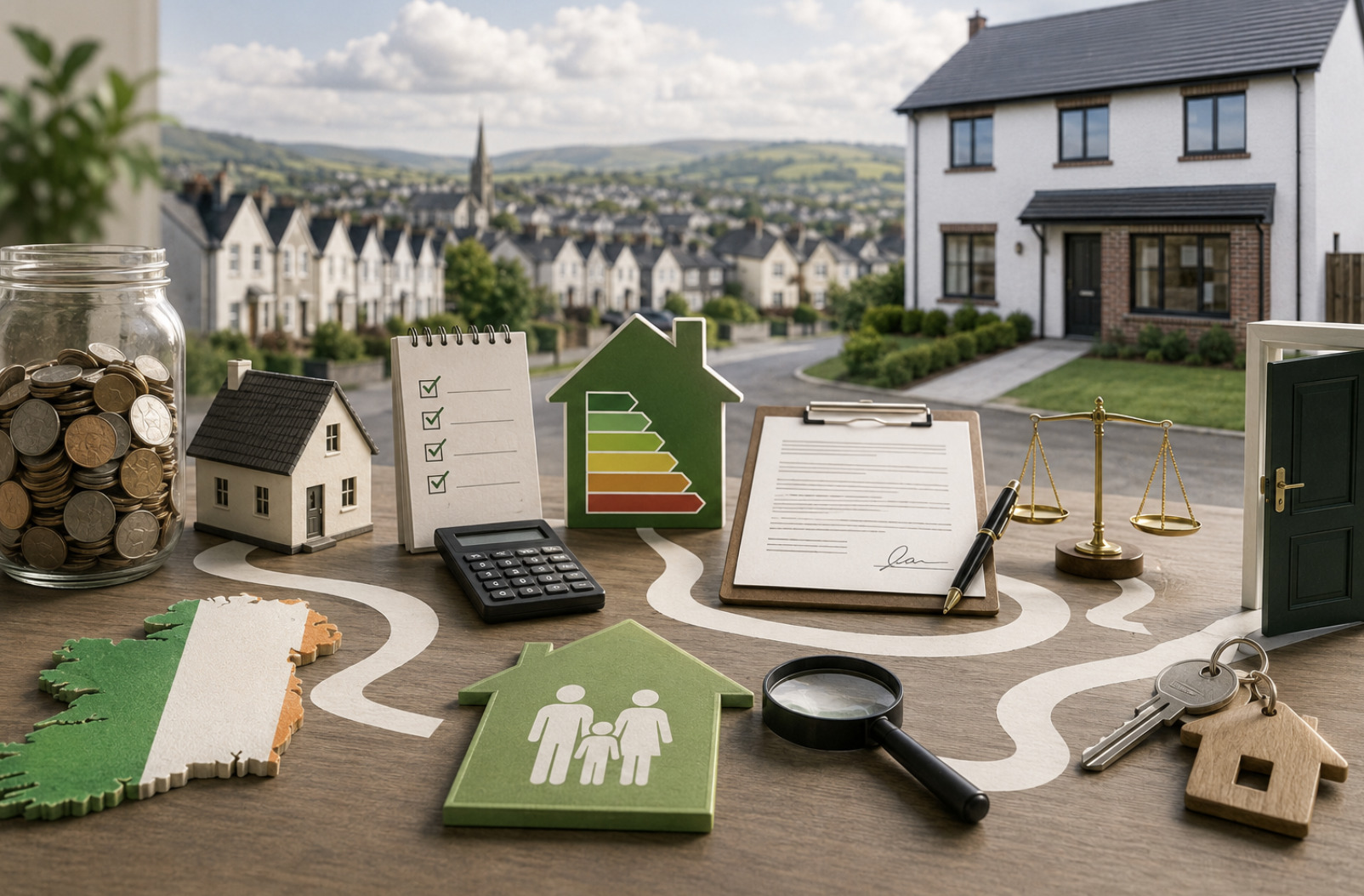
Step 1 — Know What You Can Borrow Before You Browse
The Central Bank's lending rules set the ceiling for everyone, and for first-time buyers they are more generous than for movers. You can borrow up to 4 times your gross annual household income, and you need a deposit of at least 10% of the purchase price (a 90% loan-to-value mortgage).
Two quick examples make this real. A single buyer on €45,000 can borrow up to €180,000, so with a 10% deposit saved they are shopping at around €200,000. A couple earning €95,000 between them can borrow up to €380,000, putting a €420,000 home within reach once the deposit is in place.
Lenders can grant a limited number of exemptions above the 4x multiple each year, but treat those as a bonus, not a plan. Run your own numbers first, then browse — not the other way round.
Step 2 — Build the Deposit and a Clean Bank Record
Your deposit is 10% of the price, so €30,000 on a €300,000 home. But the deposit is only half the story: lenders scrutinise six months of bank statements before approving you.
In the six months before applying, aim for a spotless record. Pay every bill on time, avoid missed direct debits, keep gambling transactions off your accounts entirely, and show a regular monthly savings habit — ideally equal to the gap between your current rent and your future mortgage repayment. If you are paying rent, that counts strongly in your favour as proof of repayment capacity.
Step 3 — Claim the Help to Buy Refund
If you are buying or self-building a new home, the Help to Buy scheme refunds income tax and DIRT you paid over the previous four years — up to €30,000 or 10% of the purchase price, whichever is lower. The property must be newly built, cost €500,000 or less, and your mortgage must be at least 70% of the price.
Apply through Revenue's myAccount before you go sale agreed: the eligibility check shows your estimated refund based on your actual tax record. Joint applicants combine their tax paid, so a couple who each paid €15,000 in income tax over four years can reach the full €30,000 together. You must be fully tax compliant for the four previous years, so file any outstanding returns first.
Step 4 — Check the First Home Scheme If the Numbers Still Fall Short
Where your mortgage plus deposit plus Help to Buy still does not reach the price of a new home, the First Home Scheme can bridge the gap. The State and participating lenders take an equity stake of up to 30% of the purchase price — or up to 20% if you are also using Help to Buy.
Two things to understand before signing. Property price ceilings apply and vary by local authority — around €500,000 in Dublin and €450,000 in County Galway at present, reviewed every six months. And the scheme owns its percentage of your home until you buy it back; a service charge starts accruing on that share after the early years, so it is support with a long-term cost, not free money.
Step 5 — Get Approval in Principle, Then Compare Rates Properly
Approval in Principle (AIP) is a lender's written statement of what they will lend you, usually valid for 6 to 12 months. Estate agents expect to see it before taking your bids seriously, so get it before viewing in earnest.
This is also the moment to shop around. First-time buyer fixed rates in mid-2026 broadly sit in the 3.1% to 3.85% range, and some of the sharpest rates are reserved for homes with a high Building Energy Rating. On a €300,000 mortgage over 30 years, the difference between 3.2% and 3.8% is roughly €100 a month — over €35,000 across the loan. Compare at least three lenders or use a broker who does it for you.
Step 6 — Bid, Go Sale Agreed and Instruct a Solicitor
When your bid is accepted you go "sale agreed" and pay a booking deposit to the estate agent — typically €5,000 to €10,000, refundable until contracts are signed. Now instruct a solicitor; conveyancing fees generally run €1,500 to €3,000 plus outlays, so get two or three quotes.
Budget for the other closing costs too: stamp duty at 1% of the price for homes under €1 million, a valuation report your lender requires (roughly €150 to €250), and a structural survey — strongly recommended on second-hand homes — usually €300 to €600. These are estimates; get written quotes in your own case.
Step 7 — From Loan Offer to Keys
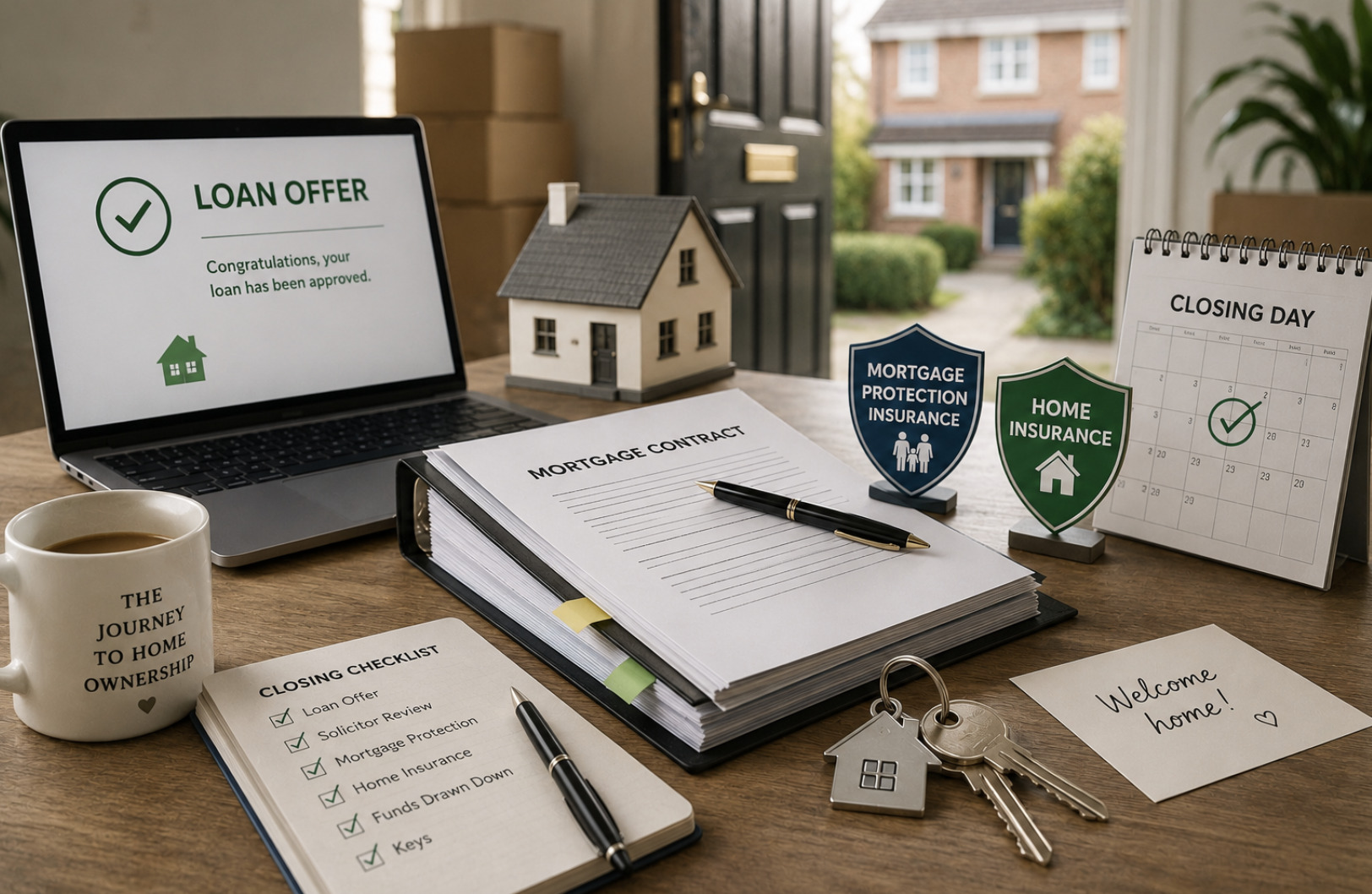
Once the valuation is in and your documents are verified, the lender issues a formal loan offer. Your solicitor reviews the contracts, raises queries with the seller's side, and you sign when everything checks out. You will need mortgage protection insurance and home insurance in place before funds are released — arrange both as soon as the loan offer arrives, because medical underwriting can take weeks.
On closing day your solicitor draws down the mortgage, transfers the funds, and registers you as the owner. Then the estate agent hands over the keys. The whole journey, from AIP to keys, typically takes three to six months for a second-hand home and longer for a new build that is still under construction.
Common First-Time Buyer Mistakes to Avoid
The most expensive mistakes are the boring ones. Buyers skip the structural survey to save €400 and inherit a €20,000 roof problem. They take the first mortgage rate their own bank offers instead of comparing. They forget that solicitor fees, stamp duty and furniture all land in the same three months and leave no cash buffer. And they max out their borrowing capacity without stress-testing the repayment against a rate 2% higher — which is exactly what lenders do, and what you should do too.
Keep €5,000 to €10,000 aside after closing if you possibly can. A home with an empty emergency fund is a stressful home.