

Both schemes are now sizeable parts of the new-build market. More than 11,000 buyers had been approved under the First Home Scheme by July 2026, according to the scheme's own progress reporting, while Help to Buy has been running since 2016 and is legislated to continue to the end of 2029. For a buyer looking at a €400,000 new build, the two together can bridge a six-figure gap.
What Help to Buy Is Worth and Who Can Claim It
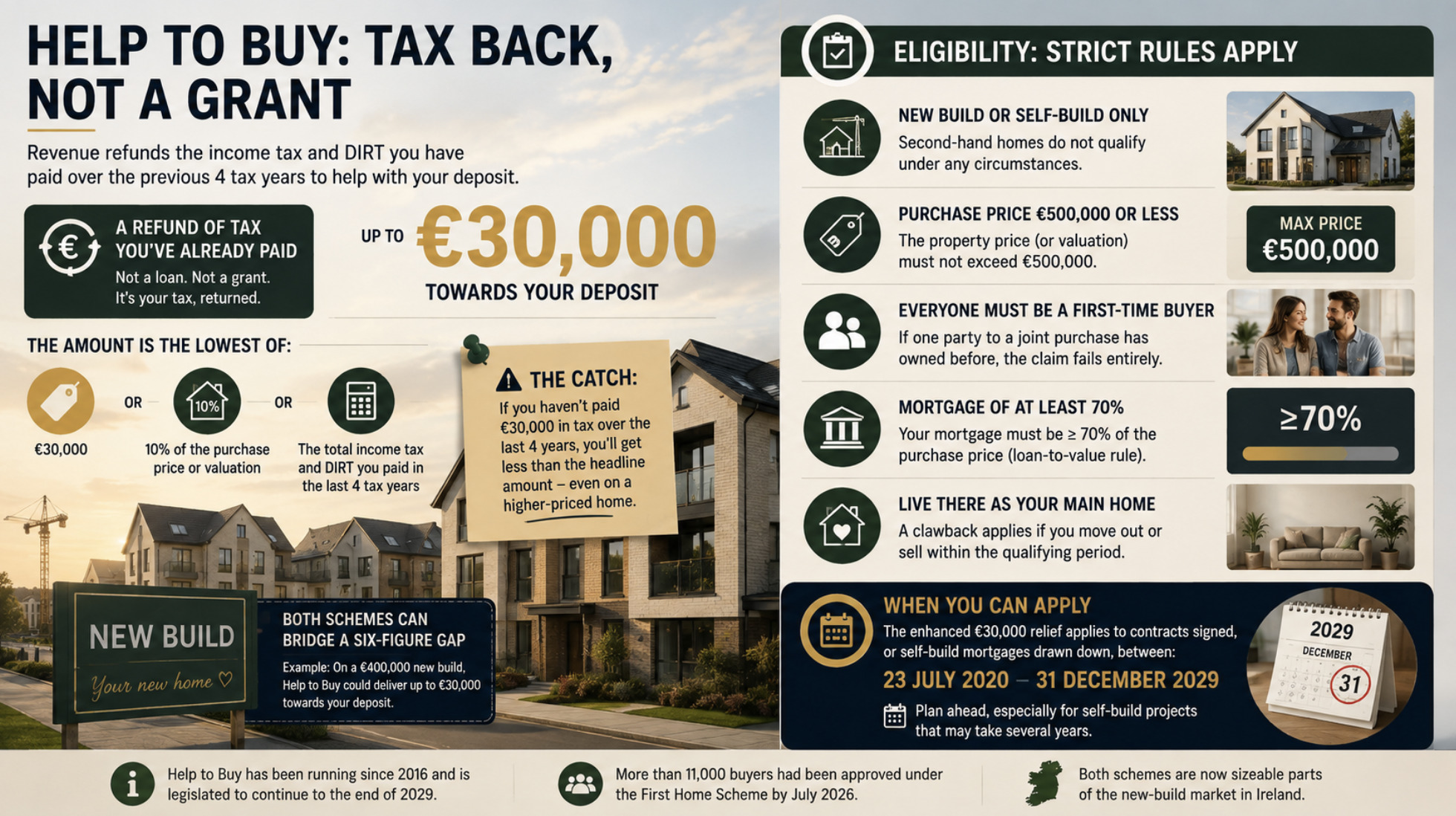
Help to Buy is a tax refund, not a grant. Revenue repays the income tax and Deposit Interest Retention Tax you have paid over the previous four tax years, and that refund goes towards your deposit.
The amount is the lowest of three figures: €30,000, 10% of the purchase price or approved valuation, or the total income tax and DIRT you actually paid in those four years. The third condition is the one that catches people out. A buyer on a modest salary, or one who has spent recent years abroad or in full-time education, may simply not have paid €30,000 in Irish tax and will receive less than the headline figure regardless of the property price.
The eligibility rules are strict:
- The property must be a new build or a self-build. Second-hand homes do not qualify under any circumstances.
- The purchase price must be €500,000 or less.
- Every purchaser must be a first-time buyer. If one party to a joint purchase has owned before, the claim fails entirely.
- Your mortgage must be at least 70% of the purchase price — the loan-to-value rule. Buyers with unusually large deposits can fall outside the scheme.
- You must live in the property as your main home, and a clawback applies if you move out or sell within the qualifying period.
The enhanced €30,000 relief applies to contracts signed, or self-build mortgages drawn down, between 23 July 2020 and 31 December 2029. There is no immediate cliff edge, but the date is worth noting for anyone planning a self-build over several years.
What the First Home Scheme Offers Buyers
The First Home Scheme is a shared-equity arrangement funded jointly by the State and participating mortgage lenders. It pays a portion of your purchase price in exchange for a percentage stake in the property.
The scheme will fund up to 30% of the purchase price, reduced to 20% where the buyer is also using Help to Buy. That reduction is not a penalty; it reflects the fact that Help to Buy has already closed part of the deposit gap.
The equity share is cost-free for the first five years. From the beginning of year six a service charge applies to the initial equity amount: 1.75% in years 6 to 15, 2.15% in years 16 to 29, and 2.85% from year 30 onwards. On a €70,000 equity share, the year-six charge is roughly €1,225 a year — a real and recurring cost that should be modelled alongside your mortgage repayment.
The more consequential point is that the stake is proportional, not fixed in euro. If the State holds 20% of your home and the property appreciates by €100,000, the redemption cost rises accordingly. Buyers benefit from capital growth on 80% of the asset; the equity provider takes the rest. In a rising market that is expensive. In a flat or falling market it works in the buyer's favour.
You can buy out all or part of the equity at any time. Redemptions require a valuation from an FHS-approved valuer, except within the first six months, and an approved valuation remains valid for 12 months.
Where the First Home Scheme Price Ceilings Sit
Unlike Help to Buy's flat €500,000 cap, the First Home Scheme applies regional ceilings that are reviewed every six months. As of the January 2026 position:
AreaCeilingDublin city, Dún Laoghaire-Rathdown, Fingal, South Dublin, Wicklow | €500,000
Galway city, Kildare | €475,000
Cork county, Galway county | €450,000
Cavan, Monaghan | €375,000
Most remaining counties | €350,000–€425,000
In mid-2026 the ceilings rose by €25,000 in Clare, Donegal, Kerry, Leitrim, Limerick (houses only, not apartments), Mayo, Roscommon and Sligo. Because the review cycle is six-monthly, a property marginally over the limit today may fall inside it within months. Buyers close to a threshold should confirm the current figure for their county before ruling the scheme out.
➡️ Buying and owning a home in Ireland — the full guide
How the Two Schemes Compare on Cost
The financial asymmetry is the heart of the matter.
Help to Buy costs the buyer nothing beyond compliance with the occupancy rule. It is a refund of your own tax. Once the clawback period passes, the money is unconditionally yours and the State holds no interest in your property.
The First Home Scheme is closer to a deferred, equity-linked loan. It carries no charge for five years, then an escalating service charge, and it retains a claim on a percentage of the home's value until redeemed. It expands your purchasing power meaningfully, but it does so by selling a slice of your future capital gain.
Put simply: take Help to Buy if you qualify. Take the First Home Scheme only if you need it to complete the purchase.
How to Use Help to Buy and the First Home Scheme Together
The schemes are designed to stack, and most buyers who use the First Home Scheme also claim Help to Buy.
Consider a €400,000 new build. A 10% deposit is €40,000. Help to Buy could contribute up to €30,000, subject to your four-year tax record. A mortgage at 90% loan-to-value covers €360,000 — but if your income supports only €300,000 at the standard four-times-income limit, a €60,000 shortfall remains. The First Home Scheme can fund that gap, up to 20% of the price, or €80,000 in this example.
To qualify for the First Home Scheme you must borrow the maximum available to you from a participating lender, generally up to four times income; you must not be relying on a Macro Prudential Exception; and you must have a deposit of at least 10%. The scheme is explicitly a gap-filler of last resort, not a way to borrow less.
➡️ First-time buyer in Ireland, step by step
Which Scheme Suits Which Buyer
Buyers with a solid Irish tax history and adequate borrowing capacity should claim Help to Buy and stop there. Adding shared equity you do not need is an avoidable long-term cost.
Buyers priced out by the four-times-income limit — particularly single applicants and those in Dublin, Kildare and Wicklow — are the intended audience for the First Home Scheme. For them the trade-off is between a share of future appreciation and not buying at all.
Buyers with limited recent Irish tax paid should model the Help to Buy figure honestly before budgeting. Assuming €30,000 and receiving €11,000 is a common and painful error.
How to Apply for Each Scheme
Help to Buy runs through Revenue's online service. You complete the application, obtain an application number and access code, and your solicitor or the developer verifies the claim. Revenue typically issues claim certificates within four to five working days of a completed submission. Your tax affairs for the four relevant years must be fully up to date first — outstanding returns are the most frequent cause of delay.
The First Home Scheme requires mortgage approval in principle from a participating lender before you apply. Approval is valid for a defined period and is tied to a specific property once you go to contract.