
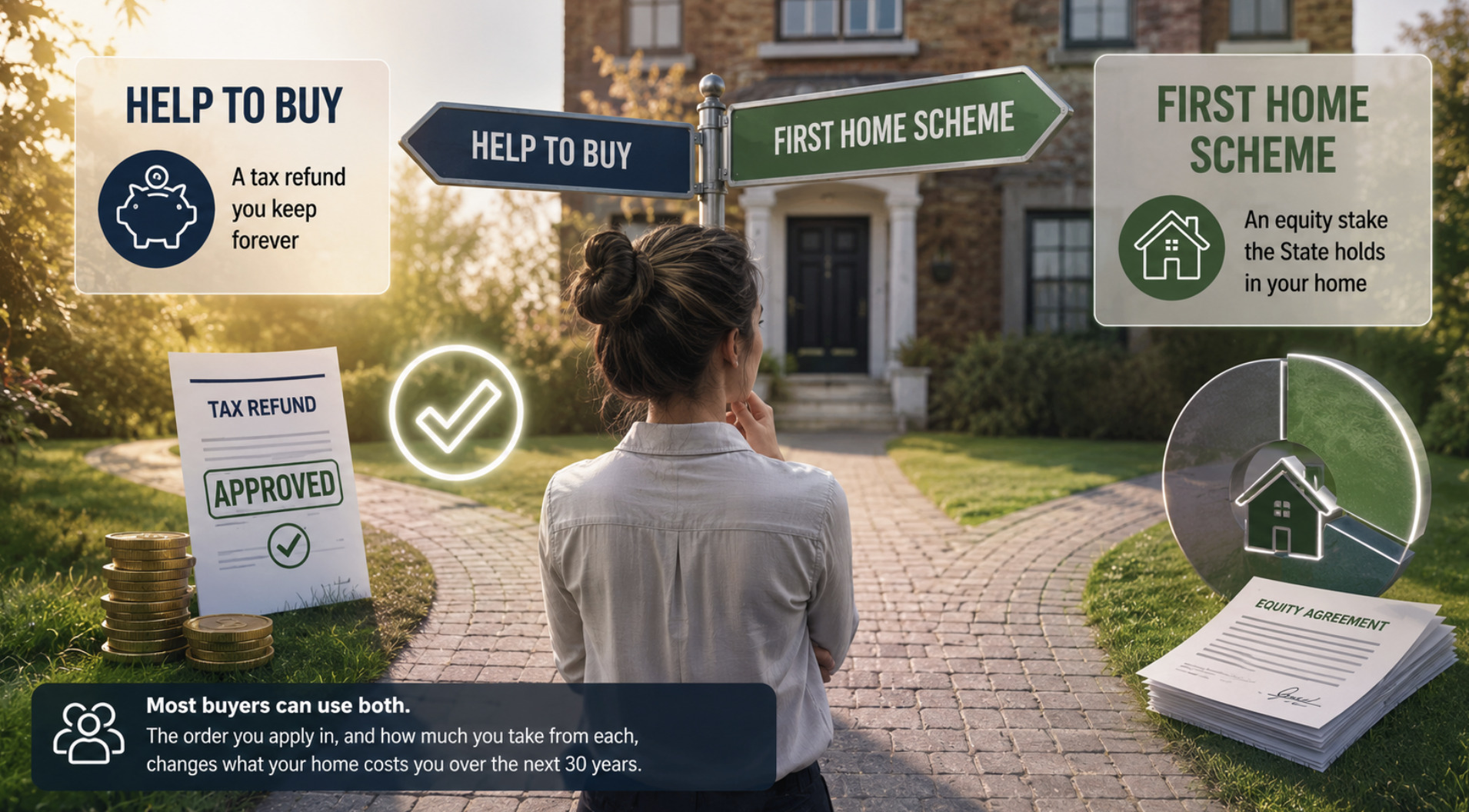
I bought my first place with both schemes stacked together, so this comparison comes from the paperwork, not the brochures. Here is how they differ, who qualifies, and how to decide.
This article is general information, not financial advice.
What the Help to Buy Scheme Gives You
Help to Buy (HTB) is a refund of the income tax and DIRT you paid in Ireland over the previous four tax years. You can claim 10% of the purchase price of a new build, up to a maximum of €30,000 — but never more than the tax you actually paid. If your income tax plus DIRT over four years comes to €22,000, then €22,000 is your ceiling, even on a €400,000 home where 10% would be €40,000.
The core rules:
- New builds and self-builds only. Second-hand homes never qualify.
- Property price of €500,000 or less.
- Mortgage of at least 70% of the purchase price (so heavy cash buyers are excluded).
- First-time buyer — you must never have owned residential property anywhere in the world.
- Tax compliant for the previous four years.
- You must live in the home as your main residence for five years, or Revenue can claw the refund back.
The money goes toward your deposit, paid directly to the builder at contract stage. Crucially, HTB is not a loan and not an equity share: once the five-year residence condition is met, it is simply yours.
What the First Home Scheme Gives You
The First Home Scheme (FHS) is a shared-equity scheme: the State and participating banks bridge the gap between your mortgage-plus-deposit and the price of the home, and in exchange they own a percentage of it. The scheme can cover up to 30% of the price of a new build — or up to 20% if you are also using Help to Buy. The minimum stake is 2.5% of the price or €10,000, whichever is higher.
Unlike HTB, there is no income tax test. Eligibility is built around your borrowing capacity instead:
- You must have mortgage approval from a participating lender and borrow close to the maximum available to you — typically four times household income under Central Bank rules for first-time buyers.
- You need a minimum 10% deposit.
- The home must be a new build, a self-build, or a tenant purchase of the home you currently rent, used as your main residence.
- The price must be under the local price ceiling for your area — €500,000 for a house or apartment in Dublin city and Cork city, €450,000 in areas such as Cork county and Galway county. Ceilings are reviewed every six months and apartment ceilings are higher in some areas.
- Besides first-time buyers, "fresh start" applicants (after divorce, separation or insolvency) can also qualify.
The scheme has scale now: more than 11,000 buyers have been approved, with roughly one in five purchases in Cork.
Key Differences at a Glance
Help to BuyFirst Home SchemeWhat it is | Tax refund, yours to keep | Equity stake the FHS holds in your home
Maximum | 10% of price, up to €30,000 | Up to 30% (20% with HTB), no fixed euro cap
Limited by | Tax you paid over 4 years | Price ceiling in your local authority area
Repayment | None (5-year residence rule) | Buy back at market value, service charge from year 6
Property price limit | €500,000 nationwide | €450,000–€500,000+ depending on area
Second-hand homes | No | No (except tenant purchase)
Can You Use Help to Buy and the First Home Scheme Together
Yes — and stacking them is the standard play for buyers with a big affordability gap. Take a €400,000 new build in Dublin with a household income of €80,000. Your maximum mortgage is around €320,000 (four times income). HTB gives you €30,000 toward the €40,000 deposit, so you need €10,000 of savings. That leaves a €40,000 gap to the purchase price — which the FHS covers as a 10% equity stake.
The one catch: using HTB cuts the maximum FHS stake from 30% to 20%. In practice that rarely bites, because HTB money reduces the gap the FHS needs to fill anyway. Applying for HTB first and keeping the FHS stake as small as possible is usually the cheaper long-term structure.
What the First Home Scheme Costs You Later
This is the part the headline numbers hide. The FHS stake is free for the first five years. From year six, a service charge applies to the original equity amount: 1.75% per year, rising to 2.15% in years 16 to 29 and 2.85% from year 30. On a €60,000 stake, that is €1,050 a year from year six — money that buys back nothing.
You can buy out the stake at any time, but at the percentage of your home's market value at that point, not the original figure. If the FHS holds 10% of a home that has risen from €400,000 to €480,000, buying them out costs €48,000, not €40,000. Partial buybacks are allowed — minimum 5% of the original equity amount, up to two payments a year. The practical advice: treat the year-five mark as a deadline and plan to start buying back before the charges begin.
Which Scheme Should You Choose
If your savings and mortgage already cover the price, take HTB only. It is free money with no long-term strings beyond living in the home for five years.
If there is still a gap after HTB and your maximum mortgage, stack both — but take the smallest FHS percentage that closes the gap, not the biggest one offered.
FHS only makes sense mainly if you have paid little Irish tax in the last four years (recently returned emigrants, for example) or you are a fresh-start applicant who no longer qualifies as a first-time buyer for HTB.
And if a figure here has changed by the time you read this — ceilings and charge rates do move — the structure of the decision stays the same: refund first, equity second, and buy the equity back early.
How to Apply for Each Scheme
For HTB, apply through Revenue's myAccount before you sign contracts; you will get an application number and a maximum refund figure to give your builder. For the FHS, get mortgage approval in principle from a participating lender first, then apply on the scheme's portal with your approval, deposit evidence and the property details. Both approvals can run in parallel, and your broker or lender will expect to see them together.