
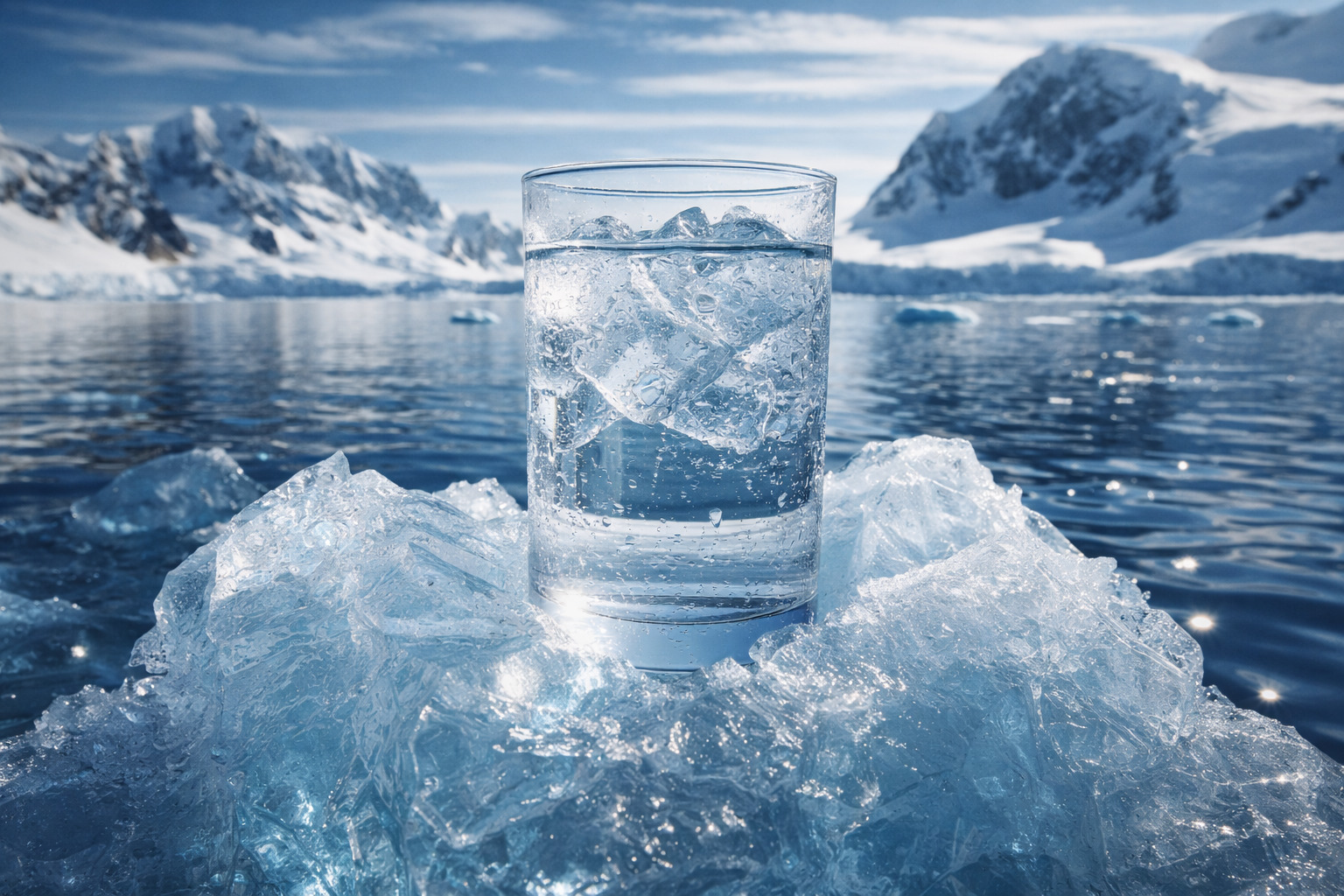
But from a scientific perspective, Antarctic ice water is not a symbol of purity. It is a biological and chemical archive — and drinking it comes with risks that are easy to underestimate.
Is Antarctic Ice Water Really Pure?
Ice does not purify water. It preserves whatever is present at the moment of freezing. Snowfall, dust, microorganisms, atmospheric particles — all become trapped layer by layer. Over time, glaciers turn into dense records of Earth’s environmental history.
Each section of Antarctic ice contains microscopic traces of the past: ancient bacteria, dormant viruses, fungal spores, and chemical compounds carried by global air currents long before modern civilization existed. The clarity of the water is visual, not biological.
Clear water can still be unpredictable water.
Ancient Microorganisms Trapped in Antarctic Ice
Scientific studies of polar ice cores have already revealed microorganisms tens of thousands — and in some cases millions — of years old. Many of these organisms survived by entering cryptobiosis, an extreme dormant state where biological activity nearly stops but life remains intact.
These microorganisms are not necessarily harmless. In fact, their survival strategies often make them unusually resilient. Some tolerate radiation, extreme cold, and long-term nutrient deprivation — traits that modern microbes rarely possess.
When ice melts, these ancient forms can reactivate. The concern is not that they are “deadly by default,” but that they are completely unfamiliar to modern biology.
Why the Human Immune System Can’t Handle Ancient Pathogens
The human immune system evolved alongside the pathogens of the last several thousand years. It recognizes threats based on patterns it has seen before — directly or through evolutionary memory.
Ancient microorganisms fall outside that experience.
This creates two possible risks:
- The immune system may fail to recognize the organism, allowing it to persist or multiply.
- Or it may overreact, triggering an excessive inflammatory response that causes more harm than the organism itself.
Modern medicine has no reliable way to predict how the body would respond to microorganisms that predate humanity. There are no vaccines, no antibodies, and no clinical history to guide treatment.
This uncertainty is precisely why scientists treat ancient ice with caution rather than curiosity.
Does Antarctic Ice Contain Chemical Contaminants?
Biological risks are only part of the story. Antarctic ice also stores chemical traces accumulated over long periods of time. Atmospheric circulation transports particles across continents, and glaciers quietly collect them.
Research has shown that Antarctic ice can contain heavy metals such as mercury or lead, as well as residues from volcanic activity and airborne pollutants. These substances may exist in low concentrations, but they are unevenly distributed and impossible to assess without laboratory testing.
Melted glacier water is not filtered, sterilized, or quality-controlled. Each sample reflects a different environmental history, making safety unpredictable.
Why Scientists Never Drink Melted Antarctic Ice
In scientific expeditions, drinking untreated Antarctic ice water is avoided almost entirely. Researchers rely on transported water supplies or carefully purified sources. Even scientists who drill ice cores daily do not consume the meltwater.
This is not excessive caution — it is standard scientific protocol.
Ancient ice is treated as data, not as a resource. The goal is to study it, not ingest it. When risks are unknown and benefits are nonexistent, science chooses restraint.
The Myth of “Natural Purity”
The idea that untouched nature equals safety is deeply cultural. Humans often associate purity with distance from civilization. But nature was never sterile. Long before humans existed, Earth was full of complex microbial ecosystems.
What we consider “clean” water today is the result of filtration, testing, and controlled treatment — not isolation.
Antarctic ice feels pure because it is visually pristine and emotionally powerful. But appearance is not evidence. Some of the most dangerous biological and chemical substances are invisible, tasteless, and odorless.
What Antarctic Ice Really Teaches Us
Drinking Antarctic ice water offers no health advantage, no nutritional benefit, and no meaningful connection to nature. What it offers instead is exposure to unknown variables — biological and chemical — that the human body is not prepared to handle.
The real value of Antarctic ice lies in what it tells us about Earth’s past: climate change, atmospheric composition, and biological evolution. Its purpose is scientific insight, not consumption.
Sometimes respecting nature means resisting the urge to experience it physically. Not everything ancient is meant to be tasted.
Key Takeaways
- Antarctic ice water is not naturally purified.
- Ancient microorganisms preserved in ice may reactivate when melted.
- The human immune system has no defenses against unfamiliar ancient pathogens.
- Heavy metals and chemical contaminants can accumulate in glaciers.
- Scientists avoid drinking untreated Antarctic meltwater for good reason.
In a world where clean, safe drinking water is readily available, consuming glacier ice is a symbolic gesture with unnecessary risk. Antarctic ice is a reminder that what looks perfectly pure may carry a history far more complex — and far less compatible with the human body — than we imagine.