
At first glance, this observation appeared to challenge one of the most familiar principles of cometary physics — that comet tails always point away from the Sun. The resulting confusion fueled speculation, debate, and, in some corners of the internet, far more exotic interpretations. In reality, the phenomenon surrounding 3I/ATLAS reveals not a breakdown of physics, but the complexity of interpreting dynamic systems observed under rare geometric conditions.
3I/ATLAS was identified as interstellar after orbital calculations showed a strongly hyperbolic trajectory. Unlike long-period comets from the Oort Cloud, which remain gravitationally bound to the Sun, this object entered the Solar System at high velocity and will leave it permanently. Its perihelion occurred at approximately 1.4 astronomical units from the Sun, between the orbits of Earth and Mars. The object never posed a threat to Earth, passing at a minimum distance of roughly 1.8 astronomical units.
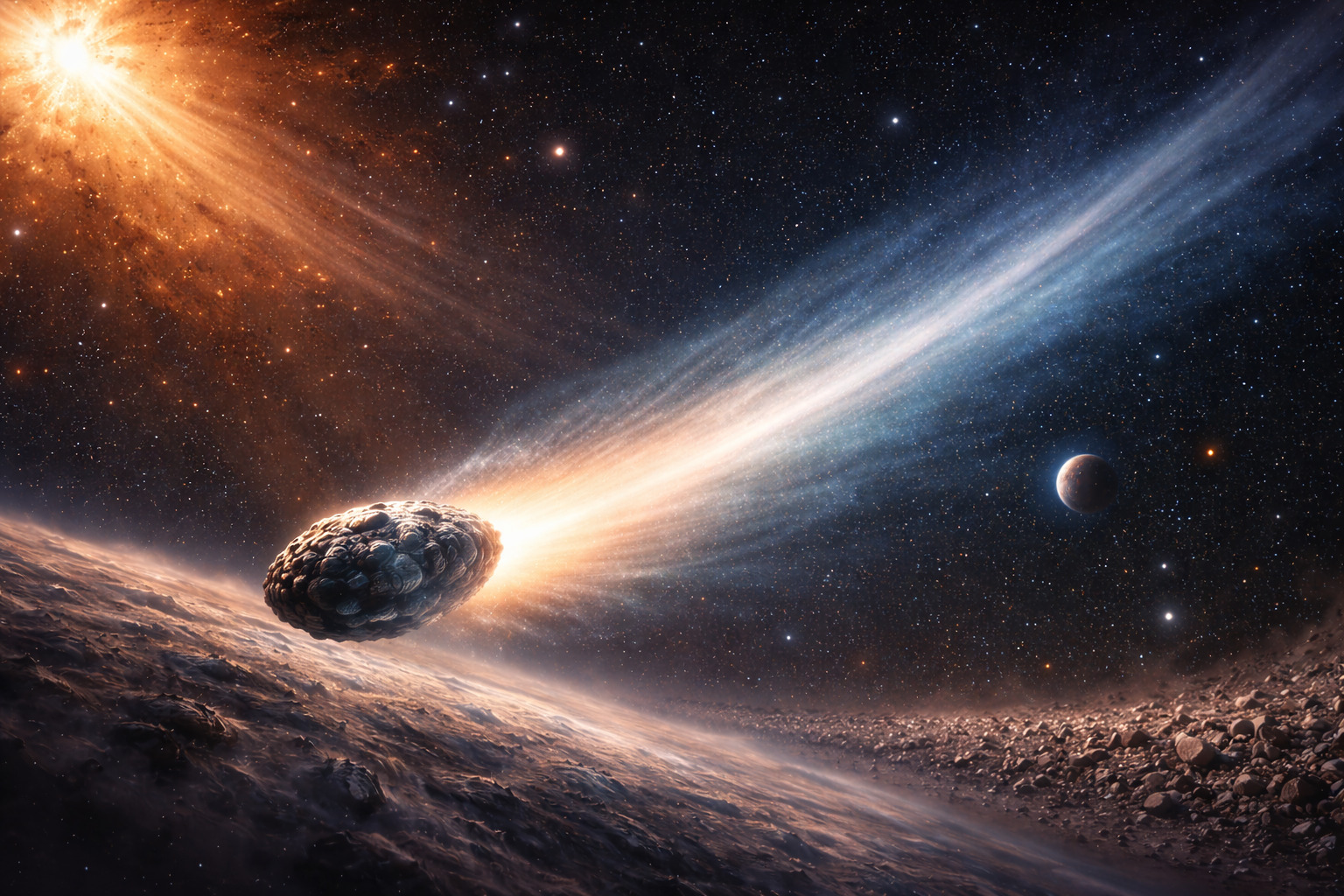
As solar heating increased near perihelion, 3I/ATLAS exhibited classic cometary behavior: the development of a coma, multiple dust jets, and evolving structures shaped by radiation pressure and gravity. It was in the post-perihelion phase that observers noted a prominent sunward feature — what appeared to be an anti-tail.
To understand why such a structure can exist, it is essential to clarify how comet tails actually form. Comets do not possess a single tail, but multiple components governed by different physical processes. The ion tail consists of charged particles swept directly away from the Sun by the solar wind, forming a straight, radial feature. The dust tail, by contrast, is composed of solid particles whose motion is governed by gravity, solar radiation pressure, particle size, and the timing of their release from the nucleus. This tail often curves and lags along the comet’s orbit.
An anti-tail does not imply that material is flowing toward the Sun. In many classical cases, it is a perspective effect. When Earth passes close to the plane of a comet’s orbit, a thin sheet of dust can appear edge-on, projecting as a narrow structure seemingly pointing sunward. The dust itself continues to move according to known forces; only the viewing geometry changes.
What made 3I/ATLAS noteworthy is that the sunward structure appeared relatively well defined and persistent, prompting discussion over whether geometry alone was sufficient to explain it. This led researchers to examine additional physical mechanisms that could enhance or sustain such a feature.
One promising explanation involves the interaction between dust particles, volatile ices, and solar radiation. Dust grains released from a cometary nucleus are not uniform. Some contain embedded ices that sublimate as they warm, while others are refractory and persist longer. There exists a dynamic boundary around the nucleus where ice-bearing grains can survive temporarily before fully sublimating. This boundary, sometimes described as an anisotropic “snow line,” is not spherical and can become distorted by rotation, jet activity, and solar illumination.
In the case of 3I/ATLAS, models suggest that a concentration of larger or ice-rich grains could form a brightness enhancement along the sunward line of sight. Rather than indicating material traveling toward the Sun, the structure represents a region where dust density, grain lifetime, and radiation pressure combine to produce a visually prominent feature.
Rotation further complicates the environment. Observations of 3I/ATLAS showed time-variable jets, implying localized active regions on the nucleus. As the nucleus rotates, these jets sweep through space, redistributing dust into complex patterns. Periodic modulation of these jets produces evolving structures that can appear coherent over short timescales, especially when viewed under favorable geometry.
Estimates based on jet behavior suggest a rotational period on the order of tens of hours, consistent with typical comet nuclei. Such rotation reinforces asymmetries in dust release, making the coma and tail structures highly directional and time-dependent.
The interstellar nature of 3I/ATLAS adds further nuance. Unlike comets native to the Solar System, interstellar objects may differ in volatile composition, dust grain size distribution, and surface processing. Long exposure to cosmic radiation in interstellar space can alter physical properties, potentially affecting how material is released when solar heating begins.
Despite these differences, the overall behavior of 3I/ATLAS remains consistent with known cometary physics. It behaves as a comet — albeit one operating within a broader parameter space than most previously observed objects.
This is the point at which speculation often enters the conversation.
Whenever an object violates visual expectations, especially one arriving from outside the Solar System, alternative interpretations emerge. In the case of 3I/ATLAS, some have proposed that the observed configuration might not represent a single natural body at all, but rather a composite or structured formation — sometimes described in popular language as a “triad” or coordinated system concealed within dust and gas.
From a scientific standpoint, such a hypothesis cannot be dismissed by ridicule alone. It must be evaluated based on what it predicts and whether those predictions are observed.
If 3I/ATLAS were not a natural comet but a structured or artificial formation, several signatures would be expected. Its motion would deviate from gravitational predictions, requiring non-gravitational acceleration inconsistent with standard outgassing models. To date, the trajectory of 3I/ATLAS aligns with expectations based on gravity and radiation pressure alone.
A multi-body system would also be expected to maintain stable relative separations between components. High-resolution observations, however, show evolving, fragmenting, and fading structures typical of dust jets and particle clouds, not rigid bodies moving in coordination.
Spectroscopic data provide another test. Artificial materials or propulsion systems would likely produce emission or reflection patterns inconsistent with known cometary volatiles. Observations of 3I/ATLAS remain compatible with standard cometary chemistry.
Finally, temporal behavior matters. A concealed formation would need to maintain coherence as viewing geometry changes. Instead, the features around 3I/ATLAS evolve exactly as predicted by dust dynamics, sublimation rates, and nucleus rotation.
The strength of the comet explanation lies not in its simplicity, but in its predictive power. Models of dust particle dynamics not only explain the existence of a sunward feature, but predict when such features should appear, how they should shift with observer angle, and how they should dissipate as the comet recedes from the Sun.
So far, 3I/ATLAS behaves exactly as those models anticipate.
This does not mean the object is uninteresting. On the contrary, it demonstrates how easily observational intuition can be misled by geometry and how interstellar objects can push familiar physics into unfamiliar regimes.
As 3I/ATLAS continues to move away from the Sun, its activity is expected to decline. Dust production will decrease, jets will weaken, and the sunward structure will fade or disappear entirely. If it were something other than a comet, anomalies would grow more pronounced over time rather than diminish.
In science, the future is not mysterious; it is testable.
The broader importance of 3I/ATLAS lies in what it teaches us about both comets and interstellar space. The detection of three interstellar objects within a decade suggests that such visitors are far more common than once believed. Each one refines models of planetary system formation and the exchange of material between stars.
3I/ATLAS, in particular, demonstrates that interstellar comets can look strange without being exotic. They can challenge expectations without breaking physical laws. Their apparent anomalies are often invitations to refine models rather than abandon them.
The sunward tail of 3I/ATLAS is not evidence of defiance against physics. It is a reminder that nature often appears paradoxical when viewed from a moving platform within a three-dimensional, time-evolving system.
What makes this object remarkable is not that it forces science to rewrite its foundations, but that it expands the range over which those foundations are tested. In doing so, 3I/ATLAS reinforces a central lesson of astronomy: the universe is not obliged to conform to our visual intuition, only to its own consistent laws.
And sometimes, the most unsettling discoveries are not signs of the unknown, but proofs of how much we are still learning to see clearly.