
For many Dubliners watching from the streets, the scene was confusing and surreal. Ireland had been part of the United Kingdom for more than a century, and the sudden appearance of armed rebels proclaiming independence seemed almost impossible. Yet for those inside the building, this moment represented something far larger than a symbolic gesture. It was the culmination of decades of political frustration, cultural revival, and growing demands for self-government.
Within a week the uprising would be crushed, the city centre scarred by artillery fire, and the leaders of the rebellion sentenced to death. But the Easter Rising of 1916 would become one of the most consequential turning points in Irish history, transforming a failed rebellion into a catalyst for independence.
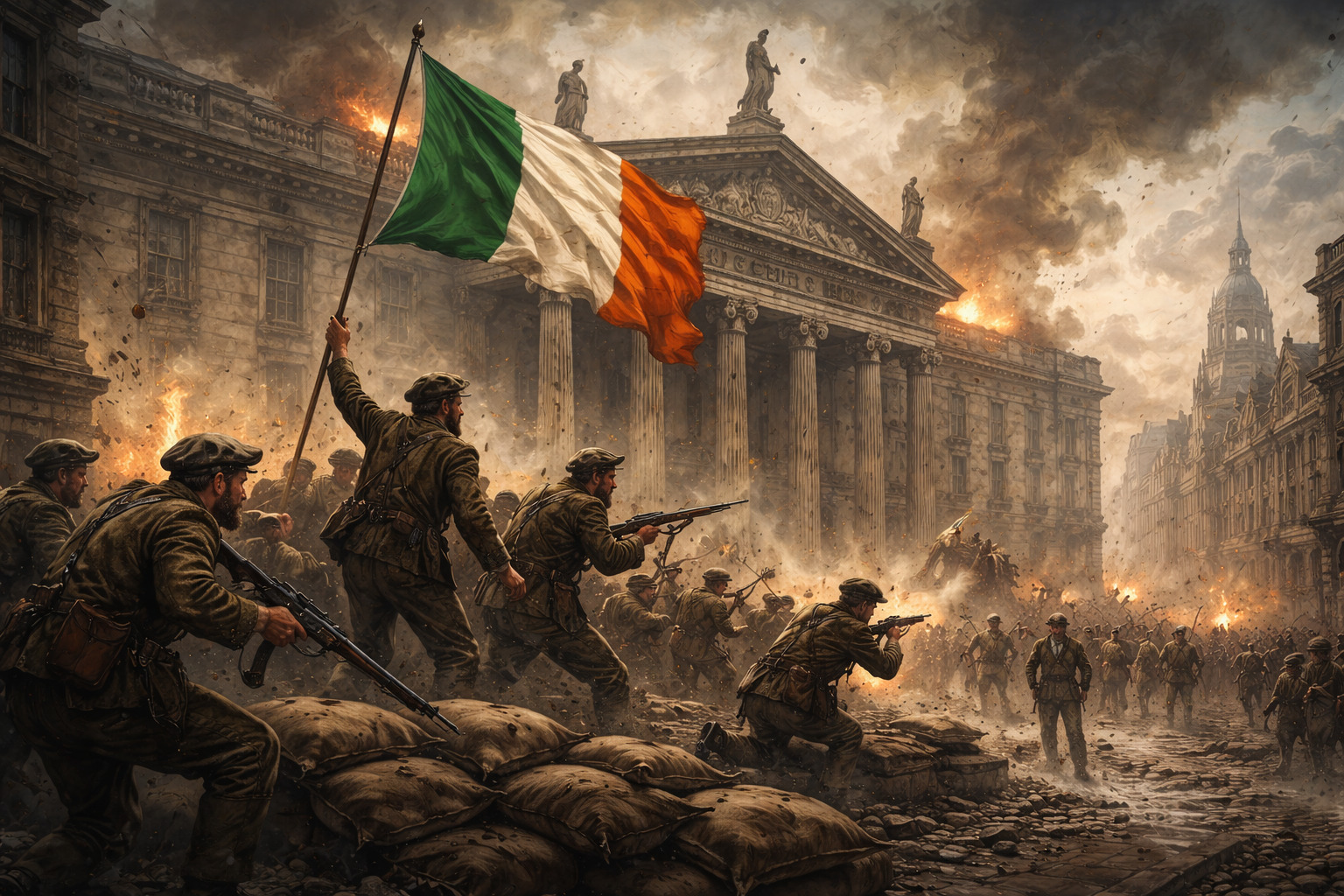
The struggle for Irish autonomy did not begin with that uprising, nor did it end there. It was the result of centuries of tension between Ireland and Britain, shaped by political movements, cultural revival and eventually armed conflict. By the early twentieth century, Ireland stood at the centre of one of the most dramatic national transformations in modern European history.
The Roots of Irish Nationalism
The origins of modern Irish nationalism can be traced back to the nineteenth century. After the Act of Union in 1801, Ireland became fully integrated into the United Kingdom, with political authority concentrated in the British Parliament at Westminster. Although Irish representatives sat in that parliament, many believed Ireland lacked meaningful control over its own affairs.
During the nineteenth century a political movement known as Home Rule emerged. Its goal was to establish an Irish parliament responsible for domestic governance while remaining within the United Kingdom. For many moderate nationalists this seemed the most realistic path toward autonomy.
One of the most influential figures in the Home Rule movement was Charles Stewart Parnell, whose leadership in the late 1800s transformed Irish nationalism into a disciplined parliamentary campaign. Parnell’s political strategy mobilized Irish voters and forced the question of Irish self-government onto the British political agenda.
Despite these efforts, Home Rule faced persistent opposition in Britain, particularly from unionist politicians and communities in the north of Ireland who feared losing their connection to the United Kingdom. Several attempts to pass Home Rule legislation stalled or were delayed, creating growing frustration among Irish nationalists.
At the same time, a cultural awakening was taking place across Ireland. Organizations such as the Gaelic League, founded in 1893, promoted the revival of the Irish language, literature and traditional culture. The Gaelic Athletic Association (GAA) encouraged participation in native sports like hurling and Gaelic football.
These movements helped cultivate a stronger sense of national identity. Ireland was increasingly seen not simply as a territory within the United Kingdom but as a distinct nation with its own culture, language and history.
By the early twentieth century the question facing many Irish nationalists was no longer whether Ireland should govern itself — but how that independence might be achieved.
The Easter Rising
When the First World War began in 1914, Britain became heavily involved in a global conflict. Some Irish revolutionaries believed the moment had arrived to challenge British rule while the empire’s resources were stretched.
A coalition of nationalist groups, including the Irish Volunteers and the Irish Citizen Army, secretly planned an uprising in Dublin.
On Easter Monday, April 24, 1916, several hundred rebels seized strategic locations across the city. The General Post Office served as their headquarters, and from its steps Patrick Pearse proclaimed an independent Irish Republic.
Militarily, the uprising was doomed from the start. British forces quickly deployed thousands of troops to Dublin, supported by artillery and naval guns positioned along the River Liffey. After several days of intense fighting, much of the city centre was badly damaged.
The rebels surrendered after six days.
Initially many residents of Dublin blamed the rebels for the destruction of their city. Yet the British government’s response soon changed public sentiment. Fifteen leaders of the rebellion were executed by firing squad over the following weeks.
These executions transformed public perception. The rebels were no longer seen as reckless revolutionaries but as martyrs who had sacrificed their lives for Irish independence.
The Rise of Sinn Féin
In the aftermath of the Easter Rising, political support for Irish independence grew rapidly. The nationalist political party Sinn Féin became the main voice of the independence movement, advocating the establishment of a fully independent Irish republic.
The turning point came in the 1918 general election, when Sinn Féin won a sweeping victory across Ireland.
Instead of taking their seats in the British Parliament, the newly elected representatives formed their own assembly in Dublin called Dáil Éireann. This body declared Ireland an independent republic and established a parallel government to challenge British authority.
Britain refused to recognise the legitimacy of the new assembly. Political tension quickly escalated into armed conflict.
The Irish War of Independence
Between 1919 and 1921, Ireland entered a period of guerrilla warfare known as the Irish War of Independence.
The conflict was fought between the Irish Republican Army (IRA) and British security forces, including the Royal Irish Constabulary and paramilitary units known as the Black and Tans. Unlike traditional warfare, the IRA relied on ambushes, intelligence networks and targeted attacks on British administrative structures. Small mobile units carried out operations before disappearing into the countryside. The British response was often brutal. Reprisals against towns and civilians increased tensions and drew international attention to the conflict. The war spread across the island, particularly in counties such as Cork, Tipperary and Kerry, where local communities frequently supported republican fighters. By 1921 the conflict had reached a stalemate. Neither side could secure decisive victory, and negotiations began.
The Anglo-Irish Treaty
Negotiations between British and Irish representatives resulted in the Anglo-Irish Treaty of 1921, one of the most significant political agreements in Irish history. The treaty established the Irish Free State, a self-governing dominion within the British Commonwealth. Ireland would control its own government, parliament and military. However, the treaty also required Irish officials to swear an oath of allegiance to the British monarch. Even more controversial was the partition of Ireland, which allowed six northern counties to remain part of the United Kingdom as Northern Ireland. Although the treaty represented a major step toward independence, it deeply divided the Irish nationalist movement.
Civil War
The disagreement over the treaty led to the Irish Civil War between 1922 and 1923. Former allies in the independence struggle found themselves fighting on opposite sides. Supporters of the treaty believed it offered the best possible path toward sovereignty. Opponents argued that accepting it betrayed the vision of a fully independent Irish republic. The civil war was bitter and destructive. Although relatively short, it left lasting political divisions that would shape Irish politics for decades. By 1923 the pro-treaty government secured victory, and the Irish Free State emerged as the governing authority across most of the island.
From Free State to Republic
In the years that followed, Ireland continued to strengthen its independence. The adoption of a new constitution in 1937 redefined the state as Ireland (Éire) and significantly reduced the remaining influence of Britain. Finally, in 1949, Ireland formally declared itself a republic and left the British Commonwealth. The long struggle for autonomy had finally reached its conclusion.
Legacy of the Independence Movement
Today the events surrounding Ireland’s independence remain central to the country’s historical identity. Sites such as the General Post Office in Dublin, once the headquarters of the Easter Rising, stand as powerful national monuments. The legacy of the struggle also continues to shape political discussions about the relationship between Ireland and Northern Ireland.
Yet modern Ireland is very different from the country that emerged from revolution a century ago. Once among the poorest nations in Europe, Ireland has become a prosperous democracy and a major participant in the European Union and global economy. Still, the memory of the independence movement endures. The story of Ireland’s struggle for autonomy reflects the determination of a people to define their own political future. What began as scattered resistance grew into a national movement that reshaped the island’s history. From cultural revival to rebellion, from guerrilla war to political negotiation, Ireland’s path to independence remains one of the most dramatic and defining stories in modern Europe. And it all began with a flag raised above a Dublin building on an April morning in 1916 — a moment that changed the course of Irish history forever.