
This article includes gambling-related content. Irishblogs.ie is committed to providing accurate and responsible information. To ensure the highest standards of quality and safety, all gambling-related content is curated and verified by industry experts. Please engage responsibly!
“99 per cent of [online gambling] activity [in Ireland is] funded via debit cards.”
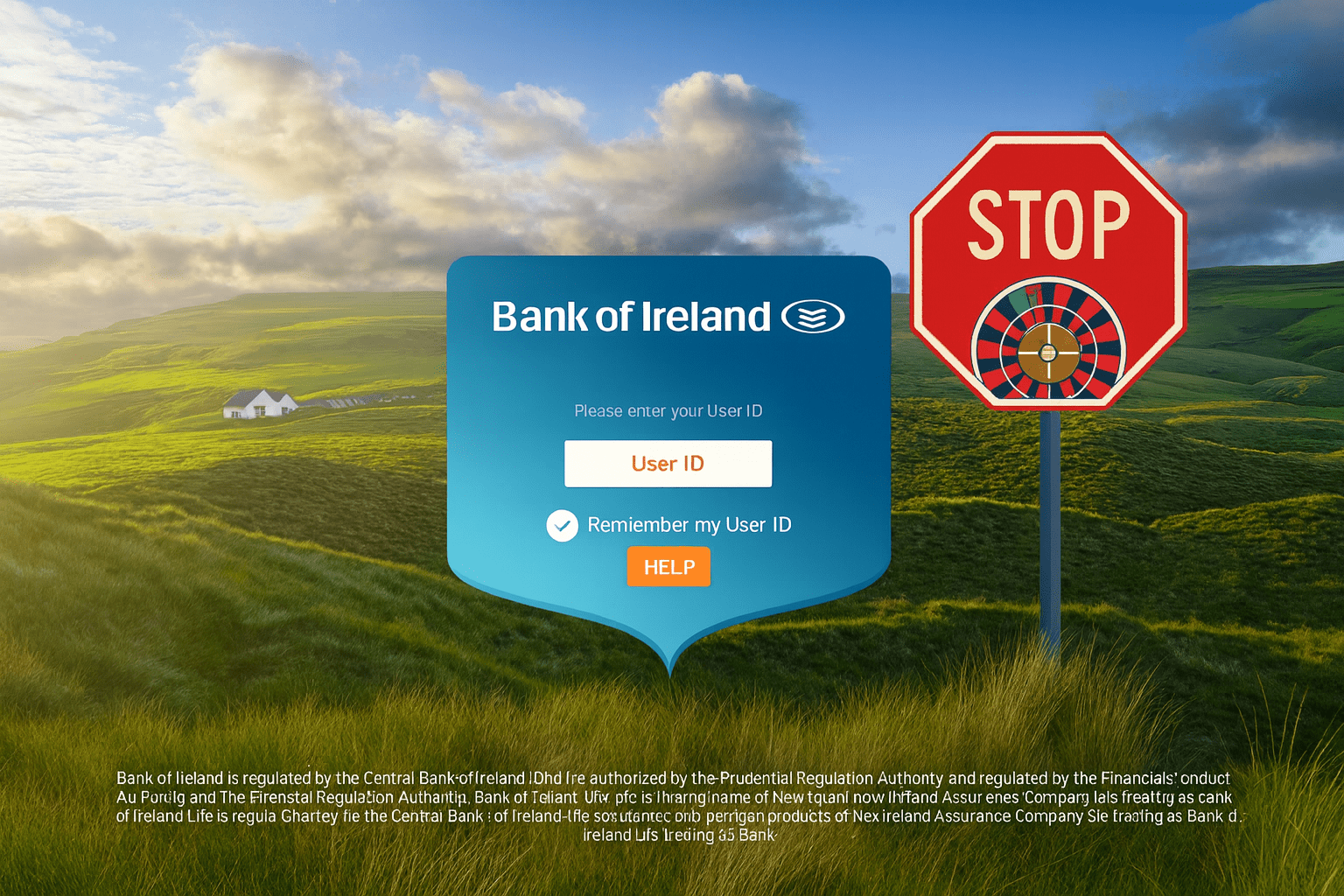
Why It Matters
The scale of the challenge is sobering. With 90 % of Irish betting now online, the accessibility and speed of payments intensify the risk for vulnerable individuals. The new system acts at the source: rather than forcing gamblers to block each website or app individually, a single toggle can prevent all regulated gambling transactions. As Extern’s project manager Barry Grant puts it, “The blanket blocking is massive. It’s just a switch – all gambling is blocked.” He notes that many service users may hold dozens of gambling accounts but typically only one bank account — the point at which intervention can be most effective.
The scheme also incorporates a cooling-off delay before the block can be reversed — a psychological buffer designed to counter impulsive urges.
Former Gaelic footballer Oisín McConville, who has spoken publicly about his own struggles, explained:
“Ninety-nine per cent of people that come forward for help … are in crisis, financially and every other way … With gambling, it’s so hidden … I think this can help.”
Oisín McConville
While the card-blocking tool is voluntary, it complements Ireland’s broader regulatory efforts. The upcoming Gambling Regulation Bill — currently under review — would establish a national gambling authority and impose stricter controls on advertising and operator conduct.
Yet, this is not Ireland’s first foray into payment-based harm reduction, and nor is it unique globally. To assess its promise, it helps to see how other countries are tackling similar challenges.
A Global Comparison: Payment Control as Harm Strategy
United Kingdom: Banking Blocks and Cool-Off Windows
In the UK, many banks already offer card and account gambling restrictions. The UK Gambling Commission provides guidance on how customers can “block gambling payments with your bank,” noting that several banks permit users to freeze or unfreeze a category of transactions, including gambling.
When a block is lifted, a cooling-off period may still apply to avoid impulsive reversals. Such mechanisms parallel the Irish approach's behavioural insights.
Sweden and the Wider European Trend: Banning Credit Card Use
Sweden is proposing to extend its ban on credit card gambling: the government would stop licensed operators from accepting credit card payments when “immediately apparent that the payment is a credit card payment.”
Unlike Ireland’s debit-card focus, this targets the risk of bettors using borrowed money to chase losses.
Similarly, Ireland’s new bill itself forbids the use of credit cards for betting — a complementary restriction that other EU states are also exploring.
Other Jurisdictions: Payment Bans and Enforcement
Beyond Europe, different models exist:
- Some countries require payment processors and banks to block transactions to unlicensed gambling operators. These measures rely on merchant‐category coding (MCC) and financial filtering.
- In jurisdictions where gambling is heavily restricted or banned, direct legal prohibition is the norm, but enforcement often stumbles when operators use alternate banking routes, shell companies, or blockchain alternatives.
- Meanwhile, some operators adapt by shifting players toward e-wallets, prepaid instruments or cryptocurrencies to circumvent conventional blocks.
Thus, the Irish scheme must contend with the fact that not all gambling flows transit through standard debit-card channels. But by capturing the dominant pathway (99 % of online gambling in Ireland uses debit cards), the measure addresses one of the most potent levers of harm.
Opportunities, Risks & Questions Ahead
Strengths of the Irish Approach
- Simplicity and scale
A single toggle covering all regulated gambling channels reduces friction for vulnerable individuals who might struggle to block dozens of sites. - Behaviour-based design
The mandatory cooling-off period adds a built-in “pause,” potentially reducing decisions made in the heat of compulsion. - Complement to regulation
The measure strengthens regulatory reforms by targeting the payment side — often the final link in the chain enabling harm.
Potential Limitations & Vulnerabilities
- Opt-in nature
Because the block is voluntary, individuals must first recognise their vulnerability and request activation. Some may never make that step. - Merchant coding loopholes
These systems depend on accurate MCC classification. Operators using nonstandard or masked MCCs might slip through the net. - Alternate payment routes
Gamblers may bypass blocks via bank transfers, e-wallets, or cryptocurrencies — especially if operators aggressively promote them. - Temporary reversals
Motivated users might disable the block and resume instantly after the cooling period, unless further guardrails are in place.
These challenges do not render the measure futile — but they underscore the need for vigilance, evaluation, and continuous adaptation.
The “Instant Withdrawal Casino” Dilemma
One particular pressure point in the online gambling world is the rise of instant withdrawal casino offerings — casinos that advertise lightning-fast cash-out of winnings to attract users. These promise minimal friction, reinforcing the temptation loop for players chasing wins. By weakening the seamlessness of payment flows, the Irish card block may help blunt the pull of instant-payout lures. However, if operators pivot toward non-card channels, the friction may shift elsewhere.
What to Watch
- Adoption and uptake — How many customers choose to activate the card block feature?
- Effectiveness data — Will Irish support agencies and financial institutions track whether clients with the block experience lower relapse or debt rates?
- Extension to credit cards and other banks — Whether all major Irish financial institutions adopt the tool, and whether it becomes default (opt-out) rather than opt-in.
- Regulatory integration — Whether the upcoming national gambling regulator uses this mechanism as a foundation to mandate broader systemic protections.
- International learning — Whether other countries will take notice and replicate a “debit card switch” in their own harm-minimisation frameworks.
In the evolving landscape of gambling regulation, financial tools now rival traditional licensing and advertising restrictions. Ireland’s card-blocking “switch” is a bold move: it confronts harm at the payment layer, applying behavioural insight to sever the link between temptation and action. As Barry Grant declared, “If you can cut it off at source, that’s massive.”
Yet, the success of this initiative will hinge not merely on its launch, but on its perseverance, coverage, enforcement, and adaptability. To truly protect citizens, Ireland must remain vigilant — closing loopholes, tracking outcomes, and ensuring that regulation, banking culture, and public health evolve in concert.