
This article includes gambling-related content. Irishblogs.ie is committed to providing accurate and responsible information. To ensure the highest standards of quality and safety, all gambling-related content is curated and verified by industry experts. Please engage responsibly!
Across Europe, the UK and Ireland, gambling regulation has moved beyond surface-level restrictions and entered a new phase: behavioural control, data accountability and systemic responsibility. The industry is no longer judged primarily on whether it follows the rules, but on whether its systems prevent harm by design.
This shift has profound consequences — not only for operators, but for investors, suppliers, affiliates, payment providers and software platforms. 2026 is not the year gambling was restricted. It is the year the industry was redefined.

From Rules to Responsibility
For most of the past decade, regulation focused on form: licences, age verification, KYC, self-exclusion registers, advertising limits. By 2026, regulators have largely concluded that formal compliance is insufficient.
The new logic is simple and unsettling for operators:
If harm occurs on your platform, regulators will ask why your systems allowed it.
This marks a fundamental transfer of responsibility. Risk is no longer framed as a player failure. It is increasingly framed as a platform failure.
The European Union
Behavioural Regulation Becomes the Core Model
At EU level, gambling remains regulated nationally, but the regulatory infrastructure around it has become Europeanised.
The most important shift comes from the expansion of EU-wide AML and digital governance frameworks, particularly:
- European Union AML Package (AMLR & AMLA)
- Digital Services Act
- GDPR
Together, these frameworks reshape gambling in three ways:
- Continuous monitoring replaces one-off checks
KYC is no longer a gate at registration. It is an ongoing obligation tied to transaction behaviour, source of funds and account networks. - Data becomes a regulatory asset
Operators must not only collect data, but demonstrate how it is used to prevent harm. Failure to act on known risk signals is increasingly treated as negligence. - Cross-border enforcement tightens
National regulators now share intelligence, blacklists and payment monitoring tools. Jurisdiction hopping — once a common survival strategy — has become expensive and risky.
For B2B suppliers, this is critical: liability is no longer isolated at operator level.
The United Kingdom
From Liberal Market to Managed Exposure
The UK remains one of the world’s most sophisticated gambling markets — but also one of the most transformed.
Following the government’s white paper and subsequent reforms to the Gambling Act, the UK model in 2026 is built around managed exposure rather than free participation.
Key changes include:
- Mandatory affordability checks at defined loss thresholds
- Restrictions on bonus intensity and frequency
- Stricter oversight of VIP and high-value player programmes
- Enhanced powers for the UK Gambling Commission to suspend licences
The UK approach is instructive because it is not anti-industry. It is anti-unmanaged risk.
For investors, the signal is clear: margins increasingly depend on player quality, not player volume.

Ireland
A Late Regulator with Early Lessons
Ireland entered this phase later than the UK, but with sharper awareness of what not to repeat.
The establishment of the Gambling Regulatory Authority of Ireland marks a decisive break from Ireland’s historically fragmented oversight. By 2026, Ireland’s framework reflects three priorities:
- Unified licensing and enforcement
- Strong advertising restrictions, especially around sports and youth exposure
- Explicit focus on social responsibility as a licensing condition
Ireland’s importance goes beyond its domestic market. As a base for many international operators and suppliers, Irish regulatory expectations increasingly influence European compliance standards.
Ireland is not the most aggressive regulator — but it is one of the most strategically positioned.
Advertising Is Not Banned — It Is Rewritten
One of the most misunderstood aspects of the 2026 regulatory environment is advertising.
Contrary to popular belief, gambling advertising has not been eliminated. It has been de-risked.
Across the EU, UK and Ireland:
- Behavioural targeting is heavily restricted
- Influencer marketing is tightly regulated
- Welcome bonuses are capped or standardised
- Language implying urgency, escape or guaranteed success is prohibited
The result is a market where brand strength matters more than offers.
This is not cosmetic. It reshapes customer acquisition economics. Affiliate-driven volume strategies face declining returns. Long-term brand trust becomes the primary growth lever.
The End of Practical Anonymity
By 2026, the idea of anonymous gambling in regulated European markets is largely obsolete.
Driven by AML obligations and payment provider scrutiny:
- Source-of-funds checks are routine
- Linked account detection is standard
- Cross-platform behaviour analysis is expanding
Crucially, regulators now pressure payment processors and PSPs, not just operators. This closes one of the industry’s traditional escape routes.
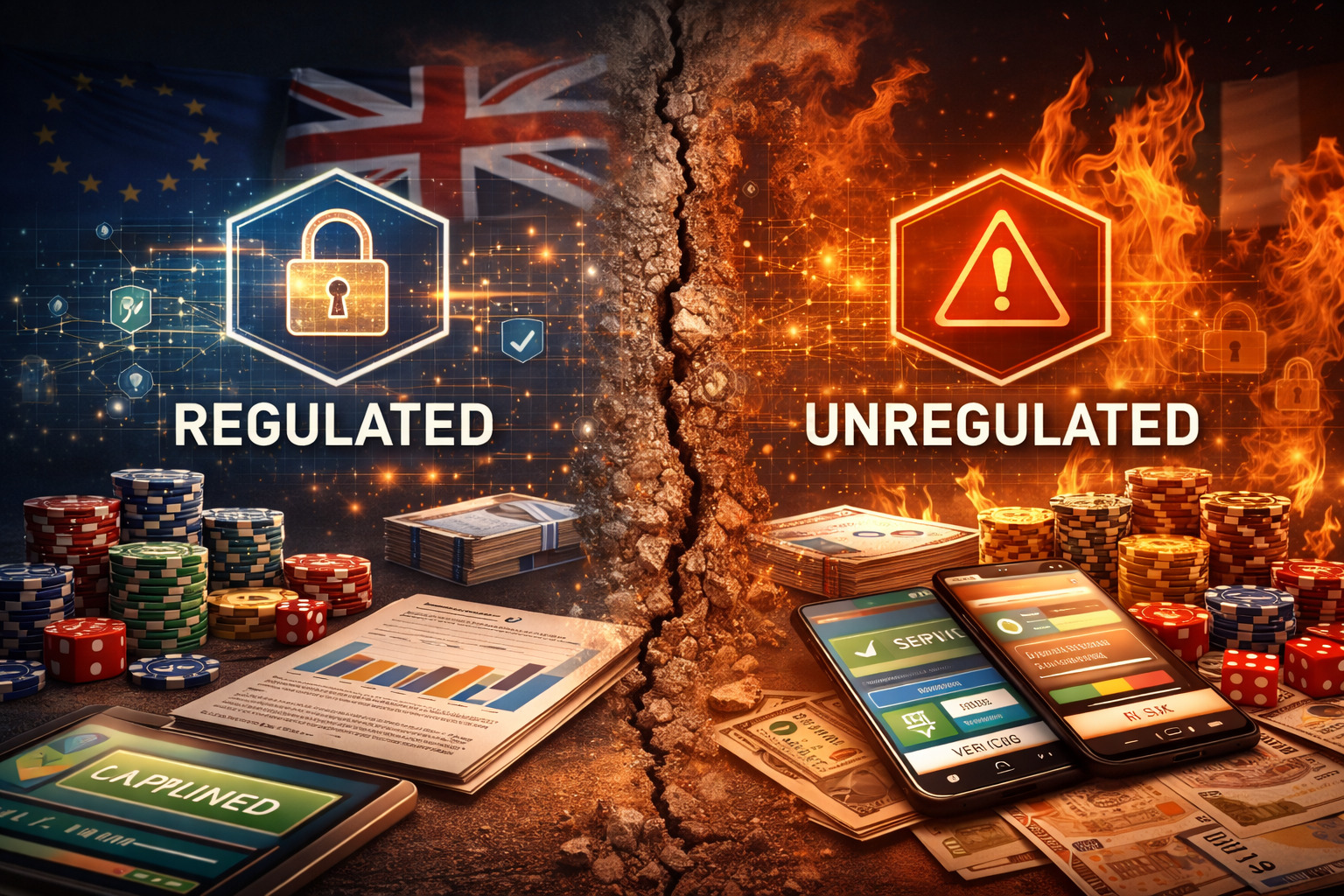
For offshore platforms, this creates a stark divide:
- Grey markets survive, but with higher friction and cost
- Regulated markets become more predictable — and more expensive to operate
What Investors and B2B Must Understand
For investors, 2026 separates speculative growth from regulated sustainability.
Winning strategies now share common traits:
- Strong compliance architecture embedded at product level
- Behavioural risk modelling integrated into UX and CRM
- Conservative acquisition with higher lifetime value
- Legal and data teams involved in product decisions, not just audits
For B2B suppliers — from game studios to analytics platforms — compliance alignment is no longer optional. Vendors increasingly face due diligence from operators and regulators alike.
The industry’s centre of gravity is shifting from marketing to infrastructure.
The Coming Legal Battles
The next phase, beginning in 2026–2027, will be shaped by precedent.
We are likely to see:
- Player lawsuits alleging platform negligence
- Regulatory actions targeting algorithmic design
- Cross-border disputes over licensing and enforcement
- Pressure on jurisdictions seen as regulatory arbitrage hubs
These cases will define how far responsibility extends — and who ultimately bears it.
The Real Meaning of the Gambling Reset
This is not a moral crackdown.
It is a governance recalibration.
Regulators have accepted that gambling will exist. What they no longer accept is unmanaged behavioural risk at scale.
For the industry, the message is blunt:
If you profit from engagement, you are responsible for its consequences.
Those who adapt early will find a smaller, calmer, more predictable market.
Those who resist will operate under permanent uncertainty.
The gambling industry is not shrinking.
It is hardening.
And by 2026, the rules of survival are no longer negotiable.