
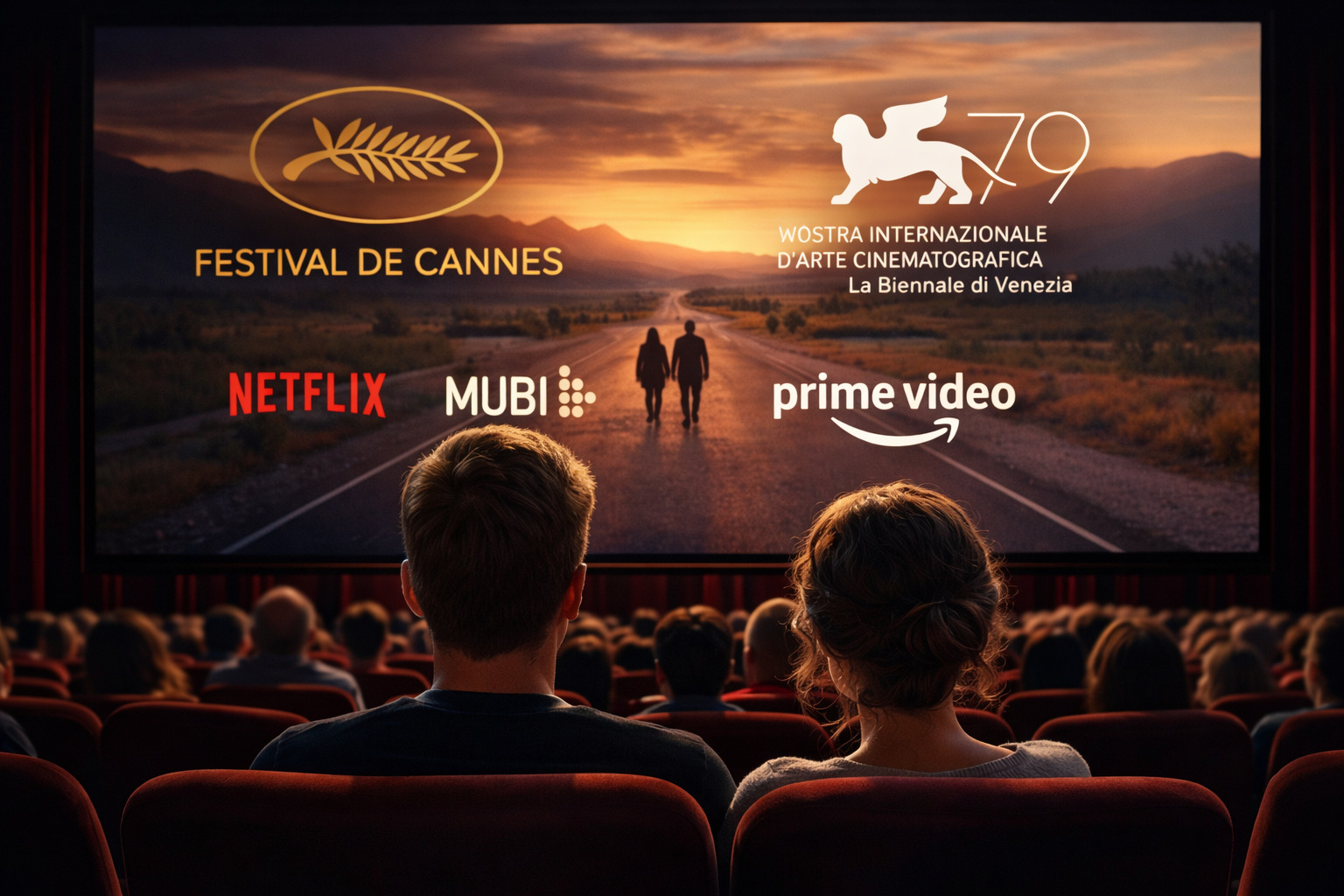
Today, that boundary has noticeably softened. Festival films no longer feel alien, and techniques that once intimidated viewers are now met with curiosity, or even comfort. This shift has little to do with festival cinema becoming simpler. Instead, it reflects a change in the audience itself — and in the environment in which films are now experienced.
When Slowness Stops Being a Barrier
For years, so-called slow cinema was seen as a test of patience. Long takes, silences, and the absence of overt narrative progression ran counter to the expectations shaped by fast editing and clearly signposted plots.
Yet in a culture dominated by constant acceleration — notifications, short-form content, perpetual distraction — slowness has acquired a new meaning. What once felt demanding now feels restorative. Festival films increasingly offer viewers space rather than stimulation, observation rather than urgency. The absence of constant narrative pressure is no longer interpreted as emptiness, but as breathing room.
This shift resonates strongly with European audiences, including in Ireland, where cinema has long been approached as an experience rather than a spectacle. In this context, slowness no longer reads as provocation, but as an alternative to noise.
How Streaming Reframed Narrative Complexity
Paradoxically, streaming platforms played a decisive role in preparing audiences for festival aesthetics. Over the past decade, viewers have become accustomed to series and films with unconventional rhythms, unresolved endings, and narratives that resist easy emotional payoff.
Streaming normalised ambiguity. It taught audiences to live with pauses, to follow stories that unfold gradually, and to accept that meaning is not always delivered on cue. As a result, festival films no longer require special “training.” Their language has become familiar through everyday viewing habits.
Equally important, streaming dismantled the ritual of exclusivity. Author-driven films no longer feel tied to specialised cinemas or limited releases. Appearing alongside mainstream content in the same digital spaces, they are approached without the psychological barrier that once framed them as inaccessible.
Festival Films and the Return to Shared Experience
The convergence between festival cinema and mainstream audiences is not only formal, but thematic. Contemporary festival films increasingly address issues that feel immediate and recognisable: loneliness in a hyperconnected world, migration, generational tension, economic uncertainty, and fragile identities.
For European viewers, these themes rarely feel abstract. Irish audiences, for example, readily recognise stories of peripheral lives, social transition, or quiet instability — even when the films themselves originate elsewhere. The emotional coordinates are shared.
Visually, too, festival cinema has shifted. The camera often meets characters at eye level, favouring intimacy over distance. Conflicts tend to be internal rather than conceptual, grounded in lived experience rather than theoretical constructs. Complexity remains, but coldness has receded.
Blurred Lines as a Sign of Audience Maturity
Crucially, the narrowing gap between arthouse and mainstream does not signal the dilution of authorial cinema. On the contrary, it suggests a more mature audience. Viewers no longer need rigid categories separating “art” from “entertainment.” They are willing to engage with challenging forms when those forms feel honest and emotionally precise.
Recent European productions and independent studios have demonstrated that festival sensibilities can coexist with broad distribution without sacrificing identity. These films do not aim to please everyone — and precisely for that reason, they find their audience.
Festival cinema feels closer today not because it has become easier, but because viewers have become more receptive. Silence, ambiguity, and emotional restraint are no longer sources of anxiety. They are recognised as legitimate modes of storytelling.
The boundary between arthouse and mainstream is dissolving not through compromise, but through cultural evolution. Festival cinema no longer stands apart. It has become part of a shared visual language — one in which complexity is not feared, but understood as a natural dimension of contemporary viewing.