
Yet in recent years, something strange has happened. The behaviour behind acting the maggot has escaped its Irish setting and reappeared online, reshaped into a global pattern. Not as slang, but as a way of acting in public digital spaces.
This shift says less about Ireland and more about how people now survive visibility.
From local mischief to digital posture
Offline, acting the maggot always relied on shared understanding. Everyone in the room knew where the line was. You could cross it briefly because someone would pull you back. The behaviour worked because it was temporary and social.
Online, that structure disappears. There is no room to read. No shared floor. No one quietly saying “that’s enough now.” What replaces it is performance. Acting the maggot becomes a posture, not a moment. A way to speak without fully standing behind what you’re saying.
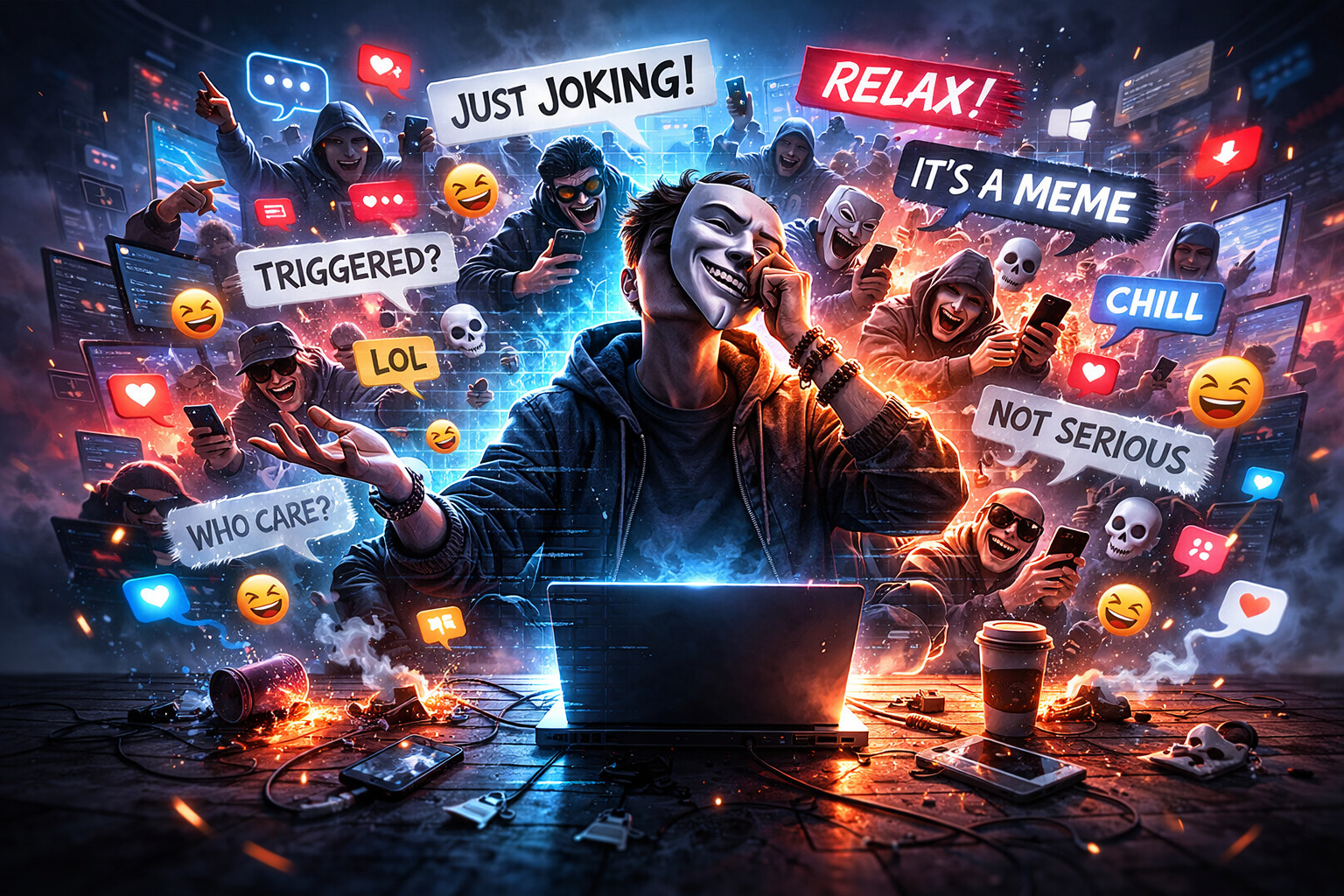
People exaggerate, derail, provoke lightly, then retreat behind humour.
“It was just a joke.”
“I wasn’t being serious.”
“I was messing.”
This isn’t accidental. It fits the architecture of the internet perfectly.
Why the behaviour thrives online
Digital spaces reward disruption, but punish clarity. Strong opinions trigger backlash. Direct criticism escalates quickly. Earnestness invites exposure. In that environment, acting slightly foolish becomes a shield.
Acting the maggot online allows people to:
- challenge norms without naming the challenge,
- criticise systems without owning the critique,
- attract attention without committing to a position.
It’s mischief with plausible deniability. What once softened social tension now protects individuals from accountability.
When play becomes expectation
Over time, this behaviour stops being optional. It becomes expected. Creators feel pressure to appear unserious. Brands adopt “playful” tones to avoid backlash. Public figures lean into irony to avoid being pinned down. The performance of lightness becomes mandatory. Seriousness starts to look risky. In this way, acting the maggot shifts from cultural expression to social survival strategy. The irony is sharp: what once allowed people to bend rules humanely now helps them avoid responsibility altogether.
The Irish contrast
In its original setting, acting the maggot always had limits. The community enforced them. Push too far and the tone changed. The humour stopped working. Online, those limits dissolve. Algorithms don’t recognise excess — they amplify it. Audiences reward escalation. The behaviour no longer resolves tension; it accumulates it. What was once playful becomes hollow repetition.
To understand the original meaning and cultural grounding of the phrase, see
acting the maggot meaning. That context matters, because without it, the behaviour loses its social intelligence.
What this reveals about modern communication
Language doesn’t change randomly. Behaviour patterns don’t spread without reason. The global adoption of “acting the maggot” as a style tells us something uncomfortable: Being sincere has become costly. Being direct feels unsafe. Being playful offers cover. Humour, irony, and performative foolishness are no longer just cultural traits — they are defensive technologies.
A quiet conclusion
This isn’t a call to abandon humour. Nor is it nostalgia for a purer past. It’s an observation. When everyone is “just messing,” nothing can be addressed properly. When everything is ironic, nothing is resolved. And when acting the maggot becomes constant, it stops being human — and becomes mechanical. The original Irish expression worked because it knew when to stop. The internet hasn’t learned that part yet.