
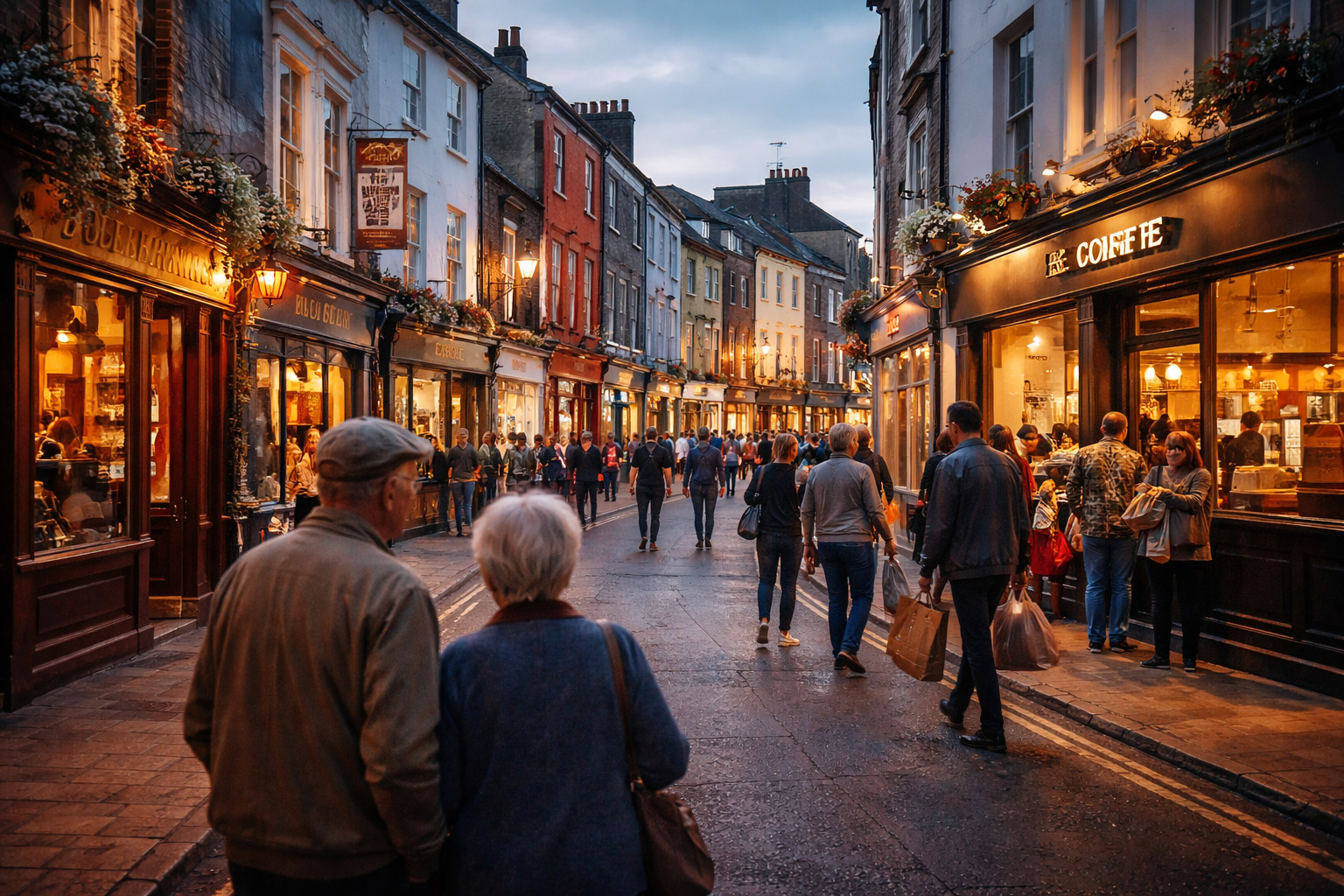
A decade ago, the centre of an Irish city was not designed to impress. It was designed to function as a place of return. Independent shops survived on repetition, not visibility. Pubs were chosen out of habit rather than atmosphere. Everyday services — workshops, hairdressers, corner stores — formed an economy of familiarity, sustained by continuity rather than turnover.
Today, these places disappear without drama. Not through scandal or demolition, but through attrition. They close “temporarily”. They reopen transformed. Or they vanish entirely, replaced by spaces that are clean, recognisable, and instantly legible to anyone passing through. Nothing is overtly worse. Everything is more presentable. What has changed is not quality, but specificity. The city has not declined. It has become interchangeable.
Cities designed for movement, not for staying
New urban formats in Ireland are increasingly built for circulation rather than residence. They privilege the passer-by over the rooted: tourists, temporary residents, mobile workers, people who can navigate the city without belonging to it. The city becomes legible to outsiders — frictionless, branded, efficient — while becoming less inhabitable as a long-term social organism.
This model is attractive precisely because it is measurable. Footfall can be counted. Turnover can be optimised. Space can be priced as a yield-producing asset. What cannot be easily priced — familiarity, routine, informal trust, the slow accumulation of local relationships — is treated as secondary. The result is not a cultural shift driven by taste, but by accounting.
Independent businesses depend on repetition: the same faces, the same rhythms, the same seasonal patience that makes a neighbourhood more than a corridor between attractions. But high rents, short leases, and investor preference for high turnover turn that ecology into a liability. Not because it lacks cultural value, but because it does not match the economics of short-term demand. A city built to host constant arrival gradually loses the infrastructure of staying.
Local life is not displaced by ideology. It is displaced by design — and priced out by structure.
This is not nostalgia — it is a system
What is happening in Irish cities is often dismissed as nostalgia for a disappearing past. That reading is convenient — and wrong. The change is not emotional. It is structural.
Over the past decade, rising tourism numbers, short-term mobility, and investment-driven redevelopment have pushed central rents steadily upward. Higher rents demand faster turnover. Faster turnover rewards standardised formats with predictable margins. And standardisation, in turn, determines who can afford to stay — not just who can operate a business, but who can live in the city centre at all.
The demographic consequences are no longer subtle. Census data and housing reports consistently show a decline in long-term family households in central urban areas, alongside a rise in childless households, short-term rentals, and transient residents. In practical terms, city centres are being recalibrated away from permanence. They increasingly function as zones of consumption, tourism, and circulation rather than places organised around everyday life.
This shift is easiest to observe not in policy documents, but on the street. City centres are crowded during working hours and animated late into the evening, yet feel curiously hollow in the early morning. Schools, local services, and routine errands fade from view. What disappears is not activity, but continuity — the quiet signals of people who expect to be there tomorrow.
This is not the loss of character through taste. It is the outcome of an economic system that privileges movement over settlement, yield over familiarity, and visibility over belonging.
Who remains
Spend time in the centre of an Irish city and a pattern emerges. Not abruptly, but steadily. The people who remain tend to fall into two overlapping realities.
There are long-term residents, often older, whose relationship with the city is rooted in memory rather than utility. They move along habitual routes, shop in the few independent places still standing, and measure change by what has quietly disappeared. Their presence anchors the past, but it no longer shapes what comes next. The city adjusts around them, not for them.
Alongside them are migrants and temporary residents — students, mobile workers, short-term renters — who increasingly sustain the daily economy of the centre. Their connection to the city is practical and immediate. They need transport, employment, accessible services, and flexible housing. Few expect permanence. Fewer still expect the city to carry their identity over time. Urban policy responds accordingly, optimising for flow rather than continuity.
Between these two realities, one group fades almost without comment.
Young families do not leave in protest. They leave quietly, when the maths no longer works.
Where the children went
The absence of children is the clearest, and most overlooked, signal of urban transformation.
Cities without children lose temporal depth. This is not a cultural choice, but a structural one. Research across Irish and European cities shows a consistent pattern: as central housing costs rise and average dwelling sizes shrink, families with children relocate outward. Census data points to declining numbers of family households in central districts, even as overall population density increases. Growth remains, but it skews adult, mobile, and temporary.
The reasons are practical. Limited space. Rising rents. A shortage of schools, green areas, and everyday infrastructure designed for long-term family routines. City centres optimised for short stays and high turnover struggle to accommodate lives organised around duration rather than access.
Families do not reject the city. They are filtered out by it.
What remains is an urban core that functions efficiently — busy, connected, productive — yet increasingly detached from the full life cycle. The city continues to move, but fewer people grow up inside it.
Emigration without drama
At this point, emigration is no longer a reaction. It is a calculation. Young Irish people are not leaving because cities lack jobs. Employment in Dublin, Cork and Galway remains strong, particularly in sectors that attract graduates. What no longer holds is the logic of staying. Housing costs have outpaced wages for over a decade. In central urban areas, average rents have risen far faster than incomes, while available space has shrunk. The city offers entry, not settlement.
The demographic signal is clear. Ireland continues to see high outward mobility among people aged roughly 25 to 39 — the cohort traditionally responsible for forming households, raising children, and stabilising neighbourhoods. Many leave temporarily, some return, others do not. What matters is not permanence, but rhythm. Urban life no longer supports the full life cycle. It supports a phase. People do not leave because they reject the city. They leave because the city no longer accommodates adulthood.
Tourism as an accelerator, not the cause
Tourism did not initiate this shift. It intensified it. As visitor numbers grew and urban centres were repositioned as destinations, the economics of space changed. Short-term accommodation, hospitality, and high-turnover retail generate higher yields than long-term residential or locally oriented uses. Over time, this reshapes demand. What survives is what can monetise attention quickly. What depends on repetition and familiarity is pushed outward.
This is not cultural preference. It is market logic.
In Irish city centres, the result is visible: rising proportions of short-term lets, declining numbers of family households, and a retail mix increasingly optimised for visitors rather than residents. The city becomes easier to consume and harder to inhabit. It remains busy, but less rooted. Urban centres are no longer organised around staying. They are organised around throughput.
What is quietly being lost
The most consequential feature of this transformation is not displacement, but its invisibility. There is no rupture to point to, no single policy to contest, no moment that announces loss. Streets remain busy. Businesses continue to trade. Investment flows uninterrupted. By conventional metrics, the city appears healthy.
What erodes instead is social density — the accumulation of unplanned presence that gives a city depth beyond function. The small, repetitive interactions that make people stay without purpose. The places that do not need to justify themselves through efficiency or turnover. These are not amenities. They are conditions. And once removed, they cannot be reinstated by design, subsidy, or regulation.
This is why the change resists correction. What disappears is not infrastructure, but continuity. Not culture as performance, but culture as habit. Cities can rebuild façades, reopen venues, and rebrand districts. They cannot easily restore the expectation of staying once the system no longer supports it.
What is unfolding in Irish cities is therefore not a temporary distortion caused by overtourism or another cycle of gentrification. It is a structural reordering of urban life, in which convenience displaces rootedness and neutrality replaces belonging. The city optimises for movement, not for memory. A city can become prosperous. It can become visually refined. It can become efficient by every measurable standard. And still, without collapse or protest, lose the people who would have grown old inside it.