
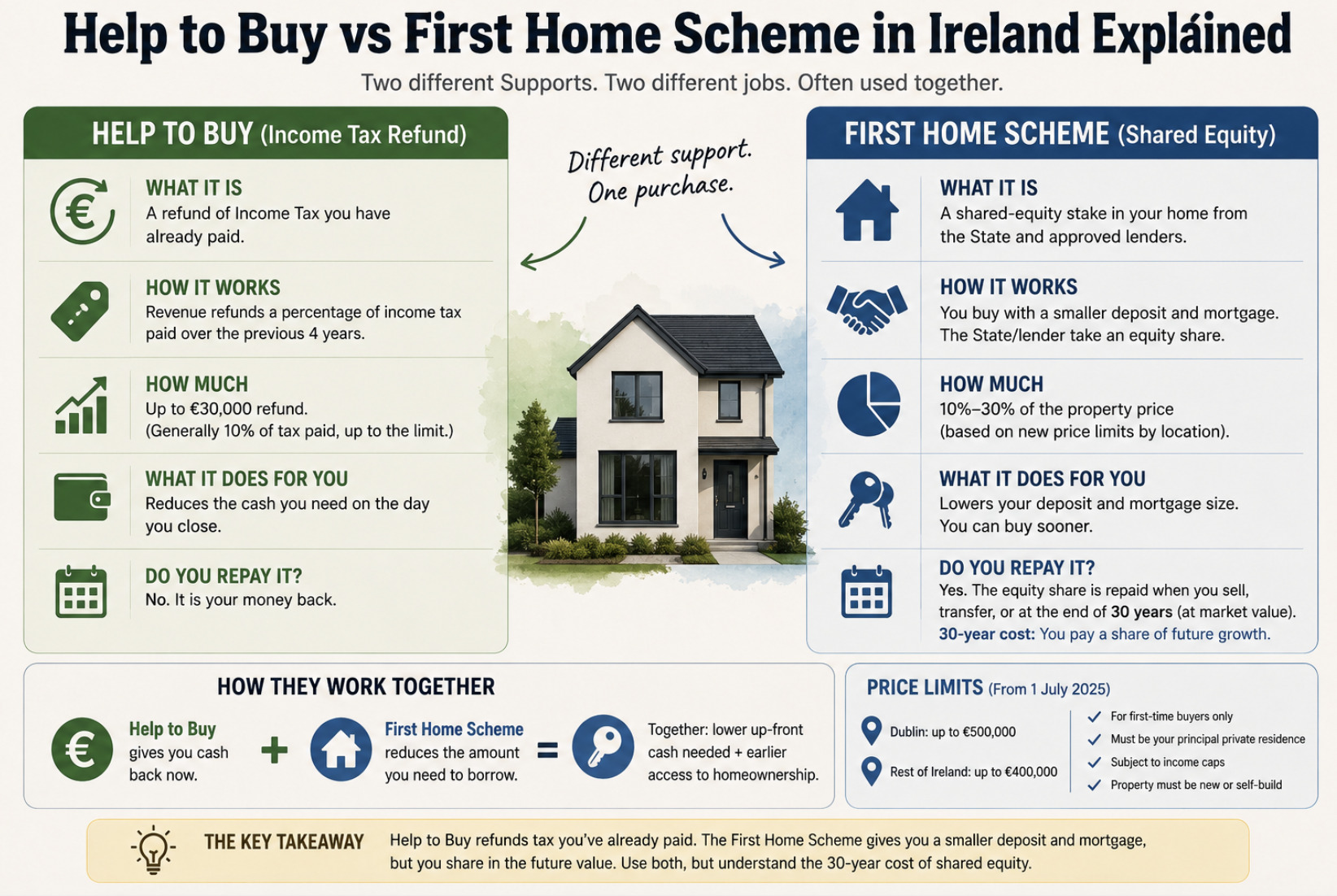
Help to Buy is administered by Revenue and returns income tax and DIRT already paid by the applicant.
How the Help to Buy scheme works
Help to Buy is administered by Revenue and returns income tax and DIRT already paid by the applicant. The refund is the lowest of three figures: €30,000, 10% of the purchase price or approved valuation for a self-build, or the total income tax and DIRT the applicant paid over the four tax years preceding the claim.
The third limit is the one that catches people out. A buyer purchasing a €400,000 new home is theoretically entitled to €30,000, but if their PAYE and DIRT payments over the previous four years came to €21,000, that is what they receive. Buyers early in their careers, or those who spent part of the four-year window abroad or out of the workforce, frequently land well short of the headline figure.
The property conditions are strict. The home must be newly built or a self-build; second-hand properties do not qualify under any circumstances. The purchase price or approved valuation must not exceed €500,000. The mortgage must represent at least 70% of the purchase price, which rules out buyers making unusually large cash contributions. The scheme currently runs for contracts signed, or self-build mortgages drawn down, up to 31 December 2029.
The refund is paid to the developer or contractor rather than to the buyer, and it counts towards the deposit.
How the First Home Scheme works
The First Home Scheme is a shared-equity arrangement backed by the State and a group of participating mortgage lenders. It pays a portion of the purchase price up front and takes an equity share of the same percentage in return. The buyer owns the property outright on the deeds, but the scheme holds a registered charge equal to its percentage until that share is bought back.
The maximum equity share is 30% of the purchase price. Where Help to Buy is also used on the same transaction, the First Home Scheme share is capped at 20%. Buyers must have a deposit of at least 10%, and must draw down the maximum mortgage their participating lender will approve — the scheme is explicitly designed to close a gap, not to reduce borrowing.
Regional property price ceilings apply and are reviewed roughly every six months. As of January 2026 the ceiling is €500,000 in Dublin City, Dún Laoghaire-Rathdown, Fingal, South Dublin and Wicklow; €475,000 in Galway City and Kildare; €450,000 in County Cork and County Galway; and between €350,000 and €425,000 across most remaining counties. Buyers should confirm the current figure for the specific local authority area before making an offer, because a review can move a county into or out of range.
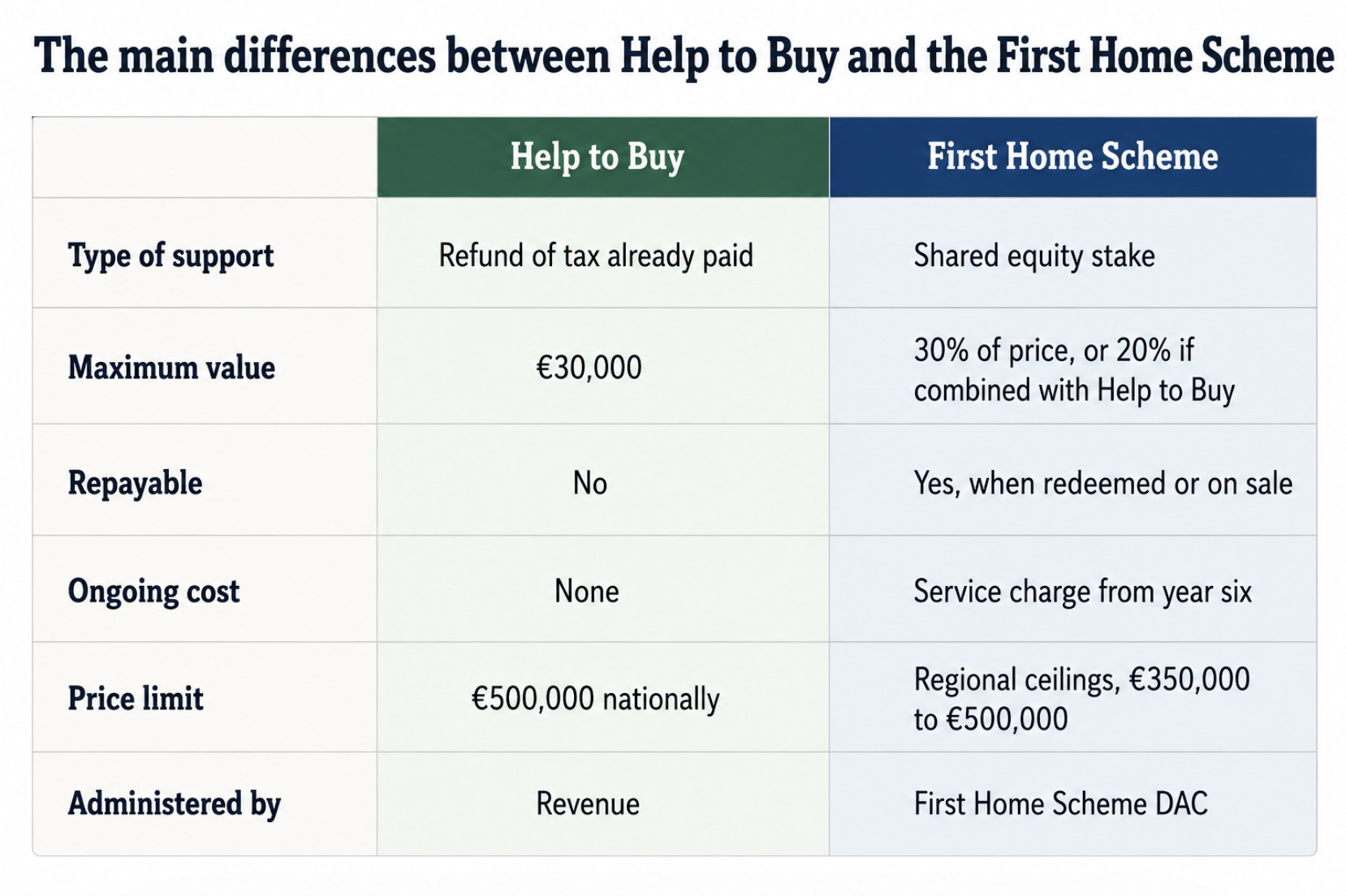
Regional property price ceilings apply and are reviewed roughly every six months.
What the two schemes look like on a real purchase
Consider a couple with a combined gross income of €80,000 buying a €400,000 new-build home. Standard Central Bank lending rules allow first-time buyers to borrow up to four times gross income, giving an approved mortgage of €320,000. The minimum deposit of 10% is €40,000.
Help to Buy provides up to €30,000 of that deposit, assuming the couple's income tax and DIRT over the previous four years covers it. They fund the remaining €10,000 from savings. Mortgage plus deposit totals €360,000, leaving a €40,000 shortfall against the purchase price.
The First Home Scheme can bridge that €40,000, which is 10% of the price — comfortably inside the 20% cap that applies when Help to Buy is also used. The purchase completes. The couple own a €400,000 home, of which the scheme holds a 10% equity share.
The long-term cost of the equity share
The equity share is free of charge for the first five years. From the beginning of year six, an annual service charge applies to the original equity amount: 1.75% in years 6 to 15, 2.15% in years 16 to 29, and 2.85% from year 30 onwards. These rates are fixed for the life of the facility and accrue daily, applied monthly in arrears.
On the €40,000 equity share above, that is €700 a year from year six, rising to €860 from year sixteen and €1,140 from year thirty. Over the first fifteen years of charges alone the cumulative cost approaches €7,000, before any redemption.
The redemption cost is the larger consideration. The percentage owed never changes, but the euro amount tracks the property's value. A 10% share taken on a €400,000 home costs €40,000 to redeem at that valuation. If the property is worth €500,000 when the buyer redeems, the same 10% costs €50,000. Redemption can be made in stages or in full at any time, and a valuation is generally required. Selling the property, moving out, renting the whole home or switching lender are mandatory redemption events, so the share cannot simply be left in place indefinitely under any circumstances.
Which scheme suits which buyer
For anyone buying a qualifying new build, Help to Buy is close to unconditional. It carries no ongoing cost, no repayment and no claim on future equity. There is no analytical reason to decline it if the property and mortgage conditions are met.
The First Home Scheme demands a genuine calculation. It is most defensible where the alternative is not buying at all, or waiting several more years while prices move. It is least attractive where the buyer could close the gap within a reasonable saving period, or where income is expected to rise sharply — in which case a slightly later purchase with a larger mortgage may leave more of the property in the buyer's hands.
A useful discipline is to model the redemption cost under a plausible price-growth assumption rather than at today's valuation, and to weigh that figure against the rent that would be paid in the intervening years. Neither answer is universal.
How to apply for each
Help to Buy applications are made through Revenue's online services. Applicants must be fully tax-compliant for the four years being claimed, which usually means filing any outstanding returns first. The process runs in two stages: an application that produces an application number and summary, and a claim stage completed once a contract is signed, with the solicitor or contractor verifying the claim.
First Home Scheme applications are made directly to the scheme and require mortgage approval in principle from a participating lender. Eligibility approval is typically valid for six months and is renewable. Applications should be lodged before signing contracts, as the equity amount must be built into the transaction.