
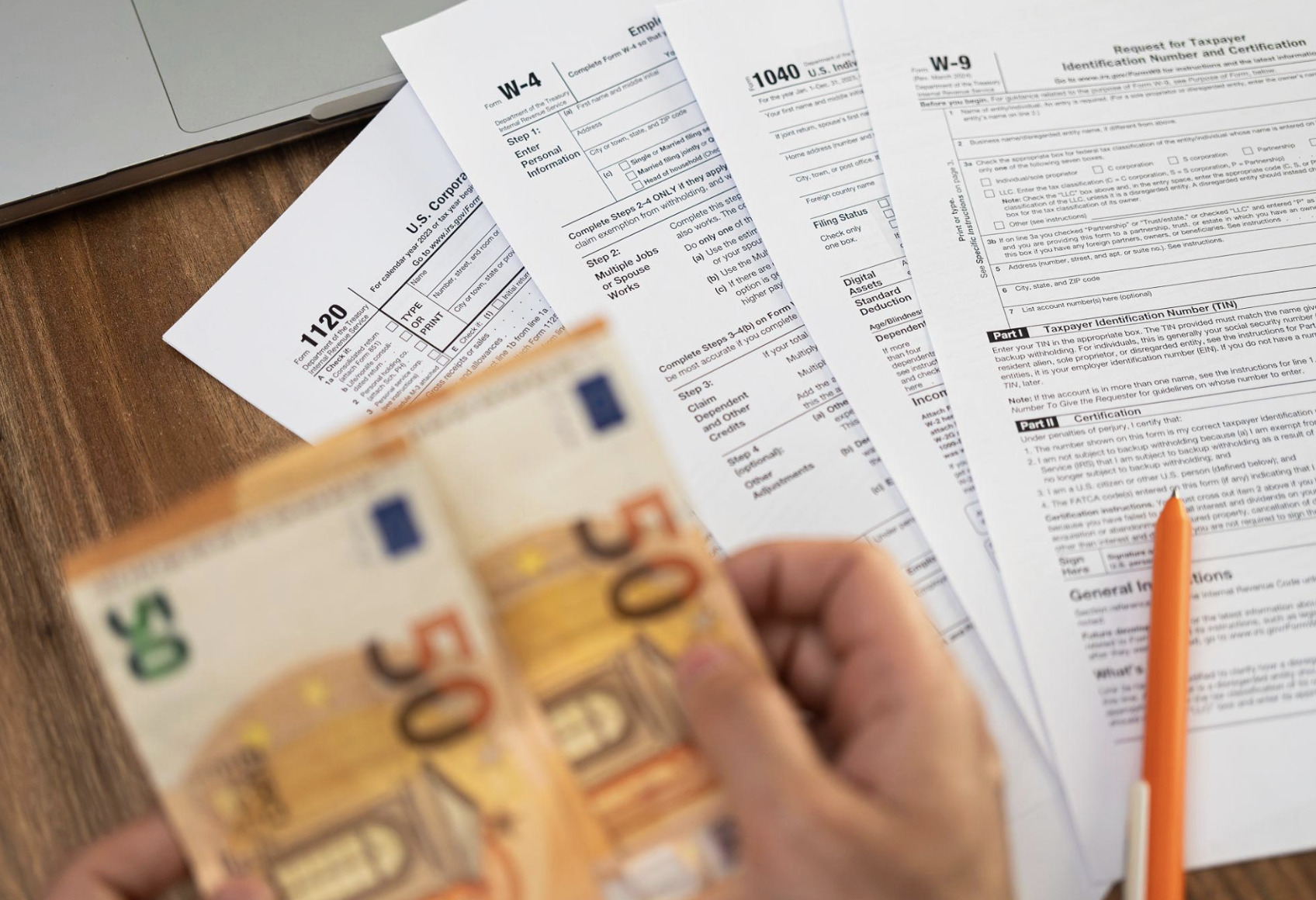
Why the overpayment happens at all
When you are paid through PAYE, Revenue applies your tax credits for you — but only the credits it already knows about. Two of them are automatic: the Personal Tax Credit and the Employee Tax Credit, which between them are granted to every employee without any action required. Almost every other relief in the system works the other way around. It exists, you are entitled to it, and it does precisely nothing until you go in and claim it yourself. The rent credit, medical expenses, remote-working relief, flat-rate expenses for your occupation — none of these is applied on your behalf. They wait.
The crucial mechanical detail is the four-year rule. You can claim back over the current year and the four years before it, which means that in 2026 the open years are 2022, 2023, 2024 and 2025. The catch is that the window rolls forward each January. On 31 December 2026, the 2022 tax year closes for good, and whatever you were owed for it simply vanishes. Anyone who has been renting, paying for healthcare, or working from home since 2022 without claiming has a full year's worth of refund quietly counting down. That is the reason to do this now rather than file it under "someday".
Step one: ask for a Statement of Liability
The simplest starting move is to request a Statement of Liability — the document Revenue used to call a P21 — for each open year through the myAccount portal. It reconciles the tax you actually paid against the tax you owed, and tells you whether you finished the year over- or underpaid. It is also the mechanism through which most refunds are issued. Requesting one is free, takes a couple of minutes per year, and there is no downside to seeing the position in black and white before you start adding reliefs.
The rent credit: the big, frequently missed one
For renters, the Rent Tax Credit is the single most valuable thing on this list and one of the most commonly overlooked. It is worth up to €1,000 a year for a single person and €2,000 for a couple who are jointly assessed, it has existed since 2022, and the government has confirmed it through to the end of 2028. It applies to private renters who are not receiving State housing supports such as HAP, and — importantly — it is claimed per tenant, so housemates sharing a property can each make their own claim. Parents paying for a student child's "digs" accommodation can claim it too.
It was smaller in its first two years, worth €500 for a single person in 2022 and 2023 before rising to €1,000 from 2024 onward, which means a single renter who has never claimed could be owed roughly €3,000 across the four open years — five hundred, five hundred, a thousand and a thousand. None of it arrives automatically. You claim it in myAccount under PAYE Services, in the Rent section, by entering your landlord's details and the rent you paid. Your landlord's PPS number is useful but, in most cases, not strictly required for the claim to go through.
Medical expenses: 20% of nearly everything you paid
The next relief most people underuse is on health expenses. You can claim back 20% of qualifying out-of-pocket medical costs — meaning the portion you actually paid, after anything reimbursed by VHI, Laya or Irish Life Health is stripped out. The list of what qualifies is broad: GP visits, consultant fees, prescription medicines, physiotherapy, and non-routine dental work, for which your dentist provides a Form Med 2 that you keep rather than submit. What does not qualify is routine dental and optical care — check-ups, cleanings, fillings, ordinary glasses — which Revenue treats as preventative rather than treatment.
The relief is given at the standard 20% regardless of whether you pay tax at the higher rate, so every €1,000 of eligible spending returns €200. Nursing home fees are the notable exception, potentially qualifying for relief at your marginal rate of up to 40%. As with everything else, the four-year rule applies, the claim is made through myAccount, and you should hold on to your receipts, which Revenue can ask to see and which you are expected to keep for six years.
Remote-working relief, and the €3.20 confusion
If you have worked from home at any point since 2022, there is a separate relief for the running costs that came with it. The e-worker relief lets you claim 30% of your electricity, heating and broadband costs, apportioned to the number of days you actually worked at home, with the relief then given at your tax rate. On its own in a single year it is often modest — a few dozen to a couple of hundred euro — but across four years, and stacked with the other reliefs, it adds up.
This is the relief that generates the most confusion, because of the €3.20 figure people half-remember. That daily amount is something an employer can choose to pay you tax-free; it is not a claim you make to Revenue. The two are separate, and you can claim the e-worker relief for your unreimbursed costs even if your employer pays nothing. One thing to be clear about: rent, mortgage payments and home insurance do not count toward the calculation, only the utility costs directly tied to working from home.
Flat-rate expenses: the receipt-free deduction nobody mentions
Finally, there is a category that requires no receipts at all and that an enormous number of workers never claim: flat-rate employment expenses. These are standard deductions Revenue grants to specific occupations to cover the typical costs of the job — uniforms, tools, professional equipment — and they are set by trade rather than by what you actually spent. Nurses, teachers, construction workers, retail staff and dozens of other roles each have a set annual figure. Because it is automatic to your occupation rather than to your spending, it is one of the easiest things on this list to claim and one of the most frequently forgotten, often left unclaimed across every one of the open years.
What to actually do this week
The whole exercise lives inside one place: the myAccount portal on Revenue's website. The efficient approach is to deal with all four years in a single sitting. Request a Statement of Liability for each, then add whatever applies — the rent credit, your medical expenses, the e-worker relief, your occupation's flat-rate expense — for 2022, 2023, 2024 and 2025 in turn. Refunds for genuinely overpaid tax are typically processed within days rather than weeks, paid into the bank account Revenue has on file.
It is, in the end, the same lesson that applies to broadband, energy and mortgages in Ireland: the default setting costs you money, and the system relies on most people never changing it. The difference with tax is that the money is already yours and the only thing standing between you and it is a fifteen-minute task — plus, this year, a clock running down on 2022.
Frequently asked questions
How far back can I claim tax relief in Ireland? You can claim for the current year and the four years before it. In 2026 that means 2022, 2023, 2024 and 2025 are open, but the 2022 year closes permanently on 31 December 2026, so it should be claimed before then.
Is the Rent Tax Credit applied automatically? No. Like most Irish reliefs, it must be claimed by the taxpayer through myAccount under PAYE Services. It is worth up to €1,000 a year for a single person and €2,000 for a jointly assessed couple, and it can be claimed per tenant.
How much do I get back on medical expenses? Relief is 20% of your qualifying, unreimbursed costs, so €1,000 of eligible spending returns €200. Routine dental and optical care are excluded, while qualifying nursing home fees may attract relief at up to 40%.
What is the difference between the €3.20 daily payment and the e-worker relief? The €3.20 a day is an optional tax-free payment your employer may make. The e-worker relief is a separate claim you make directly to Revenue for 30% of your home electricity, heating and broadband costs, apportioned to the days you worked from home. You can claim the relief even if your employer pays you nothing.