
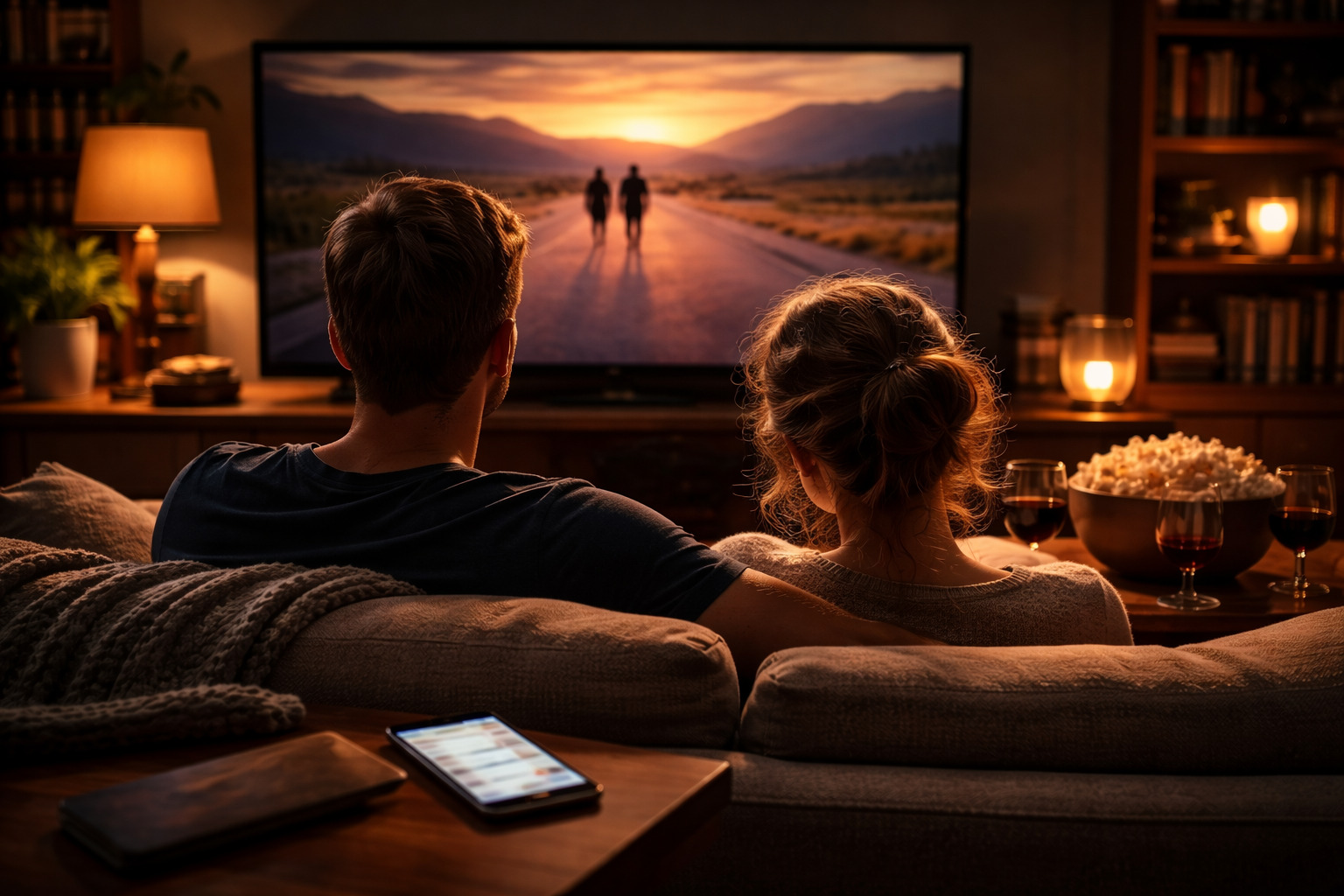
This shift is not a failure of discipline or a loss of cultural seriousness. It reflects a structural change in how attention now functions. Media researchers describe the dominant mode of home viewing as second-screen behaviour: watching while simultaneously engaging with a phone, tablet, or laptop. What matters is not how often viewers look away, but how little anxiety this produces. Missing a moment no longer feels like loss. The underlying assumption is that the film will allow re-entry. The traditional cinematic contract—darkness, silence, uninterrupted focus—has collapsed outside the theatre. At home, cinema shares space with daily life rather than isolating itself from it.
Most people recognise this experience instantly. You step out of the room during a quiet scene. When you return, a character articulates—through dialogue—what was previously conveyed visually. Or another character reacts in a way that makes the missed action immediately legible. You do not rewind. You do not feel confused. The film seems to meet you halfway. This is not coincidence, and it is not laziness on the part of the viewer. It is a deliberate structural response. Contemporary films are increasingly built with the expectation that attention will drift and must be gently recovered. Narratives are designed to survive brief absences. Viewers are no longer punished for looking away.
Screenwriting has adapted first and most visibly. Dialogue today often carries a dual function: it advances the story and secures comprehension. Information that once lived entirely in framing, gesture, or silence is now reinforced verbally. Characters restate motivations, clarify emotional shifts, or echo what has just occurred on screen. This does not signal a collapse of subtlety. It reflects an adjustment to realistic viewing conditions. Films are no longer written for ideal spectatorship, but for domestic spectatorship—fragmented, interrupted, and intermittently distracted. In this environment, clarity becomes not a weakness but a survival strategy.
Editing follows the same logic. Modern montage increasingly anticipates attention loss and builds in points of return. Key emotional beats are held longer, reaction shots linger, transitions soften. Critical information is layered: first shown, then spoken, then confirmed through consequence. Editors are no longer working solely to intensify experience; they are working to stabilise it. The goal is not to overwhelm the viewer, but to remain legible even when the viewing is imperfect. Cinema, in this sense, has learned resilience.
As a result, the role of film itself has shifted. At home, cinema behaves less like a performance and more like an environment. It fills silence, structures time, accompanies routine. It does not demand surrender; it allows coexistence. Paradoxically, this can create a different kind of intimacy. A film watched across several evenings, half-attended yet emotionally present, can linger more deeply than one consumed in total concentration. Lines overheard while doing something else, moods absorbed indirectly, scenes encountered in fragments—these experiences accumulate quietly, without spectacle.
Something is undeniably lost in this transformation. Certain forms of cinema depend on total immersion. Long silences, visual ambiguity, complex spatial construction—these languages weaken when attention fragments. Some films fracture entirely outside the theatre. Yet what is happening now is not merely erosion. It is a reconfiguration of cinematic language. Cinema is no longer built on the assumption of uninterrupted focus. It is being rewritten for a world in which attention leaks, returns, and reorganises itself constantly.
The most significant shift is philosophical. Cinema has stopped fighting for attention and started working with its absence. The new contract is quiet but clear: the film accepts that you will look away and promises that when you return, it will still be there—intelligible, waiting. We still watch films, but we no longer step out of life to do so. Cinema has moved from the centre of the evening to its background, not as a downgrade, but as an adaptation. And the films that endure in this environment are not the loudest or the fastest, but the ones designed to be lived with rather than stared at. This is not the end of cinema. It is its domestic evolution.