
This article includes gambling-related content. Irishblogs.ie is committed to providing accurate and responsible information. To ensure the highest standards of quality and safety, all gambling-related content is curated and verified by industry experts. Please engage responsibly!
The idea of variance, in plain terms
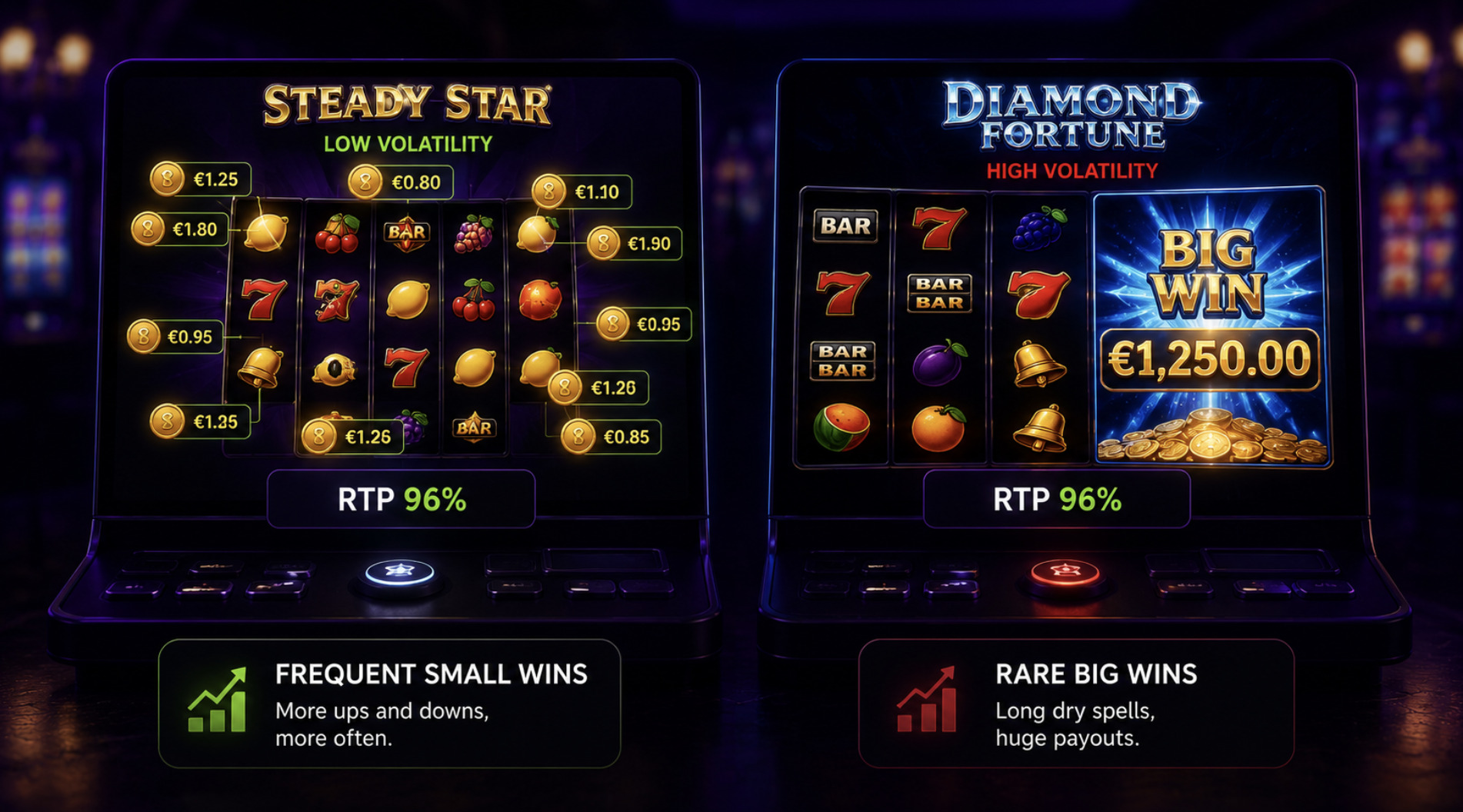
Volatility measures how a slot distributes its returns over time. Two games can pay back the same total across millions of spins while arriving at that total in wildly different ways. A low-volatility slot pays frequently in small amounts, keeping a balance ticking along with regular modest wins. A high-volatility slot pays rarely, but when it does, the wins can be dramatic. Both can reach the same long-run RTP; they simply take opposite routes.
Think of it as the difference between two hikes to the same summit. One is a gentle, gradual slope with steady footing the whole way. The other is long flat stretches punctuated by sudden steep climbs. You end up at the same height, but the journeys feel nothing alike — and if you run out of water on the flat stretch, you may never reach the peak at all. Volatility is the profile of the terrain, and it shapes everything about how a session unfolds.
Why the same RTP produces different rides
RTP is a single figure that hides an enormous amount of internal structure. It tells you the average return, but averages conceal distribution. The same 96% can be assembled from thousands of tiny frequent wins or from a handful of rare colossal ones, and the maths of the paytable — how prizes are sized and how often each combination lands — determines which. Volatility is essentially a summary of that internal distribution.
This is why RTP alone is a poor guide to how a game will feel. A player who chooses purely on RTP and lands on a high-volatility slot may be baffled when their balance drains through a long payless stretch, wondering how a "96% game" could behave so harshly. Nothing is wrong; the return is simply concentrated in events that have not yet arrived. Reading volatility alongside RTP resolves the mystery before it becomes a frustration.
Low volatility: frequent, gentle, forgiving
Low-volatility slots are the ones that feel steady. Wins land often, usually for modest amounts, and the balance tends to move in small increments rather than dramatic swings. For a player who values a long, relaxed session and who is uncomfortable watching a balance evaporate quickly, these games are the natural fit. They stretch a given budget further in terms of playing time, because the frequent small returns cushion the decline.
The trade-off is ceiling. The gentle rhythm that makes low-volatility slots comfortable also caps their explosive potential; the life-changing single spin is not what these games are built for. They reward players who are there for extended, low-drama entertainment rather than for the pursuit of a rare enormous prize. Knowing that in advance means choosing them for the right reasons and not feeling shortchanged when the big win never comes — it was never in the game's nature to deliver one.
High volatility: patient, brutal, occasionally spectacular
At the opposite end sit the high-volatility slots, and they demand a different temperament and a different bankroll. These games can go through long stretches returning little or nothing, testing patience and eating into a balance, before a bonus feature or a rare alignment produces a payout many hundreds of times the stake. The generous theoretical return is real, but it is unevenly distributed, front-loaded with drought and back-loaded with the occasional flood.
The critical implication is about bankroll. A high-volatility slot can exhaust a small balance before it ever reaches one of its big moments, which means these games are unforgiving to players who are under-funded relative to the swings. They suit those who understand the pattern, size their stakes accordingly, and accept long dry runs as the price of the rare spectacular hit. Approached without that understanding, they feel punishing; approached with it, they offer a specific kind of high-stakes excitement that low-volatility games cannot.
Matching volatility to your budget and mood
The practical value of volatility is that it lets you match a game to your circumstances rather than stumbling into a mismatch. The two variables that matter most are how large your entertainment budget is relative to your stake, and what kind of experience you actually want from a session. A modest budget paired with a high-volatility slot is a recipe for a short, disappointing session, because the swings can outstrip the funds. The same budget on a low-volatility game may provide a long, pleasant one.
Many operators now signal a game's volatility in its information panel, and this is worth checking before you play rather than discovering it the hard way. A platform such as Spookino casino that labels the variance of its slots alongside their RTP gives players the two numbers they actually need to choose well: one for the long-run cost, one for the shape of the ride. Used together, they turn game selection from guesswork into an informed decision that fits both your funds and your appetite for swings.
Hit frequency, the third piece
Volatility is often accompanied by a related figure, hit frequency, which counts the percentage of spins that produce any win at all. It is tempting to treat the two as the same, but they measure different things. A game can hit often yet still be volatile, if most of those hits are tiny and the real money is locked in rare features. Another can hit less often but pay consistent mid-sized amounts, feeling steadier despite the lower frequency.
Reading hit frequency alongside volatility sharpens the picture further. Frequency tells you how often the reels reward you with anything; volatility tells you how lumpy those rewards are. A slot that pays small amounts on nearly half its spins will feel utterly different from one that rewards a fraction of spins with occasional giants, even at identical RTP. Together these figures describe not just the cost of a game but its entire emotional texture — the rhythm of anticipation and reward that defines what it is actually like to play.
Conclusion
RTP tells you how much a slot returns over time; volatility tells you how it feels along the way, and the two together explain why games that look identical on paper deliver such different experiences. Low volatility offers frequent, gentle wins and long, forgiving sessions with a modest ceiling. High volatility offers patience-testing droughts and rare, spectacular payouts that demand a larger bankroll. Neither is superior — each suits a different budget and a different mood. The players who enjoy slots most, and who protect their funds best, are the ones who read volatility before they spin, choosing the terrain deliberately rather than being surprised by it. It is the quiet variable that turns a number on a screen into the actual character of a game.