
An Economy That Belongs Elsewhere
The numbers are clear. A significant share of Ireland’s corporate tax revenue comes from a small cluster of US multinational companies. American firms dominate the technology, pharmaceutical and digital sectors. Employment, exports and GDP growth are structurally tied to transatlantic capital. Ireland’s economic language reflects this dependence. Public debate revolves around competitiveness, innovation, productivity, scale. Success is measured quarterly. Risk is normalised. Growth is assumed to be the solution to almost everything — from housing shortages to public services.
This model works. But it also creates a quiet imbalance. When an economy speaks American, it adopts American assumptions: speed over deliberation, efficiency over cohesion, market logic over cultural continuity. Ireland benefits from this alignment — and pays for it by narrowing the range of futures it can realistically imagine.
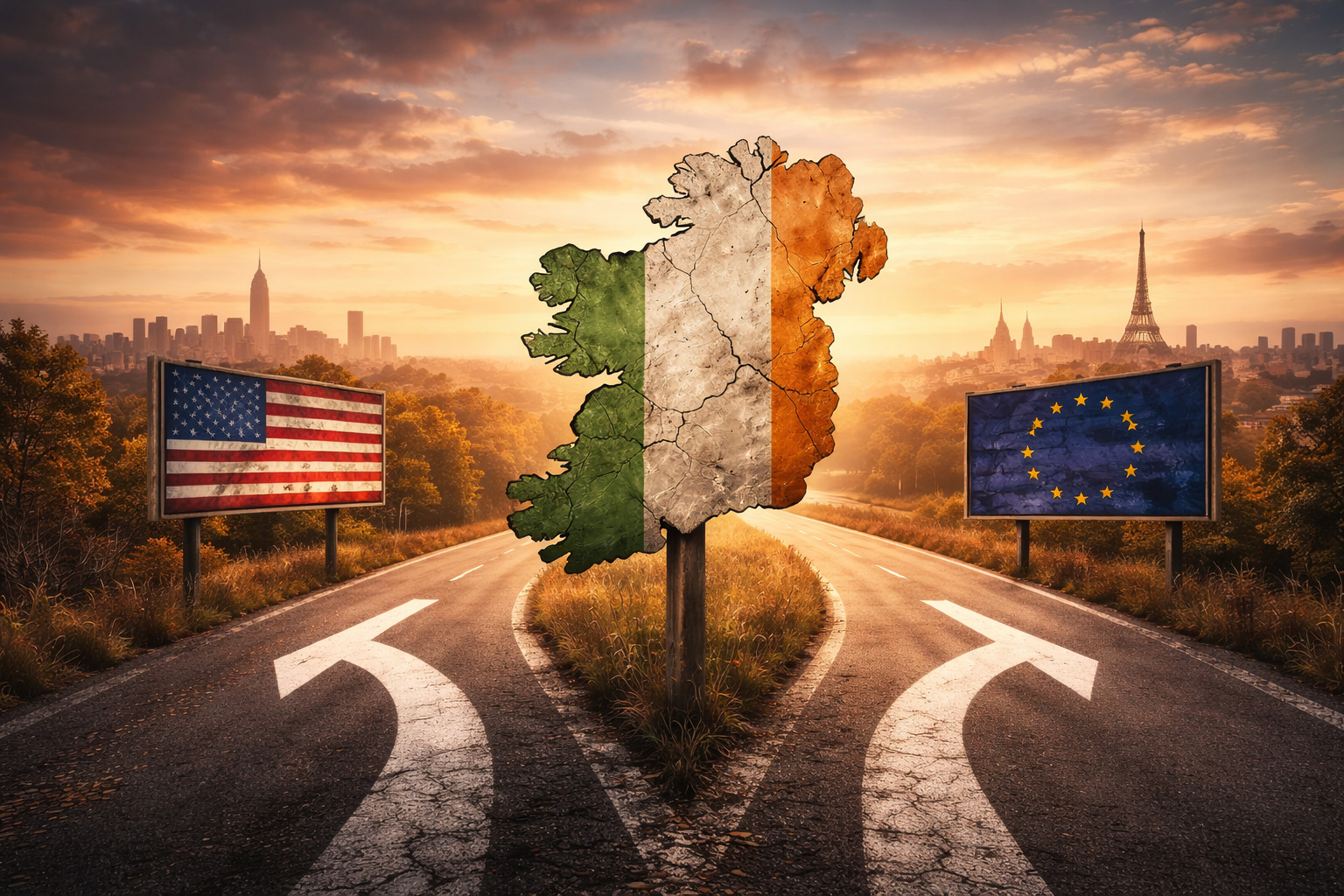
A European Culture Inside an American System
Culturally, Ireland never followed the economy all the way.
Public funding for the arts, national broadcasting, literary institutions, theatre and film still operate within a recognisably European framework. Culture is treated as public infrastructure, not as a purely commercial product. Ambiguity is valued. Silence is allowed. Failure is tolerated. Irish cultural life resists the American logic of constant visibility. It distrusts spectacle. It prefers voice to volume. Even when Irish artists succeed globally, they tend to frame their work through European references rather than American mythologies of success. This creates friction. Culture speaks one language; the economy speaks another. And the state often struggles to translate between them.
The Emotional Gap Nobody Names
The deepest contradiction is not institutional. It is emotional. Ireland does not feel American. Its relationship to power is cautious, ironic, historically informed. Nor does it fully feel continental European, shaped as it is by an English-speaking media space and a post-colonial trajectory that never quite aligns with the European core. Young professionals often embody this tension. They work for American companies, live in a European regulatory system, consume global culture and imagine futures that are geographically flexible but emotionally unstable. Belonging becomes provisional. Identity becomes transactional.
This is not cosmopolitan freedom. It is quiet dislocation.
Growth Without Grounding
Ireland’s political discourse assumes that economic success will eventually stabilise everything else. Housing will catch up. Services will expand. Cultural tension will soften. Identity will sort itself out. History suggests otherwise. Countries that outsource their economic logic while preserving a different cultural one tend to accumulate pressure rather than resolve it. The longer contradictions remain unnamed, the more they surface indirectly — through housing crises, cultural burnout, migration tensions and generational fatigue. Ireland’s housing shortage is not just a supply problem. It is the spatial expression of an economic model that moves faster than the society meant to absorb it.
Between the US and Europe When They Diverge
This in-between position becomes riskier as transatlantic relations grow more complex. Regulatory divergence between the US and the EU places Ireland in a delicate position. Align too closely with American corporate interests, and political credibility in Europe weakens. Lean too heavily into European regulation, and economic advantage erodes. Neutrality becomes harder to maintain. Silence becomes a statement. Flexibility starts to look like avoidance. Ireland has built a reputation as a bridge. But bridges do not choose the direction of traffic — they absorb the weight.
Identity Is Not a Branding Exercise
By 2026, Ireland’s challenge is no longer economic or diplomatic. It is narrative. Identity cannot be left to marketing slogans or soft power imagery. It is policy, culture and economics pulling in the same direction — or openly acknowledging when they do not.
Ireland does not need to “choose” between America and Europe. But it does need to stop pretending that the tension is temporary or purely beneficial. Economic dependence requires safeguards. Cultural belonging requires investment, not nostalgia. Political autonomy requires language that is not borrowed wholesale from either side.
Ireland has always been good at adaptation. Less so at confrontation — especially with itself.
The country’s real question in 2026 is not where it belongs, but whether it is willing to define the space it already occupies. Being economically transatlantic and culturally European can be a position of strength — but only if it is articulated deliberately, not lived by default. Otherwise, Ireland risks becoming something increasingly familiar in global politics:
a successful country, admired from the outside, quietly uncertain of its own centre. And uncertainty, unlike contradiction, rarely stays quiet forever.