
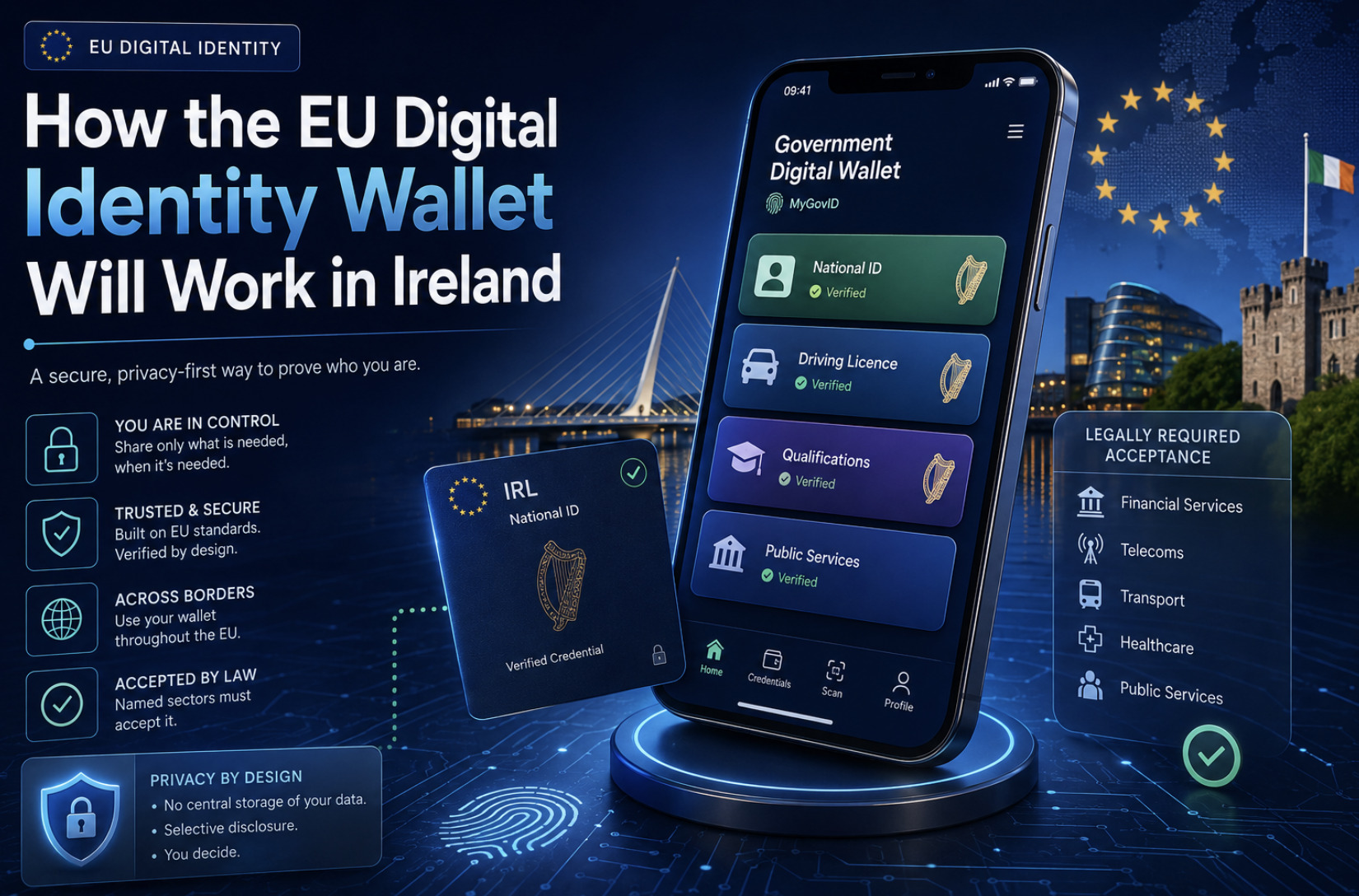
The scale of the obligation is what makes this different from previous digital identity initiatives. This is not a voluntary product competing for adoption. It is a regulated infrastructure that named sectors of the economy will be legally required to accept.
What the EU Digital Identity Wallet actually is
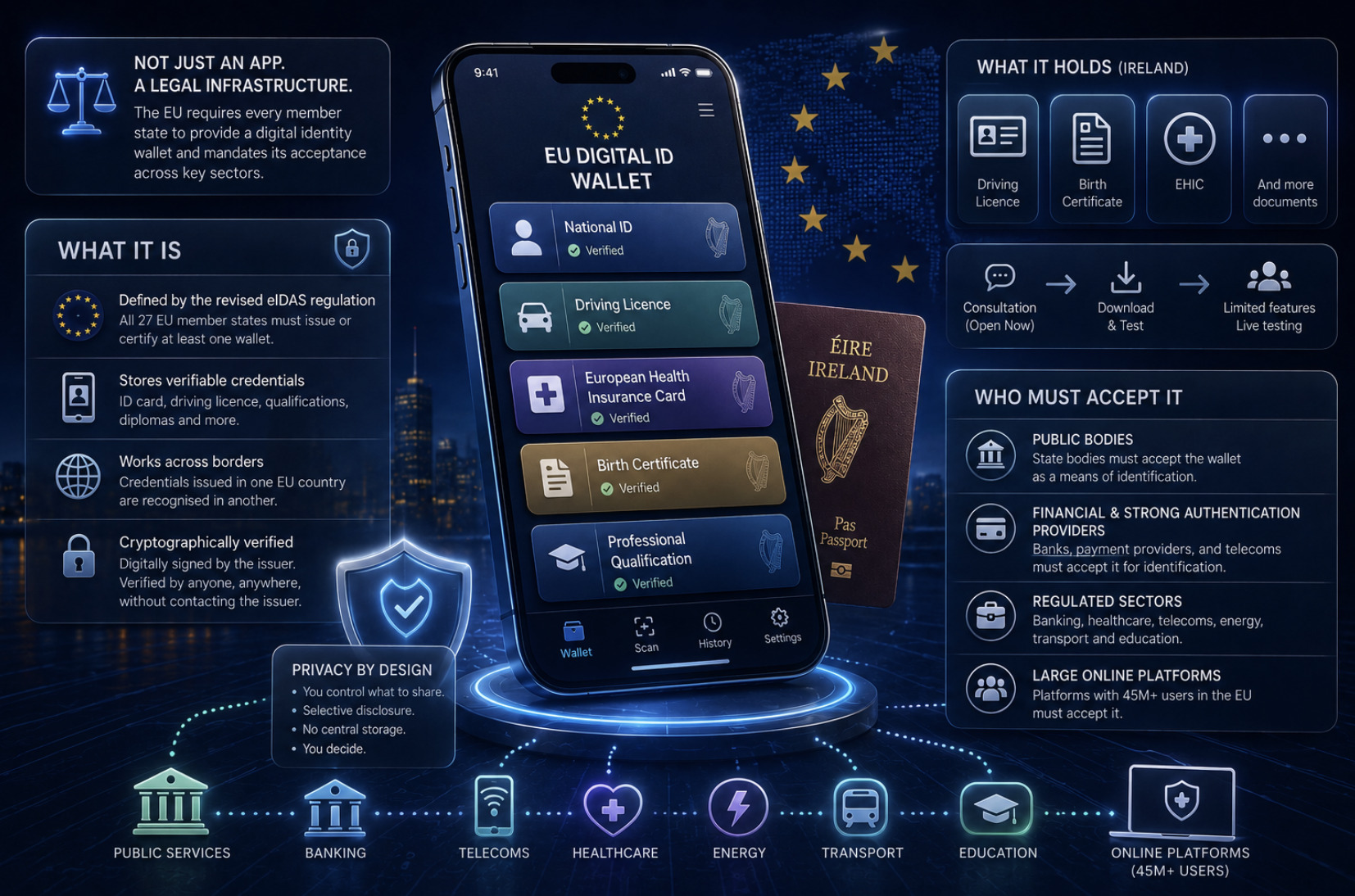
The wallet is defined by the revised eIDAS regulation, the EU framework governing electronic identification and trust services. Under it, all twenty-seven member states must issue or certify at least one wallet application, and must do so within twenty-four months of the relevant implementing acts being adopted.
Functionally, it is a mobile application that stores verifiable credentials issued by trusted authorities. Those credentials can include a national identity document, a driving licence, professional qualifications and academic diplomas. The wallet works across borders, so a credential issued in one member state must be recognised in another, and it is designed to operate both online and in person.
The distinction from a photograph of a document in a phone gallery is cryptographic. Each credential carries a digital signature from the issuing authority, and the party requesting it can verify that signature without contacting the issuer. That is what makes the credential usable as proof rather than as a picture.
What Ireland's Government Digital Wallet holds
The Irish implementation is being delivered by the Department of Public Expenditure, Infrastructure, Public Service Reform and Digitalisation, with Minister Jack Chambers and Minister of State Frank Feighan opening the consultation phase.
The rollout has been structured in two stages. The first allows anyone to view the proposed design, submit feedback and register interest. The second allows people aged sixteen and over to download the application and test a limited set of functions in live conditions.
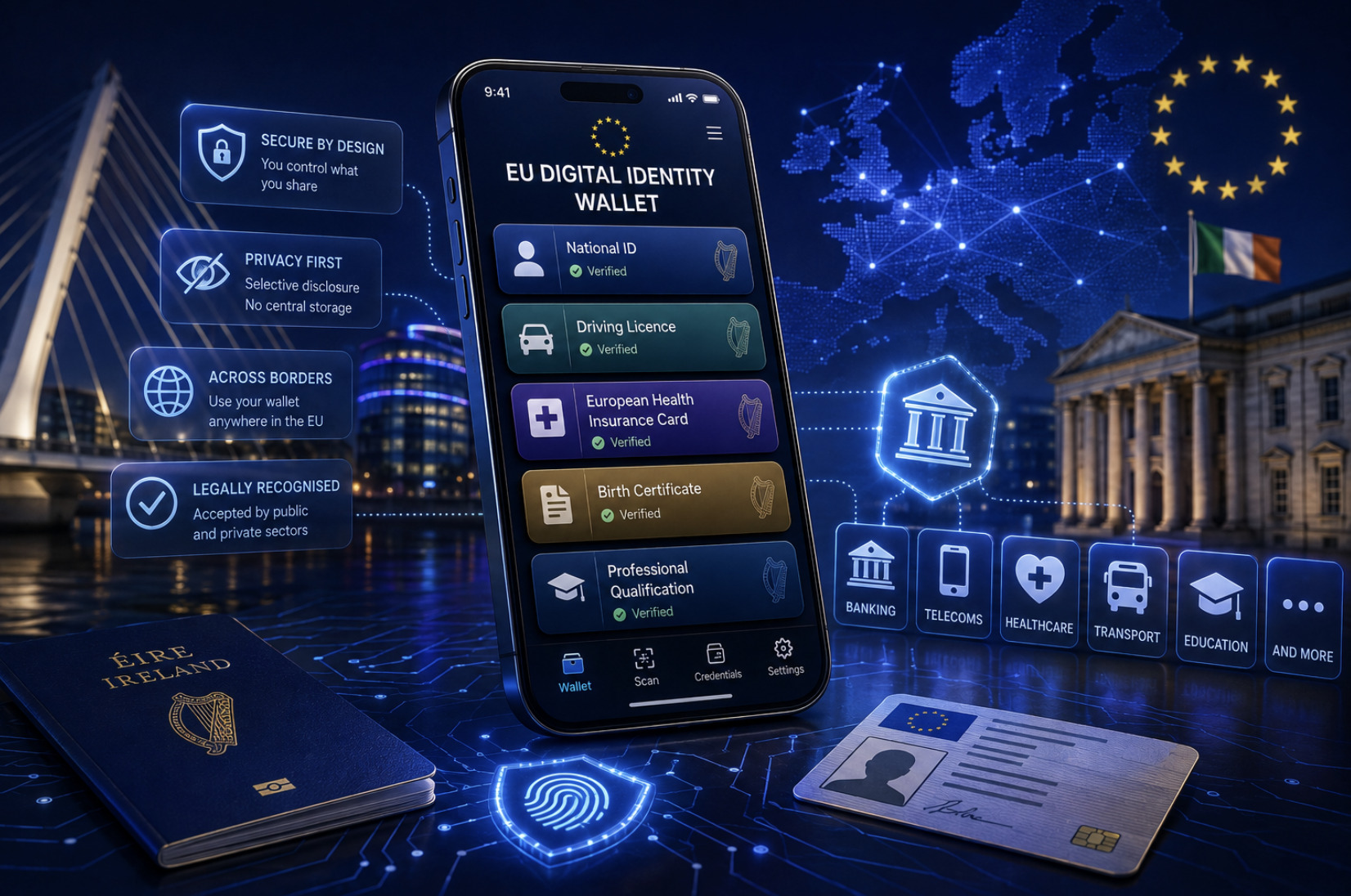
On the credential side, the wallet is intended to hold digital versions of the driving licence, the birth certificate and the European Health Insurance Card, alongside other official documents. The practical target is the situation most people encounter several times a year: proving identity or entitlement to a public body without producing paper.
Building on MyGovID matters more than it might appear. It means the identity assurance process behind the wallet is the one already used for welfare, revenue and public service access, rather than a new verification exercise for every user. It also means the wallet inherits the political history of that infrastructure. Ireland's earlier experience with the Public Services Card, which became the subject of a sustained data protection dispute over the legal basis for its wider use, is the reason domestic scepticism about state-issued digital identity is more developed here than in several other member states.
Who is required to accept it
The acceptance obligations arrive in sequence, and the sequence is the part most consumers will notice.
Public bodies come first. Once the wallet is operational, state bodies must accept it as a means of identification, which is the point at which it becomes genuinely useful rather than experimental.
Private-sector obligations follow. Providers that carry out strong customer authentication — banks, payment service providers and telecommunications companies — will be required to accept the wallet for identification. The broader regulated categories named in the framework cover banking, healthcare, telecoms, energy, transport and education.
Separately, very large online platforms, defined as those with more than forty-five million users in the EU, fall within the acceptance requirement. This is the provision with the widest reach for ordinary users, because it brings the wallet into the consumer internet rather than confining it to regulated services.
For an Irish consumer the cumulative effect is that opening a bank account, taking out a mobile contract or verifying an account on a major platform should become possible using a single credential set held on a phone, without repeatedly uploading photographs of documents to intermediaries.
How selective disclosure and zero-knowledge proofs work
The technical design of the wallet rests on the principle of data minimisation, and two mechanisms deliver it.
Selective disclosure allows a credential holder to share individual attributes rather than the whole document. Where a driving licence proves name, address, date of birth, licence number and entitlement categories, selective disclosure permits the holder to release only the attribute the requesting party actually needs.
Zero-knowledge proofs go further. Rather than sharing an attribute at all, the wallet can produce a cryptographic proof that a statement about the attribute is true. The clearest application is age. Instead of transmitting a date of birth, the wallet transmits a proof that the holder falls within a required age range. The requesting party learns that the condition is satisfied and nothing else.
The European Commission has developed an age verification application on this basis and has published successive versions of its technical blueprint. The design goal is to allow platforms to enforce age restrictions without accumulating identity documents belonging to their users.
The privacy objections and whether they hold
The cryptography is strong. The objections raised by privacy researchers and civil liberties organisations are mostly not about the cryptography, which is why they deserve to be taken seriously rather than dismissed as technical misunderstanding.
The first concerns metadata. Selective disclosure limits what is shared in a transaction, but it does not eliminate the record that a transaction occurred. Repeated presentations, wallet-provider logs and the timing and location of verifications can support profiling even where no attribute is disclosed. The privacy guarantee is at the level of content, not at the level of activity.
The second concerns concentration of risk. A credential store used by hundreds of millions of people is a target of a different order to any individual database. The consequences of a breach scale with adoption, and the framework's success is precisely what would create that exposure.
The third concerns platform dependency. In practice a wallet application is distributed through the Apple and Google application stores and runs on their operating systems and secure hardware. Critics have argued that requiring an account with one of two American companies in order to hold a European public credential is a structural weakness in digital autonomy, independent of how well the cryptography performs.
The fourth is the broadest. If proving identity or age becomes technically frictionless, it tends to become the default demand rather than the exception. Organisations including the Electronic Frontier Foundation have argued that routine identity verification changes the character of online participation even where each individual verification is privacy-preserving, and that the social effect can include self-censorship. There has also been public campaigning within the EU to make the privacy-preserving design of the age verification application legally binding rather than a matter of implementation choice — an argument that concedes the technical design is sound while doubting that it will be reliably honoured.
None of these objections are answered by pointing at zero-knowledge proofs, because none of them are claims that the proofs fail.
What this means in practice
For most people in Ireland the sensible position is neither enthusiasm nor refusal, but attention to a small number of practical points.
Participation in the testing phase is voluntary and open to anyone aged sixteen or over, and the consultation stage accepts feedback from anyone. Those are the only points at which the design is genuinely open to influence.
When the wallet becomes operational, the relevant discipline is to check what a requesting party is actually asking for. A wallet that supports selective disclosure still permits an organisation to request more than it needs, and the interface will show what is being requested before it is released. The privacy benefit is available, but it is not automatic.
It is also worth understanding that the wallet does not replace physical documents on a mandatory basis at the outset. The obligation sits on organisations to accept the wallet, not on individuals to use it.