
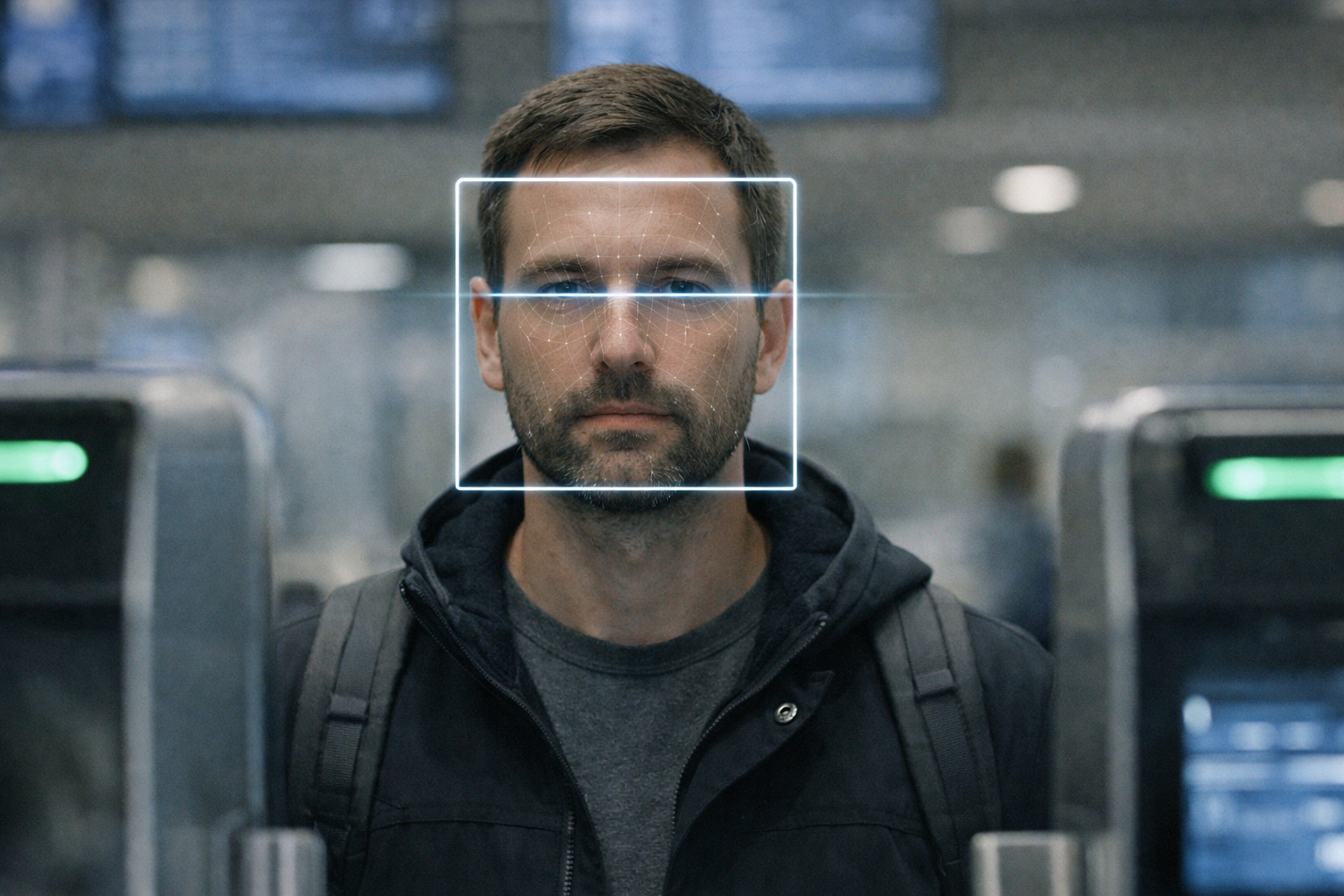
This shift is not theoretical. It is already changing how migrants, asylum seekers, students, and workers experience Europe — including Ireland.
From border checks to data checks
The most visible change is biometric identification. Fingerprints, facial images, and digital identity records are now central to how Europe manages entry and stay. These systems are designed to ensure consistency and security, but they also mark a fundamental transition: identity is no longer verified once — it is continuously evaluated.
A person crossing a border today does not simply present documents. They enter a network of databases that record movements, applications, refusals, overstays, and previous encounters with authorities. Travel history has become a living file, not a past event.
For Ireland, which operates within the EU migration framework while maintaining certain national controls, this creates a hybrid reality. Decisions made elsewhere in Europe increasingly shape outcomes at Irish borders and visa offices, even when applications are submitted locally.
Automated travel histories and silent decisions
One of the least understood changes concerns automated travel history checks. New EU systems allow authorities to reconstruct where someone has been, how long they stayed, whether they complied with visa terms, and how often they attempted entry.
What used to require manual investigation is now instant.
This matters because automation removes context. A delayed exit due to illness, a missed flight, or administrative confusion may appear identical to intentional non-compliance when reduced to data points. For applicants, this can mean refusals that feel sudden and opaque, with explanations that reference “system findings” rather than human judgment.
From an Irish perspective, this raises practical questions. Appeals become harder when the logic behind a refusal is embedded in interconnected systems rather than a single decision-maker. Transparency becomes procedural rather than personal.
AI and risk scoring: prediction enters migration policy
The most sensitive development is the growing use of AI-assisted risk assessment. These tools do not make final decisions, but they influence them by flagging applications for closer scrutiny or accelerated rejection.
Risk is inferred from patterns: travel frequency, country of origin, previous refusals, inconsistencies in documentation, and correlations drawn from historical data. The promise is efficiency and fairness. The risk is that bias becomes automated.
European institutions insist that these systems support, rather than replace, human oversight. Yet in practice, time-pressed officers rely heavily on system outputs. A “high-risk” flag changes how an application is read before a human even engages with it.
For migrants and asylum seekers, this shifts the experience from interaction to evaluation. They are no longer simply explaining their situation. They are being compared to statistical profiles they will never see.
Why this matters for rights and law
This new architecture introduces legal and ethical tensions that Europe is still learning to manage.
First, there is the question of explainability. When an AI-assisted system influences a refusal, what exactly must authorities disclose? Current frameworks struggle to balance security concerns with the individual’s right to understand and challenge a decision.
Second, there is the issue of proportionality. Digital systems tend to accumulate data indefinitely. Mistakes, once recorded, can follow applicants across borders and years. The possibility of correction exists in theory, but in practice it is slow, complex, and often inaccessible.
Third, there is the risk of uneven impact. Certain nationalities and migration routes are more heavily scrutinised by design. When these patterns are encoded into automated systems, they risk reinforcing existing inequalities under the appearance of neutrality.
Ireland, with its strong legal culture and emphasis on procedural fairness, will increasingly face questions about how much discretion remains at national level — and how much is effectively outsourced to European systems.
A different experience of migration
For people applying for visas or asylum today, the experience is quietly transforming. Interviews matter less than records. Explanations matter less than consistency. The system remembers everything, even when circumstances change.
This does not mean Europe is becoming less humane by design. It means it is becoming more system-driven. Efficiency and security are prioritised in response to political pressure, irregular migration, and public concern. But systems do not interpret nuance easily.
The result is a migration environment that feels colder, more procedural, and harder to navigate — especially for those without legal support or institutional literacy.
Ireland’s position in a digital Europe
Ireland is not leading this transformation, but it is not insulated from it either. As EU-wide systems expand, Irish authorities will rely more heavily on shared data and risk frameworks. This may reduce administrative burden, but it also narrows the space for contextual judgment.
For policymakers, the challenge is balance. How to benefit from shared security infrastructure without eroding transparency and trust. How to ensure that technology supports law, rather than quietly redefining it. For migrants, the challenge is adaptation. Understanding that the border now begins long before the airport — in databases, algorithms, and records that travel faster than people do.
The quiet shift
Europe’s digital borders are not announced with fences or uniforms. They appear in software updates, system integrations, and regulatory frameworks. Their impact is subtle, cumulative, and deeply consequential.
The question is no longer whether technology will shape migration policy. It already does. The question now is whether legal safeguards, accountability, and human judgment will evolve at the same pace. Because once borders become predictive, reversing their decisions becomes far harder than crossing a line on a map.