
When Design Starts Competing With Function
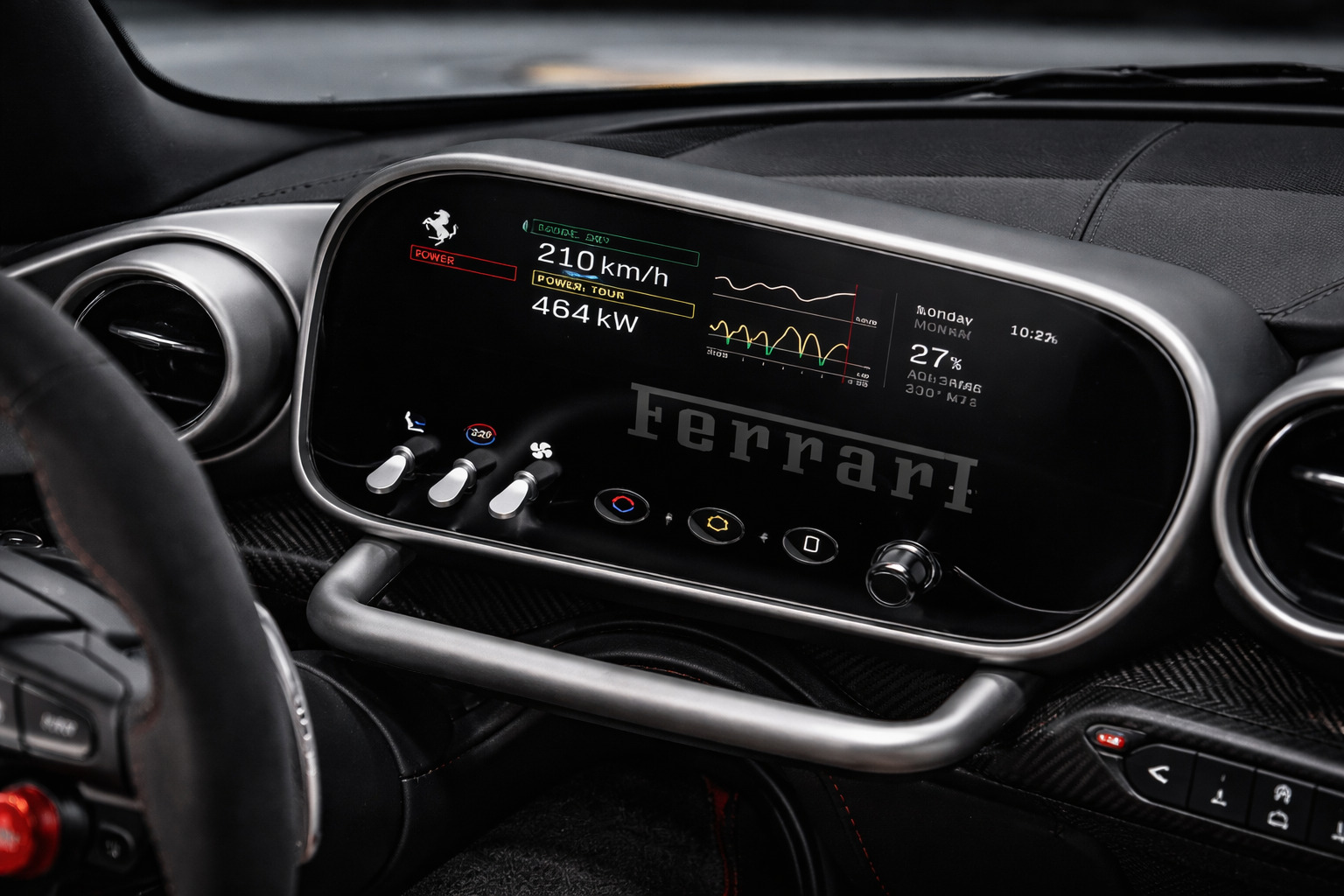
The shift toward screen-only controls was never just about technology. It was about aesthetics.
Car interiors became simplified, almost architectural. Physical buttons were seen as clutter. Screens, on the other hand, offered flexibility — one surface, endless functions.
On paper, it made sense.
In reality, it changed how drivers interact with the car in motion.
Adjusting mirrors, climate control, or even basic settings increasingly requires navigating through layers of menus. What used to be a single tactile action — a button you could find without looking — now demands visual attention.
And attention, in driving, is not a design detail.
It is the core resource.
The Attention Economy Inside the Car
What is becoming increasingly evident is that screens don’t just replace controls — they reshape attention.
Unlike physical buttons, which rely on instinct and muscle memory, digital interfaces demand verification. Every action becomes a two-step process: input, then confirmation. You don’t simply adjust — you glance, process, and often correct.
This introduces a subtle but persistent form of friction.
Individually, these moments seem insignificant. A quick look. A brief adjustment. But in motion, they accumulate into a pattern of repeated distraction — small interruptions that fragment focus over time.
Road safety research consistently shows that even short visual diversions can materially increase risk. When interaction depends on looking rather than feeling, the duration of each glance extends. The driver is not just acting — they are monitoring the interface.
This is not a problem of misuse or carelessness. It is embedded in the design of everyday interaction.
And that is precisely what makes it systemic.
Why Physical Controls Still Matter
Physical buttons offer something screens cannot fully replicate: muscle memory.
Once learned, they allow drivers to operate essential functions without shifting focus. The feedback is immediate, tactile, and predictable.
There is no need to confirm.
This is why safety organisations in Europe are beginning to push back. New evaluation frameworks are placing renewed importance on how quickly and intuitively core controls can be accessed — not just whether they exist.
It marks a subtle but important shift.
The question is no longer: how advanced is the system?
But: how usable is it under real conditions?
The Hidden Problem of Interface Bias
There is a deeper layer to this issue that rarely gets discussed — and it sits at the intersection of design assumptions and human behavior.
Most vehicles are engineered within a global framework where left-hand drive is the default. As a result, the entire interface logic — from screen placement to interaction flow — is implicitly optimized for right-hand use. It is not something drivers are told. It is something they feel.
In right-hand drive markets like Ireland or the UK, this logic quietly breaks.
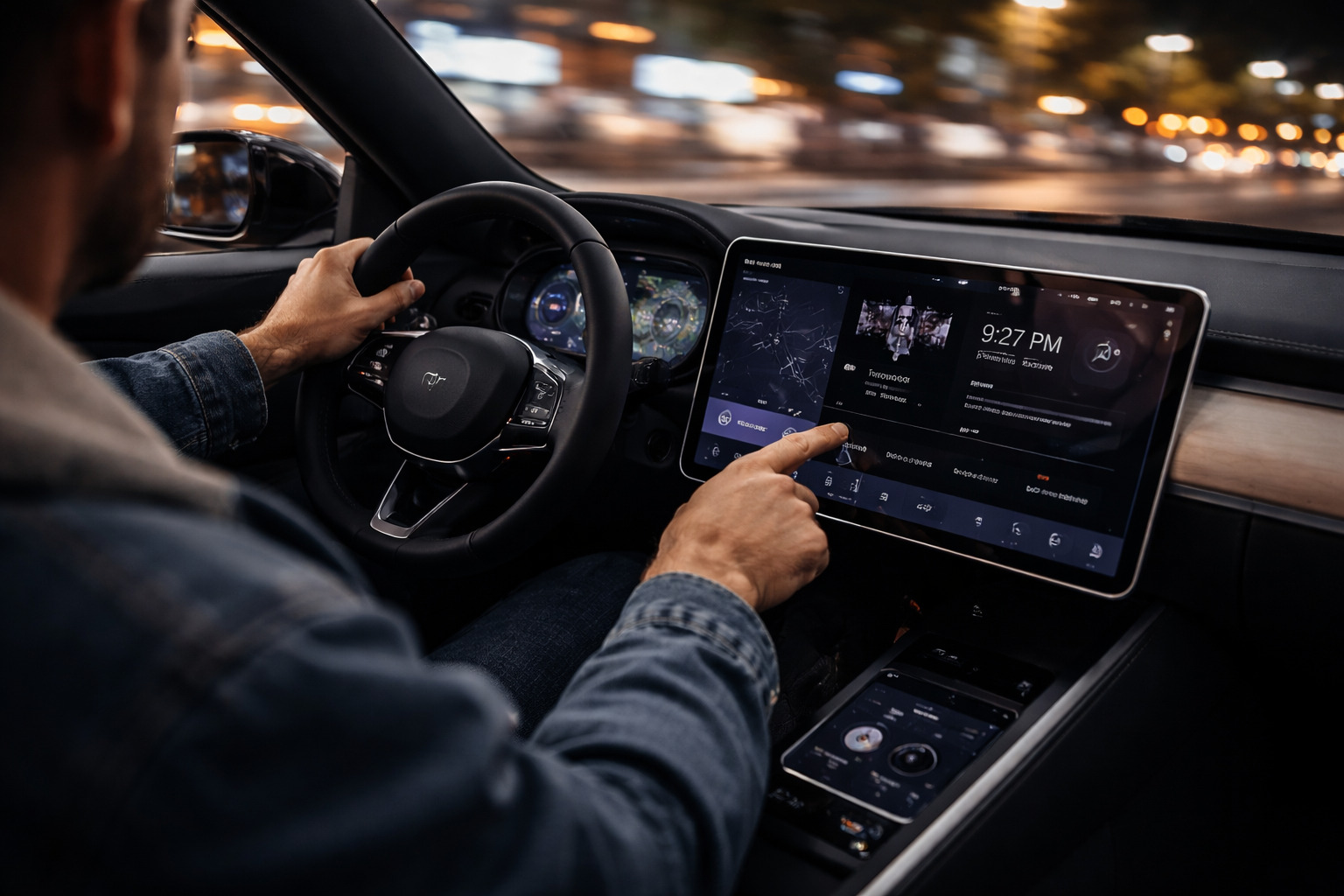
Drivers are required to interact with central screens using their non-dominant hand, often in situations that already demand precision and speed. What might be a fluid, almost automatic movement in one context becomes slower, less certain, and more cognitively demanding in another.
The friction is subtle. It doesn’t stop the interaction — it complicates it. Each movement requires slightly more attention, slightly more correction, slightly more awareness of the body itself. Over time, this shifts interaction from instinctive to deliberate. And that distinction matters. Because driving depends on reducing conscious effort wherever possible. The more actions rely on thought rather than habit, the more mental bandwidth is consumed. On its own, this asymmetry seems negligible.
But layered onto an already complex digital interface, it contributes to a broader pattern: systems that are technically advanced, yet not fully aligned with how people naturally operate. And modern car design is already approaching a critical threshold — where the amount of information, interaction, and decision-making begins to compete with the primary task of driving itself.
Digital Minimalism vs Real-World Complexity
What makes this moment particularly revealing is that it is not a rejection of technology — it is a correction of its overreach.
Screens are not going anywhere. Modern vehicles depend on them for navigation, connectivity, driver assistance systems, and increasingly for over-the-air updates that define the car long after purchase. In Europe, over 90% of new cars now come with fully digital infotainment systems, and large central displays have become a standard expectation rather than a premium feature.
The issue is not their presence.
It is their dominance.
For years, the industry pursued a philosophy of digital minimalism: fewer physical elements, cleaner surfaces, unified interfaces. Inspired in part by smartphones, car interiors were redesigned to feel intuitive, seamless, and visually controlled.
But driving is not a controlled environment.
It is dynamic, high-speed, and cognitively demanding. According to road safety studies, drivers process up to 20–30 distinct pieces of information per minute in complex traffic conditions. In that context, simplicity is not about reducing visual clutter — it is about minimizing effort.
And effort, in a moving vehicle, translates directly into risk.
Research cited by safety organizations such as Euro NCAP indicates that interacting with touchscreen systems can take a driver’s attention away from the road for anywhere between 5 and 40 seconds, depending on the complexity of the task. At motorway speeds, even a two-second glance can mean traveling over 50 meters without full awareness.
This reframes the role of design entirely.
The most efficient interface is not the one that looks the cleanest.
It is the one that requires the least confirmation, the least interpretation, and the least time.
A Quiet Rebalancing
The industry is already responding.
Manufacturers are beginning to reintroduce physical controls — not as a stylistic choice, but as a functional necessity. New models increasingly combine digital interfaces with tactile elements, particularly for high-frequency or safety-critical actions.
This includes:
- dedicated physical buttons for core functions such as climate control and hazard lights
- tactile switches and rollers integrated into steering wheels
- hybrid control systems that allow both touch and physical interaction depending on context
Euro NCAP has reinforced this direction by signaling that future safety ratings will increasingly consider the accessibility and usability of essential controls. In practical terms, this means that cars relying too heavily on screen-based interaction may be penalized in safety assessments.
This is not a return to older design.
It is a recalibration.
A recognition that clarity on a screen does not equal clarity in use.
What This Shift Really Means
Beyond the automotive industry, this shift reflects a broader tension in how digital systems are integrated into everyday life.
Over the past decade, screens have expanded into nearly every environment — from phones and homes to workplaces and now vehicles. Each step was justified by convenience and flexibility. But as these systems become more embedded, their limitations become more visible.
The question is no longer whether something can be digitized. It is whether it should be.
In driving, the answer is increasingly pragmatic. Tasks that require speed, instinct, and minimal cognitive load do not benefit from layered interfaces. They benefit from immediacy.
This is where the current pushback gains its significance. It is not anti-technology.
It is pro-function.
Conclusion
The future of car interiors will not be defined by screens alone.
It will be defined by balance.
Digital systems will remain central, enabling navigation, connectivity, and advanced vehicle intelligence. But they will coexist with physical controls designed for speed, intuition, and reliability under pressure.
Because in a moving vehicle, performance is not measured by how much a system can do.
It is measured by how little it demands from the driver.