
This article includes gambling-related content. Irishblogs.ie is committed to providing accurate and responsible information. To ensure the highest standards of quality and safety, all gambling-related content is curated and verified by industry experts. Please engage responsibly!
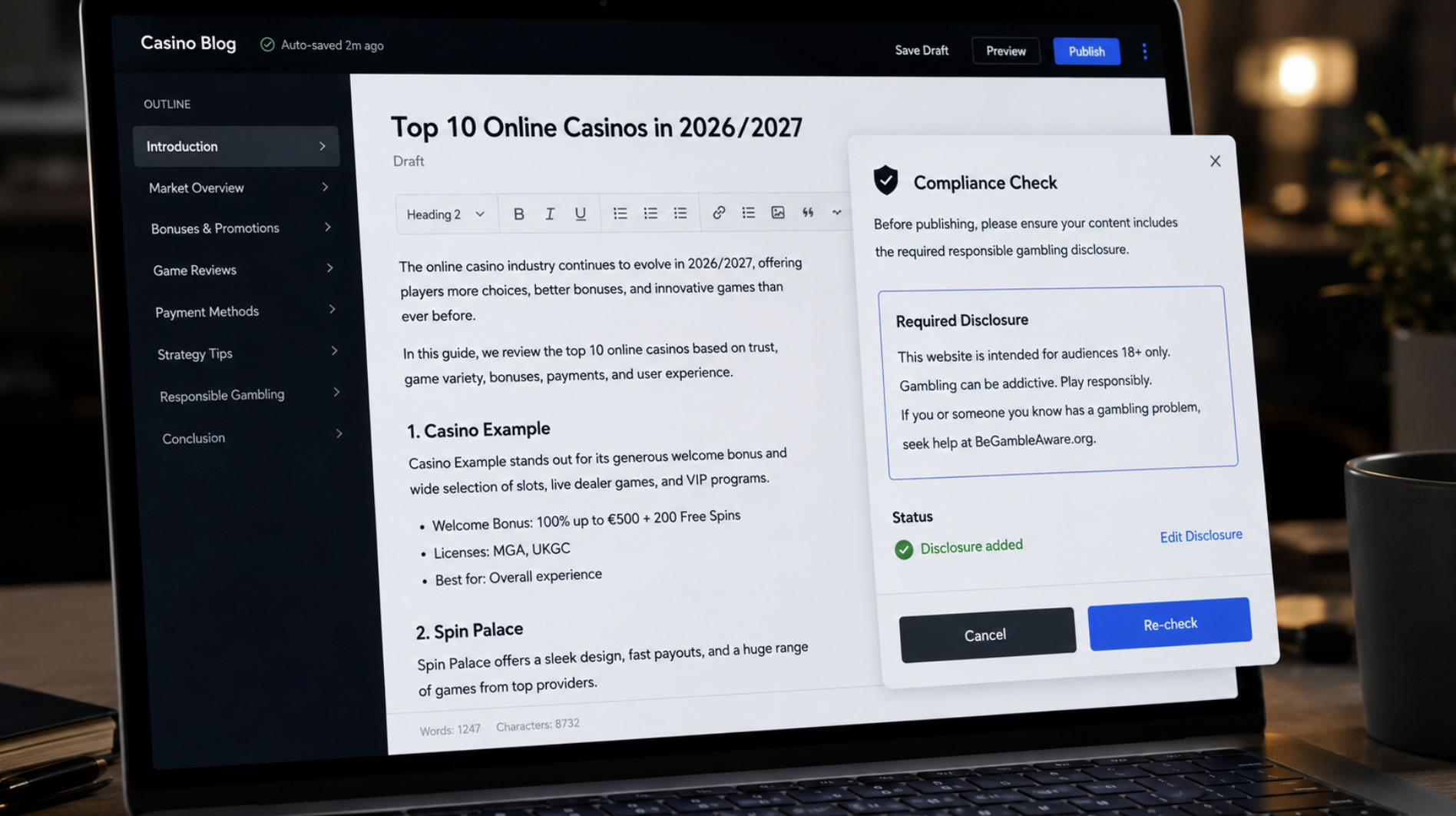
Gambling affiliate industry operated inside
For roughly fifteen years, the Irish gambling affiliate industry operated inside a regulatory vacuum that almost nobody outside the sector understood existed. Affiliates — the publishers, reviewers, comparison sites and content creators who direct traffic to licensed and unlicensed gambling operators in exchange for revenue share — built businesses on the assumption that the rules that applied to operators did not directly apply to them. The Betting Act of 1931 had nothing to say about content publishers. The Gaming and Lotteries Act of 1956 had even less. The marketing codes that emerged through the 2010s were industry self-regulation that affiliates could choose to read or not.
That era ended on 4 February 2026, when Minister for Justice Jim O'Callaghan signed the Commencement Order that brought the Gambling Regulation Act 2024 into force. Section 152 of the Act and the regulations being developed underneath it have, between them, constructed the most consequential regulatory framework for gambling affiliates in any common-law jurisdiction. The Gambling Regulatory Authority of Ireland — GRAI — now has direct statutory authority over how gambling content is produced, promoted and monetised inside the State, regardless of where the operator being promoted is based.
The affiliate sector has not, by every available indication, absorbed this. The trade press has covered the operator-facing parts of the new regime carefully. The affiliate-facing parts have received much less attention, and the consequences are beginning to arrive.
This is a long-read for anyone who writes, hosts or earns income from gambling content connected to the Irish market, and for the broader question of what the new regulatory infrastructure is going to do to a category of online media that has, in 2026, become unexpectedly large.
What Section 152 actually does
The shape of the regulatory change is contained in three operative provisions of the Act and the implementing regulations being phased in through 2026 and 2027.
The first is the definition of an advertisement. Under the previous regime, the question of what counted as gambling advertising was the subject of long-running debate between operators, regulators and the Advertising Standards Authority for Ireland. The 2024 Act resolves the debate by adopting a deliberately broad definition that captures editorial-style content, comparison tables, review sites, video reviews, podcasts, social media posts and any other form of content that promotes specific operators or specific products. The crucial threshold is whether the content is intended to encourage participation in gambling. If a court would find that this was a purpose of the content, the content is an advertisement, and the full advertising regime applies.
The second is the identity of the responsible party. Under the previous regime, the legal liability for advertising compliance sat almost entirely with the operator. The affiliate could publish more or less what they wanted, and any regulatory consequence fell on the gambling company whose product was being promoted. The new Act makes the affiliate a co-responsible party. A non-compliant advertisement now produces administrative liability for the affiliate as well as the operator. The fines, under the Act's general enforcement provisions, can reach twenty million euro or ten per cent of annual turnover, whichever is greater.
The third is the disclosure regime. Affiliates earning revenue share or fixed payment from gambling operators are now required to make this relationship clear in any content that promotes the operator. The disclosure must be prominent, in plain language, and present at the point of any link or call-to-action. The standard is closer to the United States Federal Trade Commission's influencer disclosure requirements than to the looser conventions that had previously prevailed in Europe.
These three changes, taken together, do not technically prohibit gambling affiliate marketing in Ireland. They do, however, restructure it in a way that makes the previous business model substantially more difficult to operate at the cost levels the industry had become used to.
Who is affected, and how
Three groups of publishers face different practical problems under the new framework.
The first is the comparison sites and review aggregators that produce structured rankings of licensed Irish operators. These sites are the most directly addressed by the new regime. They are advertising under the broad definition, they are co-responsible parties under the liability provision, and they require comprehensive disclosure. The largest sites in the category have, in most cases, retained legal counsel and are in the process of restructuring their content to comply. The smaller sites, including many one-person operations that built audiences during the 2018-2024 period, are facing a more difficult adjustment. Several have already taken Irish-facing content offline rather than complete the compliance process.
The second is the content creators and personalities who produce gambling-related video, podcast and social media content with Irish audiences. The Twitch streamers, YouTube reviewers and TikTok casino-content creators who built followings during the pandemic-era boom face a particular challenge. The new disclosure regime applies to them. The advertising regime applies to them. The watershed rules that prohibit gambling content on broadcast media between 5:30 a.m. and 9 p.m. do not directly apply to on-demand platforms, but the broader prohibition on content targeted at minors does. Each of these elements, individually, requires adjustment. Collectively, they require a different relationship with the platform infrastructure than many creators have had.
The third is the non-specialist content publishers who produce gambling content as part of broader output. Lifestyle blogs, sports media, financial commentary, comedy podcasts and general-interest publications that occasionally cover gambling or accept gambling affiliate links face the same compliance regime as specialist gambling publishers. The cost of compliance is much higher relative to the revenue that gambling content generates for these publishers, and several mainstream Irish media outlets have already exited the category entirely rather than maintain the compliance infrastructure.
The cumulative effect is a meaningful redistribution of the Irish gambling content economy. The category is not disappearing. It is consolidating around the publishers who have the resources to comply, and contracting at the edges.
The licensing question that nobody is talking about yet
There is a provision of the Act that has not yet been enforced but that may, when activated, change the picture again. The Gambling Regulation Act 2024 provides for a category of licence called the B2B affiliate licence. The provisions for this licence are written into the legislation but the practical implementation has been deferred while GRAI focuses on the first wave of operator licences. The Authority has indicated that affiliate licensing will become a serious priority in 2027.
When affiliate licensing comes online, the regulatory picture will shift again. Affiliates who reach a certain scale of revenue, traffic or commercial relationship with licensed operators will need to apply for a B2B licence, satisfy the fit-and-proper-person requirements, pay an annual fee, and submit to ongoing compliance monitoring. The cost of the licence itself is expected to be in the low five figures annually. The cost of the compliance regime around it is likely to be substantially higher.
For affiliates who have built businesses on revenue share with offshore operators not licensed by GRAI, the position will be especially difficult. The Act does not directly criminalise the affiliate relationship with offshore operators, but it does provide GRAI with substantial tools to make that relationship operationally costly. Payment service providers can be required to refuse processing. Search engines can be required to delist. Hosting providers in Ireland can be required to take action. None of these are theoretical capacities. The Authority has signalled clearly that it intends to use them.
What this means for the broader media ecosystem
The affiliate regulation is not, on its own, a story about gambling. It is the first concrete application of a regulatory model that other categories of online content are likely to face in the years ahead. The combination of broad-definition advertising, co-responsible parties, mandatory disclosure and licensing thresholds is a template that policymakers in finance, alcohol, pharmaceuticals, cosmetics and several other categories are studying closely.
The Irish case is being watched with particular attention because the Irish state has consolidated regulatory authority over both the operator and the content layer in a single agency. Most comparable jurisdictions, including the United Kingdom, have separated the two functions across multiple regulators, which complicates enforcement. The Irish model, by giving GRAI authority over both, produces the possibility of much faster and more coordinated enforcement than has been historically achievable.
This is a strength from a public-interest perspective. It is a real complication for affiliates and content creators who operate at the boundary between editorial and commercial speech. The next few years will, in significant part, be the working-out of where that boundary is in the new system.
What an affiliate should be doing in May 2026
Three practical actions are reasonable now for any publisher with Irish-facing gambling content.
The first is a disclosure audit of all existing content. Any piece of content that links to a gambling operator, recommends a gambling operator, or discusses specific operators in a way that could be construed as promotional should have a clear, prominent, plain-language disclosure of any commercial relationship. The standard to adopt is the maximum requirement under the new regime, which is more conservative than the legal minimum but provides margin against ambiguity in enforcement.
The second is a legal review of contractual relationships with operators. Many affiliate agreements were written under the previous regime and contain language that is now non-compliant. New agreements should explicitly allocate compliance responsibility, provide indemnification appropriate to the new co-responsible-party regime, and reflect the disclosure standards required by GRAI.
The third is infrastructure preparation for affiliate licensing. Publishers above the likely licensing threshold should expect to need it within the next eighteen months and should begin preparing the documentation now. Corporate structure, beneficial ownership disclosure, anti-money-laundering compliance and operational records will all be required. The work is substantial and is much easier to do over twelve months than in the three months between the licensing application opening and the deadline.
The honest summary
The Irish gambling affiliate industry of 2026 is in a different category, legally and operationally, than the Irish gambling affiliate industry of 2024. The change has been built incrementally through legislation, regulation and statutory instrument, and the cumulative effect is a far more constrained and more closely supervised environment than the one most operators in the space remember.
The publishers who will continue to operate productively in the new environment are the ones who treat compliance as part of the product rather than as an overhead. The publishers who will exit, voluntarily or otherwise, are the ones who assume the new rules will not be enforced. Anne Marie Caulfield's public statements over the past four months have been consistent. The enforcement will come. The first enforcement decisions, when they arrive, will set the tone for the rest of the regime.
For an affiliate sector that is, in many cases, still operating on the assumption that the old rules continue to apply, the next twelve months are going to be uncomfortable. The information is available. The reading is required. The cost of waiting is rising every month.