
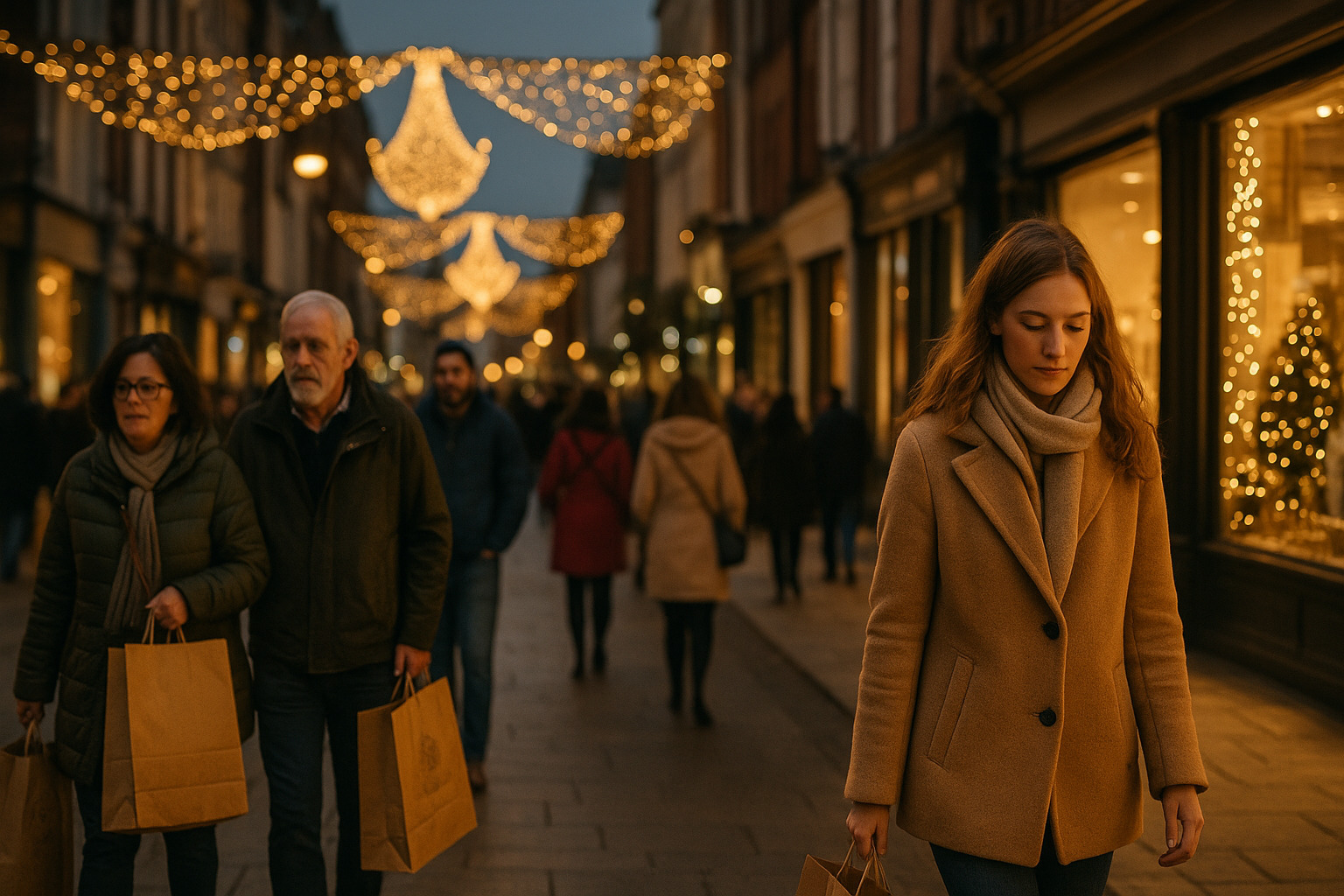
Ireland has entered what economists and cultural observers now call the Considered Winter Economy, a seasonal shift defined not by buying less but by buying with purpose. It is not a recession-triggered hesitation, nor a sign of declining holiday spirit. It is a quiet cultural recalibration that touches everything from retail to rural life.
A Cultural Turn Toward Meaningful Consumption
Irish shoppers this December display a striking pattern: they still spend, but not impulsively. They ask questions. They compare craftsmanship. They trace the origin of materials. They want to know who stands behind a product, not just what it costs.
The shift is partly emotional. The past few years were marked by global instability, economic pressure, and a constant digital noise that pushed people toward simplicity. But Ireland responds to complexity in its own distinct way — not by rejecting consumption, but by rooting it in meaning.
Buying becomes a way to vote for values.
Local Makers at the Heart of the Season
If any group is quietly celebrating this December, it is Ireland’s independent artisan community.
Across Dublin, Limerick, Donegal, Galway and the rural West, local makers record an increase in foot traffic and online orders. Not a fleeting trend — a sustained, noticeable rise in attention.
Irish people are choosing:
– handwoven scarves over factory-produced knitwear,
– ceramic mugs from a Mayo potter instead of imported glassware,
– natural candles poured by a family business in Kerry,
– jewellery crafted in small coastal studios rather than mass-market pieces.
The economic motivation is only part of the story.
There is also a cultural instinct at work — an old, deep-rooted respect for craftsmanship that Ireland never fully lost. In a season traditionally dominated by scale and speed, handmade objects feel like an anchor. They carry the warmth of human work, the Irish sense of place, the memory of rural traditions. Buying local becomes a quiet return to roots.
Sustainable Gifting Takes the Lead
“Sustainability” used to be a marketing slogan.
In December 2025 it is a lived behaviour.
Irish shoppers now gravitate toward:
– durable wool items,
– natural cosmetics,
– organic hampers,
– recycled crafts,
– experience-based or digital gifts with minimal environmental footprint.
Sustainability here is not a strict ideology but an intuitive reaction. People feel overwhelmed by objects that break, fade, or end up in storage boxes. The emotional desire is simple: fewer things, more meaning.
The logic is clean and unmistakably Irish:
A good gift should live, not linger.
Quality Over Quantity: The New Holiday Equation
Retailers across Ireland are observing a pattern that feels subtle on the surface but speaks volumes underneath. The average basket value is climbing, yet the number of items inside it is shrinking. This isn’t a sign of reduced enthusiasm or financial caution; it is the opposite. Irish consumers are deliberately upgrading, choosing fewer things but choosing them well. Years of rising prices have taught people to value longevity over novelty. A distinctly Irish cultural aesthetic — one that naturally gravitates toward honest materials and quiet authenticity — reinforces this instinct. And the digital sphere, which once pushed maximalism and endless consumption, now promotes a softer rhythm, encouraging people to curate rather than accumulate. The result is visible everywhere: shoppers lingering longer in stores, asking about craftsmanship and materials, and willingly investing in something built to last. This December, quantity feels almost irrelevant. Quality, story, and origin define the mood of the season.
Rural Ireland Rises Into Focus
This mindful approach to winter spending has had an unexpectedly powerful effect on rural Ireland. Small workshops from Connemara to Clare, from Sligo to West Cork, and across the Aran Islands are experiencing a renewal — not a spike, not a trend, but a steady, thoughtful wave of attention. Social media helped shine light on these makers, but the real engine is cultural. Rural craftsmanship carries a sincerity that mass production can never imitate. When someone buys hand-dyed tweed from Donegal, a wooden ornament carved in a family shed in Sligo, a small-batch bottle from a micro-distillery in West Cork, or a hamper filled with farm-made preserves, they are doing more than purchasing an item. They are choosing a piece of Ireland itself — its landscape, its knowledge passed down through generations, its sense of place. The idea of “supporting the countryside” has transformed into something much stronger: an affirmation of identity, a decision to root the holiday season in the textures of Irish life rather than imported uniformity.
A Mindful Winter: The Emotional Shift
Beneath all these economic signs lies an emotional truth. Ireland is tired — tired of political intensity, digital overload, environmental anxiety, and the constant stream of information that leaves little room to breathe. December, with its natural symbolism of ending and beginning, becomes a refuge, a space where people can reclaim rhythm and balance. Across the country, individuals are choosing quieter celebrations, evenings without rush, smaller circles with deeper meaning. Families seek moments that feel real rather than obligatory. Gifts, too, have shifted from gestures of volume to gestures of understanding — things that reflect emotional landscapes rather than social expectations. The change is not dramatic or loud; it unfolds the way Ireland itself often moves through the world: gently, warmly, and with steady conviction. But it is unmistakably here. A new kind of winter has settled over the country, one that values presence more than pressure, intention more than excess.
What This Means for Ireland
The shift unfolding in Ireland this winter is far more than a seasonal trend. Economists quietly describe it as a healthy correction — a sign that the Irish market is maturing, not slowing. Sociologists view the same behaviour as a demonstration of cultural resilience, the ability of a nation to adapt without losing itself. For small businesses, especially in rural counties, this new consumer mindset feels like a lifeline: a steady stream of people choosing authenticity over volume, craft over convenience. And for ordinary consumers, the change brings a sense of relief. There is no longer pressure to chase endless sales, to accumulate objects, or to measure affection through quantity. Instead, consumption becomes a relationship — an encounter between buyer and maker, between region and community, between tradition and the present moment. December stops behaving like a race and begins to resemble a gentle act of choosing: choosing what matters, choosing what lasts, choosing what feels true. Ireland, without drama or declarations, is redefining winter through intention.
A New Irish December Identity
If Ireland once hurried through the holiday season with arms full of bags and calendars packed to the edge, now it moves through December differently — more slowly, with intention, with a softness that feels almost protective. The winter economy is quieter not because people are spending less, but because they are choosing with more awareness, placing meaning where there used to be momentum. Consumption has shifted from a reflex to a relationship, from accumulation to connection.
And perhaps that is the most Irish instinct of all: the understanding that the worth of a thing is never measured by the price attached to it, but by the warmth it carries, the story it holds, and the way it threads people back to one another.