
This article includes gambling-related content. Irishblogs.ie is committed to providing accurate and responsible information. To ensure the highest standards of quality and safety, all gambling-related content is curated and verified by industry experts. Please engage responsibly!
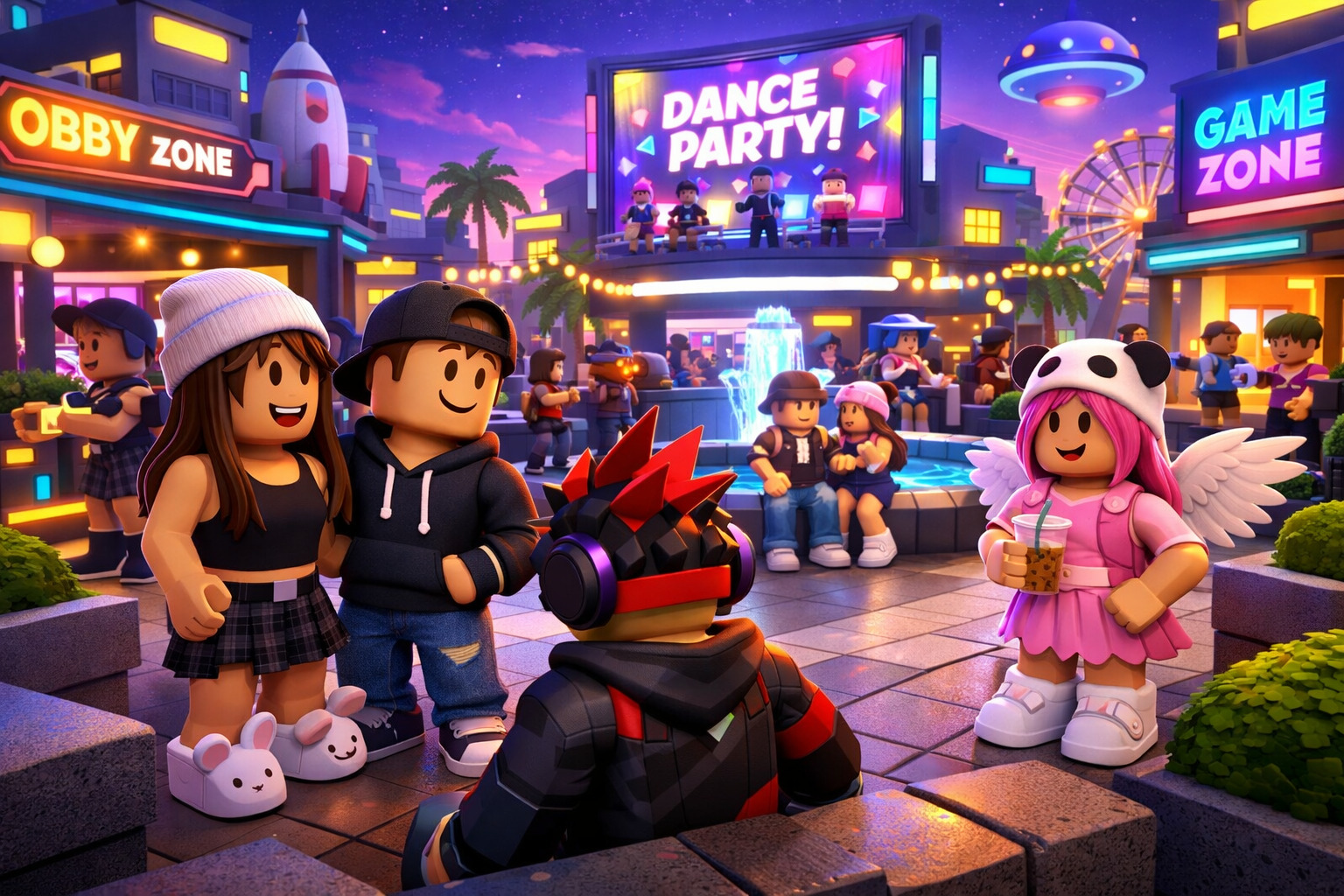
By 2025, Roblox has evolved into something far more complex: a persistent social world where millions of people don’t just play, but spend time, build identity, form communities and return daily. It is no longer defined by gameplay mechanics or visual polish, but by presence. Roblox has quietly become one of the most active social environments on the internet.
What makes Roblox different from traditional online games is not production value or narrative ambition. It is structure. Roblox does not ask players to complete experiences — it invites them to inhabit them. The platform is built around continuity rather than endings, participation rather than mastery.
To understand the scale of this shift, the numbers matter.
Roblox by the Numbers (2025)
- 111+ million daily active users worldwide
- 380+ million monthly active users
- 67% of users are aged 13 and older
- Millions of user-generated experiences, updated daily
- Average user visits 20+ experiences per month
- Top Roblox games rival or exceed concurrent player counts of major AAA titles
These figures place Roblox not just among the largest gaming platforms, but among the largest social platforms in the world.
What these numbers reveal is not simply popularity, but habit. Roblox is something people return to every day. Not because there is always something new to win, but because there is always somewhere to be. Spend time inside Roblox today and the pattern becomes clear. Many users are not focused on objectives or progression. They are customising avatars, joining voice chats, attending virtual events, testing experimental games made by other players, or simply existing together in shared spaces. The experience feels closer to a digital neighbourhood than a game lobby.
This is why Roblox remains one of the most discussed platforms on forums, Discord servers and social media. The central question is no longer “Is Roblox good?” but “What’s happening inside Roblox right now?”
The answer changes constantly — and that is precisely the point.
Roblox thrives on user-driven culture. Trends emerge organically, peak quickly and dissolve just as fast. One week it’s horror experiences. The next it’s fashion shows, role-play cities or social deduction games that resemble improv theatre more than traditional gameplay. Players are not just consuming content; they are producing and remixing it at scale. This sense of ownership is critical. Roblox gives players agency. Anyone can create. Anyone can fail. Anyone can improve. In an internet dominated by polished performance and algorithmic perfection, Roblox normalises experimentation and imperfection. Bad games coexist with brilliant ones. Awkward social moments are part of the experience. Nothing feels irreversible.
That flexibility makes Roblox especially attractive to younger generations navigating unstable offline realities. Housing is expensive. Cities feel temporary. Social spaces fragment easily. Roblox offers continuity. You log in and your world is still there. Your avatar remembers you. Your friends are online. Your place hasn’t disappeared.
This stability is not escapism — it is emotional infrastructure.
The platform also functions as a training ground for social skills rarely acknowledged in traditional gaming discourse. Collaboration, leadership, moderation, conflict resolution and even basic economic thinking are practised constantly. Entire communities self-organise, govern themselves and adapt in real time. At the same time, Roblox raises uncomfortable questions. When social life becomes embedded in privately owned platforms, issues of safety, moderation and monetisation acquire real weight. These debates now dominate player discussions not because users are hostile to Roblox, but because they are invested in it. People argue about rules because the space matters to them.
This is where many critics misread the platform. Roblox is mocked for its simplicity, yet that simplicity is strategic. It lowers the barrier to entry and shifts value away from spectacle toward participation. Roblox does not compete with AAA games on graphics. It competes with social media, streaming platforms and endless scrolling — and often wins.
You don’t just watch culture on Roblox. You build it.
You don’t just follow trends. You generate them.
That is why Roblox has outgrown the label of “game.” It functions as a social system — one that blends play, creation and community into a single persistent environment.
Roblox’s success is not driven by hype, but by structural insight. It understands how people increasingly want to interact online: not through disposable experiences, but through persistent environments. Users are drawn to spaces that retain memory, support continuity and allow presence without performance. Roblox provides this imperfectly and at scale — which is precisely why it is not ageing out of relevance, but evolving alongside its audience.