
This article includes gambling-related content. Irishblogs.ie is committed to providing accurate and responsible information. To ensure the highest standards of quality and safety, all gambling-related content is curated and verified by industry experts. Please engage responsibly!

The payment methods Irish players actually use
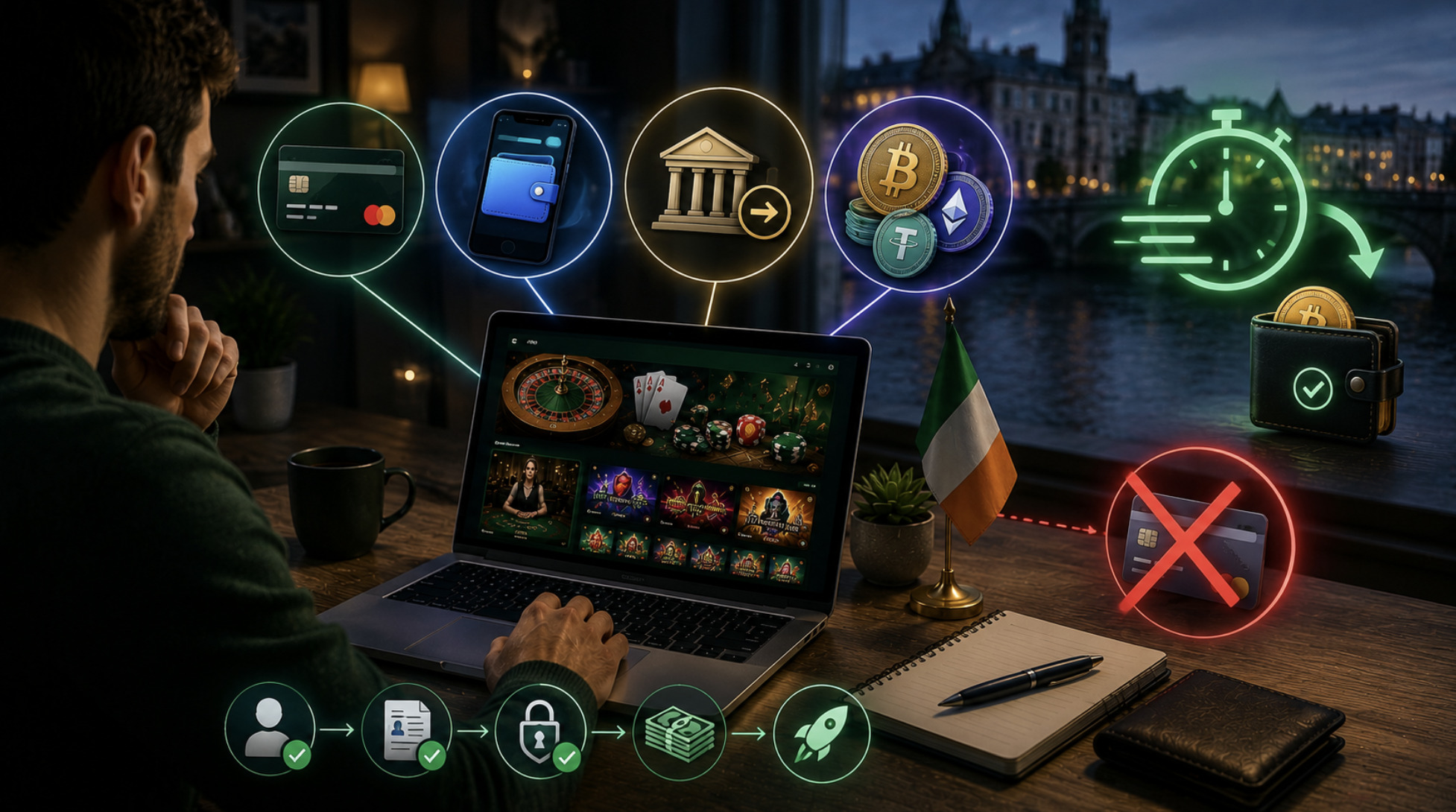
Start with the menu, because the choice of method drives everything that follows. Broadly, players deposit and withdraw through four families of method, each with its own trade-offs. Debit cards are the familiar default — widely accepted, instant to deposit, and requiring no extra account — though withdrawals back to a card tend to be the slowest of the modern options. E-wallets, the intermediary services that sit between your bank and the casino, have long been popular precisely because they are fast in both directions and add a layer of separation between your bank account and the gambling site.
The other two families are bank transfer and cryptocurrency. Direct bank transfer, including the instant bank-payment services that have become common, appeals to players who want to move money straight from their account without an intermediary, and it is trusted for larger sums. Cryptocurrency — Bitcoin, Ethereum and increasingly stablecoins like USDT — has grown from a fringe option into a mainstream one, valued above all for withdrawal speed. The right choice depends on what a player prioritises: familiarity, speed, privacy, or the size of the transaction. There is no single best method, only the best method for a given priority, which is why understanding the trade-offs matters more than chasing whichever option a site pushes hardest.
The credit-card ban and why it matters
The single most important recent change to how Irish players can pay is a regulatory one, and it is worth understanding clearly. As part of the new framework overseen by the Gambling Regulatory Authority of Ireland, the use of credit cards for gambling has been banned. The reasoning is direct: gambling with a credit card means gambling with borrowed money, which can turn a bad session into a debt, and removing the option is a deliberate harm-reduction measure aimed at keeping people from betting funds they do not actually have.
For players, the practical effect is simple but real: at licensed sites operating under the new rules, you cannot fund your play with a credit card, and will need to use a debit card, e-wallet, bank transfer or another permitted method instead. This is not a limitation to resent so much as a protection to understand — it exists to stop the specific harm of gambling on credit. It also neatly illustrates why the regulatory changes and the payments picture are connected: the rules about how you can pay are now part of the broader player-protection framework, a shift covered in detail in how the new GRAI gambling licences affect Irish players. The way you move money is no longer just a convenience question; it is partly a regulated one.
What actually determines withdrawal speed
Ask players what frustrates them most and withdrawals will top the list, so it is worth being precise about what really governs how fast you get paid — because it is rarely just the method. The first and biggest factor is verification. The first time you withdraw, a casino will run identity checks (KYC), and until those are complete the payout waits, no matter which method you chose. This one-time step is why a first withdrawal almost always feels slow while later ones are quicker, and preparing your documents in advance is the single most effective way to avoid the delay.
Once verification is done, the method takes over as the main variable. Crypto withdrawals are typically the fastest, often settling in minutes to an hour, because they bypass the traditional banking rails entirely. E-wallets are usually next, frequently landing within a day. Card withdrawals and bank transfers are the slowest, commonly taking several business days, because they run through conventional banking processes that were never built for speed. There is also the casino's own internal processing time — the window in which it reviews and approves a withdrawal before it is even sent — which varies by operator and sits on top of the method's own speed. The honest summary is that payout speed is a chain: verification, then operator processing, then the method itself, and the slowest link sets the pace. This is exactly the kind of practical signal experienced players weigh, as explored in what experienced players usually look for before choosing an online casino.
Crypto, speed and the fast-payout trend
Because withdrawal speed is such a common pain point, it has become a genuine point of competition, and cryptocurrency sits at the centre of that. The appeal is straightforward: by settling on a blockchain rather than through a bank, crypto withdrawals sidestep the multi-day processing that makes card and bank payouts feel sluggish, which is why so many operators marketing themselves on speed lean heavily on crypto. Stablecoins in particular — cryptocurrencies pegged to the value of a currency like the dollar — have gained ground because they combine the settlement speed of crypto with far less price volatility than Bitcoin.
Fast-payout, crypto-friendly brands are increasingly common, and a representative example of that European style of operator is Bearo casino, which lists Bitcoin, Ethereum and USDT alongside traditional cards and e-wallets, and markets crypto withdrawals that settle far faster than a bank payout would. It is worth being clear-eyed about two things here. First, crypto's speed advantage is real, but it still comes after verification — no method skips KYC on a first withdrawal. Second, an offshore, crypto-friendly brand is not the same as a locally licensed one operating under the new framework; the speed and flexibility come without the protections a licensed site is required to provide. For a player, crypto is a genuinely fast option to understand, not a shortcut around the checks or the trade-offs that apply to where you choose to play.
Practical guidance for Irish players
Pulling it together, a few practical habits make the whole payments experience smoother. Choose your method by your actual priority: cards for familiarity, e-wallets for a fast all-round balance, bank transfer for larger sums, crypto for the quickest withdrawals — and remember that the credit-card route is no longer available for gambling at licensed sites. Complete your identity verification early, ideally before your first withdrawal, so the one-time KYC delay is behind you rather than ahead of you. And read the fine print on limits and fees for your chosen method, since minimums, maximums and processing windows vary and can catch out an unprepared player.
Above all, keep the payments question in proportion. Fast withdrawals and slick deposits are genuinely nicer, but they are a feature of the experience, not a reason to gamble more or a measure of a good session. The universal rules matter most: gambling is entertainment, never a way to make money or recover a loss, and the healthiest approach is to set deposit and time limits before you play and treat any winnings as a bonus rather than a plan. The new credit-card ban is itself a reminder that how money moves and how players are protected are now bound together — and that the safest play is always the one made within limits you have set yourself. If gambling stops being fun, free and confidential support is available; setting limits and taking breaks is always the stronger move.
Frequently asked questions
Can you use a credit card to gamble online in Ireland? No. Under the framework overseen by the Gambling Regulatory Authority of Ireland, using credit cards for gambling has been banned as a harm-reduction measure, since it prevents people gambling with borrowed money. Players at licensed sites use debit cards, e-wallets, bank transfer or other permitted methods instead.
What is the fastest way to withdraw from an online casino? Cryptocurrency withdrawals are typically the fastest, often settling within minutes to an hour, because they bypass traditional banking. E-wallets are usually next (often within a day), while card and bank withdrawals are slowest, taking several business days. However, the first withdrawal always waits on one-time identity verification (KYC), whatever the method.
Why is my first casino withdrawal so slow? Because of a one-time identity verification (KYC) check that most casinos run before releasing a first payout. Until it is complete, the withdrawal waits regardless of method. Completing verification early — before you request your first withdrawal — is the most effective way to avoid the delay, after which later payouts are usually faster.