
This article includes gambling-related content. Irishblogs.ie is committed to providing accurate and responsible information. To ensure the highest standards of quality and safety, all gambling-related content is curated and verified by industry experts. Please engage responsibly!
What the Gambling Regulatory Authority of Ireland does
GRAI is the licensing body for every form of commercial gambling offered to people in the State — retail betting, remote betting, gaming, and the operation of gambling products by lottery and charitable bodies within defined limits. Its remit covers both the licence itself and the conduct of the licensee afterwards.
The Authority's Strategy Statement for 2025 to 2027 set out an operating model built around three functions: licensing, supervision through an annual inspection programme, and enforcement through dedicated investigation units. The inspection programme was scheduled to begin in July 2026, with standing investigation and enforcement units established in the third quarter of the year.
The scope is broader than traditional bookmaking. In July 2026 the Authority indicated it may bring proceedings against a prediction market operator, an early signal that products which do not describe themselves as gambling can still fall inside the statutory definition.
The licensing timeline and what changed on 1 July
The rollout has run to a published sequence. GRAI opened its application portal to betting and gaming operators on 5 February 2026. Applicants seeking a remote betting licence were required to publish statutory legal notices by 3 June 2026 in order to be processed in time for the first issuance date.
The first remote betting licences were issued from 1 July 2026. From that date, offering online betting to customers in Ireland without a GRAI licence became an enforcement matter rather than a grey area.
In-person operators follow a separate track. Bookmakers and retail gaming premises holding permissions from the Revenue Commissioners transition into the GRAI regime by 1 December 2026. Operators running both channels need to manage two application processes with different deadlines.
What a licence costs an operator
Fees are governed by the Gambling (Licence Application Fees) Regulations 2026, made by GRAI under sections 9 and 38 of the Act and published in Iris Oifigiúil on 13 February 2026.
Application fees are tiered by the size of the applicant's Irish-facing business in the preceding year, with new entrants assessed on estimated first-year figures. The baseline application fee for a remote licence has been reported at €20,000 — a substantial increase on the cost of the previous Revenue-administered permissions, and a point of sustained objection from smaller operators during consultation.
Licences run for three years, with renewal fees to be set by later regulation. Separate annual charges fund the Authority's operating costs.
The fee basis itself has moved. After industry consultation raised concerns that turnover overstated the commercial scale of low-margin operators, GRAI indicated it would reassess the structure to work from gross gambling revenue rather than turnover. The practical effect is to bring smaller operators' fees closer to their actual income.
The consumer protections now in force
Several provisions changed the day-to-day experience of gambling in Ireland rather than merely the paperwork behind it.
Credit card gambling is banned. Operators cannot accept credit as a funding method, which removes the most direct route from a losing session to consumer debt.
Age verification is mandatory rather than nominal. Licensees must verify age before allowing a customer to gamble, and offering gambling to a person under 18 is a licensing breach.
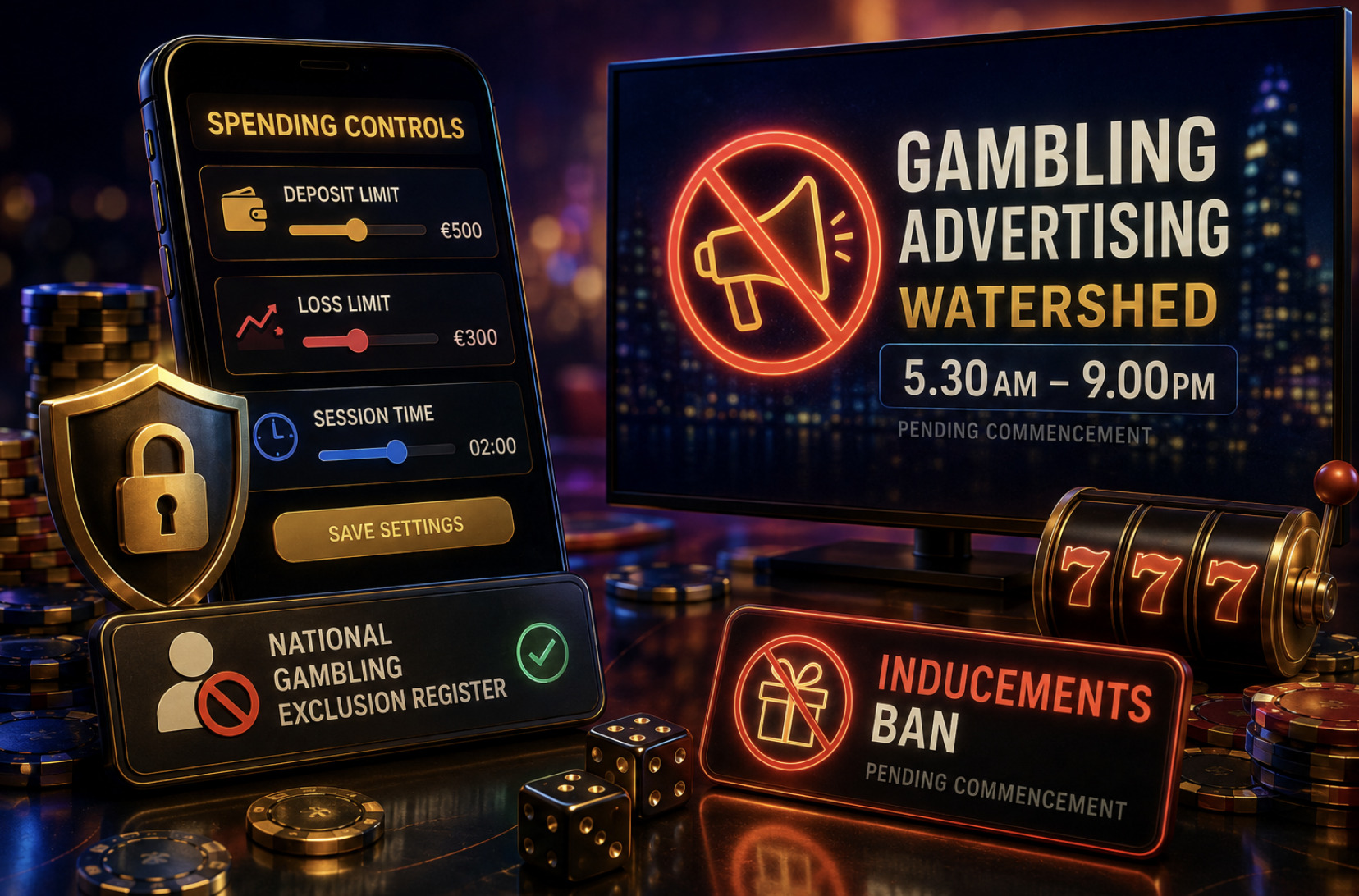
Every licensee must provide spending control tools: deposit limits, loss limits and session time controls. These are obligations on the operator, not optional features. A licensed operator that fails to make them available is in breach regardless of whether any customer requests them.
GRAI is also establishing a National Gambling Exclusion Register, comparable in function to GamStop in the United Kingdom. Every licensee is required to participate, meaning a single self-exclusion applies across all licensed operators rather than requiring the customer to approach each one separately.
The advertising watershed and the inducements ban
Two of the most contested provisions in the Act concern marketing, and both should be understood as pending rather than active.
The Act provides for a watershed prohibiting gambling advertising on television and radio between 5.30am and 9.00pm. In effect this confines broadcast gambling advertising to late evening and overnight. Legal commentary through 2026 has expected commencement during the year, but the provision had not been fully commenced at the time of writing.
The Act also restricts inducements, with particular attention to targeted offers. The clearest example given during the legislative debate was the practice of sending free bets to a customer showing signs of harmful gambling, often precisely when that customer was attempting to reduce their activity. The restriction is aimed at the targeting, not merely at promotional offers in general.
Separately, the Act creates a Social Impact Fund financed by annual contributions from licensed operators, calculated by reference to turnover. The fund is intended to support research, education and treatment relating to gambling harm.
Enforcement and penalties
The penalty regime is the sharpest departure from the previous arrangement. GRAI can impose administrative sanctions of up to €20 million, or 10% of an operator's turnover, whichever is the higher figure.
For a large international operator the percentage limb is the binding one, which is the point of drafting it that way. A fixed cap would have been absorbed as a cost of business by the largest licensees. Tying the ceiling to turnover means the maximum exposure scales with the operator.
Alongside financial sanctions, GRAI holds licensing powers — conditions, suspension and revocation — that carry more commercial weight than any fine for an operator whose Irish business depends on continued authorisation.
What is still to come
The regime is not finished. Renewal fee regulations, the full commencement of the advertising and inducements provisions, and the operational launch of the exclusion register all remain in progress. Further regulations are expected as GRAI completes the phased commencement of the Act.
For consumers, the practical checks are straightforward: confirm that an operator holds a current GRAI licence, use the deposit and loss limit tools rather than relying on self-discipline, and treat any operator still offering credit card funding to Irish customers as operating outside the regime.