
This article includes gambling-related content. Irishblogs.ie is committed to providing accurate and responsible information. To ensure the highest standards of quality and safety, all gambling-related content is curated and verified by industry experts. Please engage responsibly!
The GAA preempted this. In a decision that received very little attention outside the gambling industry trade press at the time, the Association formally ended all commercial relationships with betting operators in 2018, eight years before the legislation that would have forced the question. The official language at the time talked about customer protection and the social responsibilities of an organisation with members under the age of eighteen at every level of the structure. The unofficial language, available to anyone who spent ten minutes in a clubhouse, was simpler. The GAA understood, before most national sporting bodies in Europe, that the optics of a county jersey carrying the name of a bookmaker were going to become permanently bad. They left while the market was strong enough to absorb the gap.
What the Association quietly figured out
The GAA's decision looks more impressive in 2026 than it did in 2018. Eight years ago the alternative sponsorship money was real and accessible. Credit unions, financial services groups, food and beverage brands, energy companies and a growing wave of tech firms with an interest in the diaspora market were all viable replacements. The Association moved the All-Ireland Hurling sponsorship to a credit union network, secured a long-running football sponsorship from an insurance brand, and absorbed the rest into local and regional deals.
The financial damage was visible but not catastrophic. The reputational dividend, which is harder to quantify but easier to observe, was real. When the gambling regulator finally arrived in 2026, the GAA was the only major Irish sporting body that did not have to write a transition plan. It had already lived through eight years of the post-gambling sponsorship economy.
This is the part of the story that the League of Ireland does not have.
The structural difference no statement can soften
The League of Ireland is not the GAA, and the comparison is not entirely fair. The Association is the largest sporting organisation in the country, with somewhere between four hundred and fifty thousand and five hundred thousand members across its clubs, a national broadcasting deal of substantial size, and a property portfolio that includes Croke Park. Its commercial leverage is qualitatively different from any other Irish sporting body's. The League of Ireland is structured almost as the inverse. Twenty senior clubs across two divisions, most of them operating on annual budgets that would not pay the wage bill of a mid-table Championship side in England, with broadcasting revenue that is meaningful only in the context of how small it is.
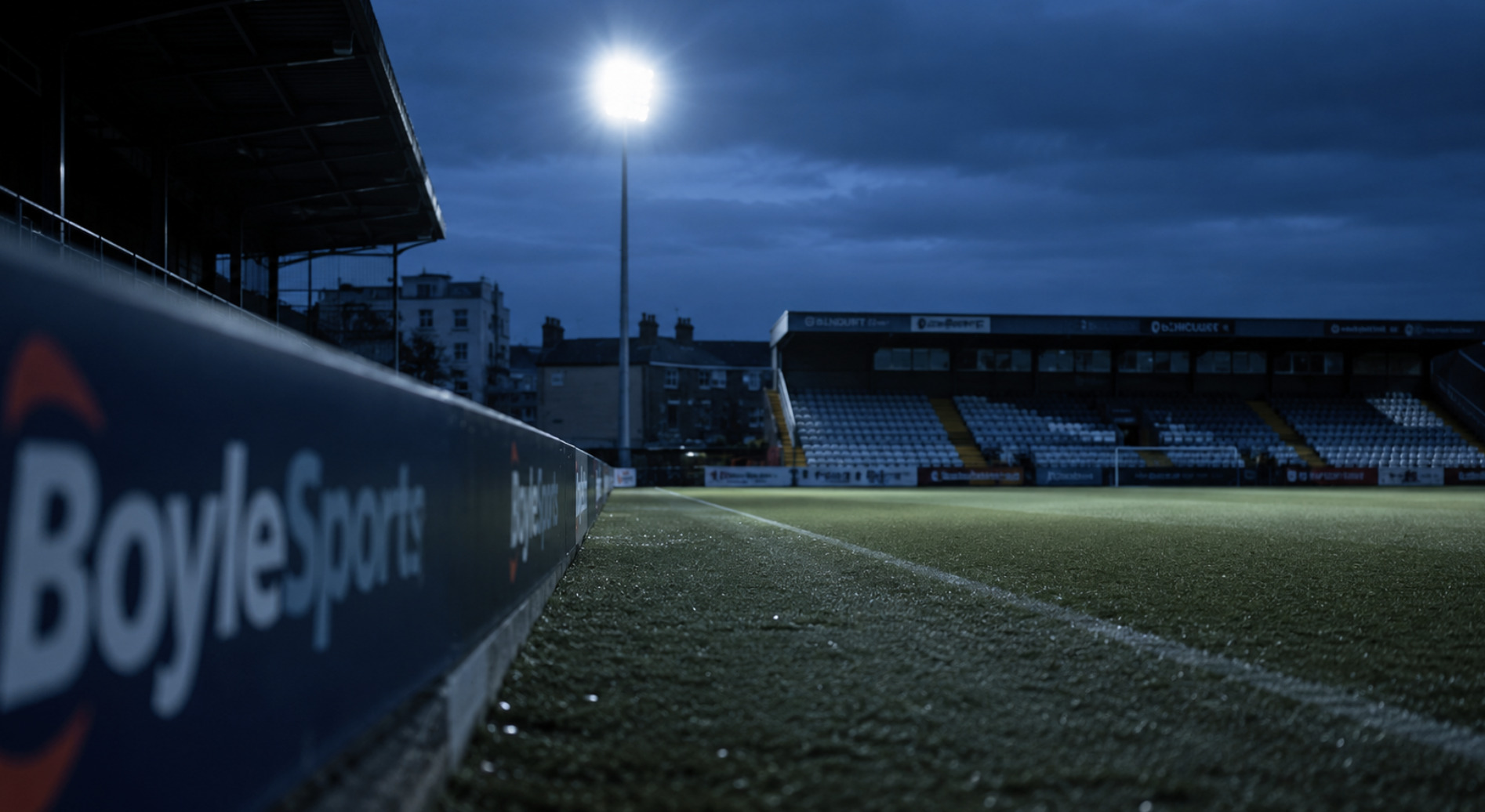
Gambling sponsorship has done specific things for these clubs that no other category of sponsor has, until now, been willing to do at the same scale. Shamrock Rovers, Bohemians, Derry City, Shelbourne, St Patrick's Athletic and several others have carried betting operator branding on jerseys, perimeter advertising and digital content for most of the last decade. The total value across the league is not enormous in absolute terms. The League of Ireland is not a Premier League grant economy. But the value is concentrated in places where it is functionally irreplaceable. Front-of-jersey sponsorships, in particular, are difficult to refill at anything close to the same price point when the betting operators step away, because no other category has the same combination of marketing budget, willingness to associate with under-resourced clubs, and indifference to the negative cultural connotations that other brands consciously avoid.
The clubs that lose this revenue are not, in most cases, going to fail because of it. They are going to operate on smaller margins. Some will sell players sooner. Some will defer ground improvements. Some will reduce their academy intakes. The damage will be distributed across small decisions that almost never produce a headline, which is the kind of damage that is least likely to generate political attention.
What Section 159 actually does to the calendar
The Act came into force on 4 February 2026 and the Authority opened for licence applications on 9 February. The advertising restrictions, including the watershed that prohibits broadcast of gambling advertising between five-thirty in the morning and nine in the evening, are following on a phased timeline. The sponsorship provisions of Section 159 are widely expected to be enforced from 2027, giving existing contracts a transition period that will end somewhere between mid-season and the end of next year.
There is a specific reading of the Act, supported by initial guidance from legal firms specialising in sports and gambling, that treats any club with even a single under-eighteen member, or any ground used by such a club, as falling within the prohibition. Almost every senior club in Ireland runs an underage structure, either directly or through an integrated youth academy. The few that do not still use grounds that host children's matches in other competitions. The practical scope of the section, when read in this way, leaves almost no senior Irish sporting environment outside its reach.
This is the part of the legislation that has not yet been argued in any specific case, and the part where there is room for narrower interpretation. There will be pressure, both from clubs and from operators, to read the section in a way that excludes professional senior teams whose youth structures are administratively separated. Whether the Authority accepts that reading, or treats it as a workaround, is one of the genuine open questions of the next eighteen months. The answer will determine whether the League of Ireland loses most of its gambling revenue in 2027 or finds a way to retain a portion of it under restructured commercial arrangements.
The argument the operators are not making in public
Gambling operators have, with very few exceptions, declined to publicly fight the sponsorship provisions. The reasons are partly tactical. The Authority has the power to attach licence conditions, and a public confrontation with it before any licences have been granted would be commercially suicidal. The reasons are also partly philosophical, in a way that is rarely acknowledged in public statements. Senior figures in the industry have known, for at least five years, that the social licence for gambling advertising in sport has been eroding faster than the commercial value of the sponsorships. Operators have continued to spend because the marginal acquisition cost remained favourable. They have not built strategic dependence on the channel.
The argument they have been making, quietly and to the Authority directly, is about timing. A faster phase-out is preferable for them than a longer one, because a long transition makes the eventual exit more disruptive to relationship continuity. The clubs disagree, for the obvious reason that a longer transition gives them more time to find alternative revenue. The compromise that is emerging, although it has not been formally announced, is likely to look like a hard sunset by the start of the 2028 League of Ireland season, with provision for existing contracts to run out naturally up to that date.
What replaces the money
The honest answer is that nothing fully replaces the money for the lower-tier clubs. The categories that will partially fill the gap are predictable. Construction and property, currently flush with cash and looking for community-level association in cities where their public reputation is mixed. Credit unions, building on the model the GAA used. Insurance and financial services, where regulatory friction is low and brand-safety calculations are favourable. Energy and renewables, where the political tailwind is strong enough to overcome the historical reluctance of these brands to spend on sport.
The categories that will not return at scale are the ones that left a decade ago for reasons unrelated to gambling. Beer and spirits brands have been retreating from front-of-jersey deals for years and are unlikely to come back. Telecoms have consolidated to the point where the marginal value of further sports association is low. Crypto, which briefly flooded the European football sponsorship market in 2021 and 2022, has not stabilised into a reliable category for clubs without significant international fan bases.
The result, plausibly, is that League of Ireland clubs operate with somewhere between fifteen and thirty per cent less sponsorship revenue from 2028 onwards, until and unless a new dominant category emerges. That is a significant compression for an ecosystem already operating on tight margins.
The harder argument
The hardest argument to make in this debate, and the one that almost nobody is making cleanly, is that the gambling revenue was always borrowed from a different ledger. The clubs received the money. The cost of that money was distributed across the population of problem gamblers, including the young people who watched the match-day broadcasts and absorbed the brand association at exactly the age the academic research, including the recent Cambridge study and the longstanding ESRI work, has identified as decisive for later harm.
To put it in the dryest possible terms, Section 159 is a transfer mechanism. It moves money out of one column of the social ledger and back into another. The clubs that lose sponsorship are paying, in slow instalments, for a category of harm that the previous regulatory framework allowed to accumulate. This is not a comfortable framing for the clubs, and it is not, in fairness, a framing that captures everything that mattered about the previous arrangement. But it is the framing that the Authority has, in effect, written into law. The question for Irish sport is not whether to resist that framing, because the resistance has already been ruled out. The question is what shape it builds in the space the gambling money used to occupy. The GAA had eight years to answer that question. The League of Ireland has perhaps eighteen months.
The bill, on the most generous reading, is coming due in 2027.