
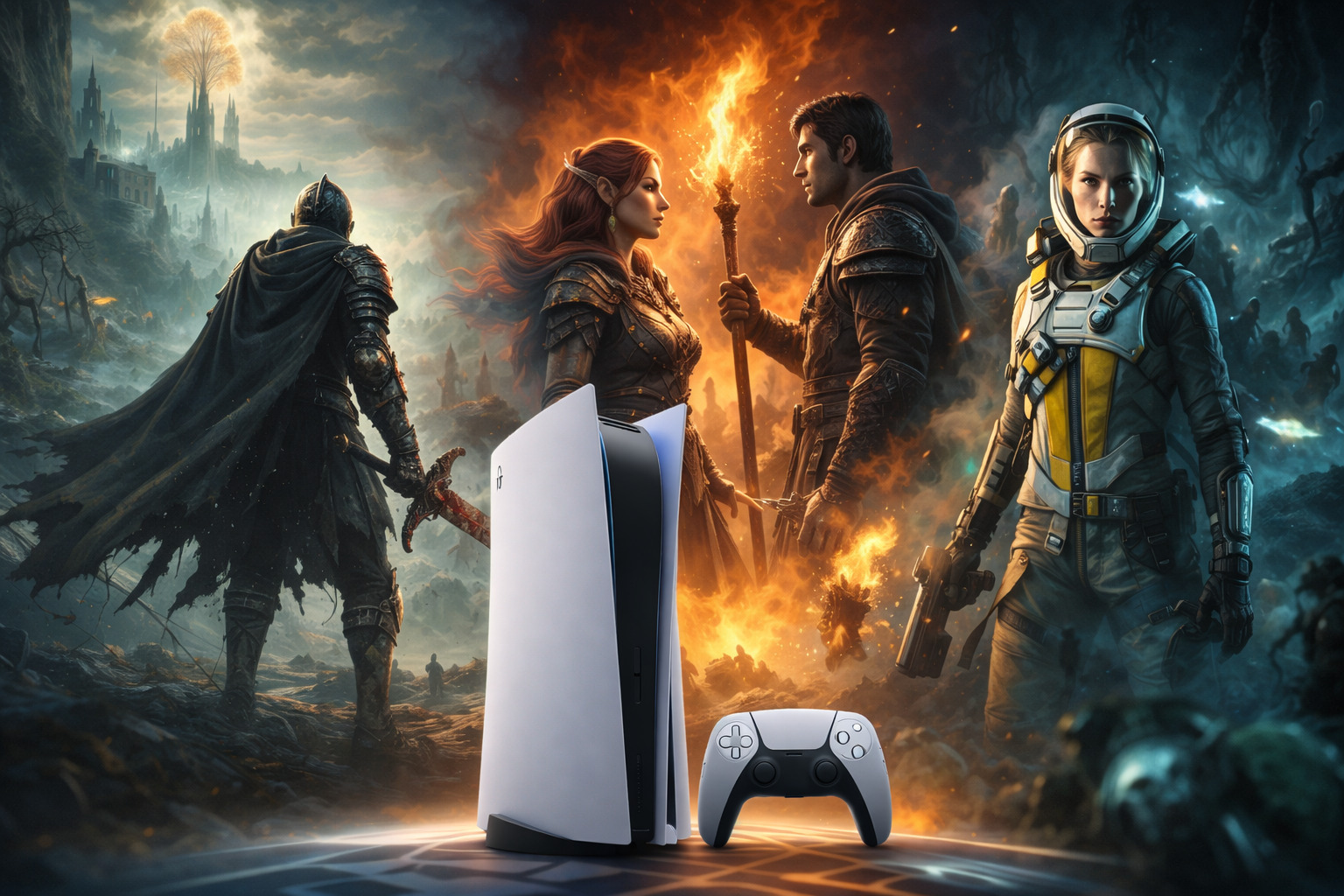
What’s striking about playing on PS5 in 2026 isn’t sheer novelty. It’s density. Density of ideas, of systems layered upon systems, of worlds that assume you are not a beginner anymore. Games no longer explain themselves excessively. They trust you. And in doing so, they reward patience, curiosity and commitment in ways that feel almost old-fashioned — yet distinctly contemporary.
Take Elden Ring. Years after its original release, it remains less a single title and more a reference point. The addition of Shadow of the Erdtree didn’t merely extend its lifespan; it reframed it. Returning to the Lands Between in 2026 feels like stepping back into a place that has aged alongside its audience. The combat is still uncompromising, the world still refuses to guide you by the hand, but there’s a quiet confidence in how it all fits together. You’re not chasing objectives here — you’re absorbing a rhythm. Few games demand so much and give back so generously in return.
That sense of trust between game and player also defines Baldur’s Gate 3, which by now has cemented its status as one of the most important role-playing games of the decade. On PS5, it plays like an elaborate conversation rather than a checklist of quests. Decisions echo hours later. Characters remember what you’ve done, how you spoke, what you avoided saying. It’s a game that assumes intelligence and emotional literacy from its audience, and that assumption changes everything. In a market often dominated by immediacy, Baldur’s Gate 3 is unapologetically slow, layered and demanding — and players have met it on those terms.
Not all defining PS5 experiences are sprawling RPGs. Returnal, still one of Sony’s most distinctive exclusives, feels even more relevant now than at launch. Its looping structure, once seen as niche, aligns perfectly with how players actually engage with games today: in bursts, in cycles, with skill and memory accumulating invisibly over time. The story unfolds elliptically, almost reluctantly, and that restraint is part of its power. Returnal doesn’t ask you to understand everything. It asks you to persist.
Then there is Astro Bot, a reminder that sophistication doesn’t always wear a serious face. In 2026, amid increasingly heavy narratives and complex systems, Astro Bot stands out precisely because it prioritises joy. It’s playful without being shallow, inventive without feeling indulgent. The DualSense integration still feels magical, not because it’s new, but because it’s used thoughtfully. This is design with a smile — and it matters more than it might seem.
God of War Ragnarök occupies a different emotional register entirely. It represents the culmination of a long, carefully controlled narrative arc — one that balances spectacle with intimacy. By now, its reputation is firmly established, but revisiting it in 2026 highlights just how carefully paced it is. Combat feels deliberate rather than frantic, dialogue breathes, and silence is used as effectively as action. It’s a reminder that blockbuster games can still afford nuance, that scale doesn’t have to erase restraint.
Marvel’s Spider-Man 2 approaches scale from another angle. Its genius lies not in reinvention but in refinement. Movement is fluid to the point of becoming second nature. The city feels less like a backdrop and more like a living environment you flow through instinctively. Switching between Peter Parker and Miles Morales adds texture without overcomplication. It’s confident, polished and deeply aware of its own appeal — a game that understands that sometimes excellence comes from doing one thing exceptionally well.
Horror, too, has found new footing on PS5. Resident Evil Requiem signals a subtle but meaningful shift for the franchise. Early players have noted its renewed focus on atmosphere and psychological tension rather than pure action escalation. In 2026, horror feels less interested in shocking the player and more intent on unsettling them slowly. Requiem fits that mood, suggesting that fear, like storytelling itself, benefits from restraint.
Looking ahead, anticipation plays its own role in shaping the PS5 experience. Few titles loom larger than Grand Theft Auto VI. Even before release, its presence is felt as a gravitational force within the industry. Expectations are vast, perhaps impossibly so, but Rockstar’s long development cycle suggests a project that understands the weight it carries. Whether it reshapes open-world design again remains to be seen, but its cultural impact is already assured.
Alongside these giants, smaller and more experimental titles are quietly redefining what PS5 gaming looks like. MIO Memories in Orbit, for example, doesn’t chase scale. Instead, it invites contemplation. Its hand-painted visuals and patient pacing reward attention rather than speed. Similarly, Housemarque’s upcoming Saros builds on Returnal’s foundations but introduces permanence into its progression, hinting at a future where roguelike structures coexist with long-form narrative continuity.
What ties all these experiences together is not genre or budget, but intention. PS5 games in 2026 feel deliberate. They are less concerned with proving technical capability and more invested in shaping how players feel over time. The industry’s obsession with constant engagement has softened, replaced by a quieter confidence that depth, when done well, sustains interest far longer than novelty alone.
For players navigating this landscape, choice is both a privilege and a challenge. The temptation is to chase the newest release, the loudest launch. But some of the most rewarding experiences available now are those that have had time to settle, to be understood and re-evaluated. The PS5 library rewards revisiting as much as discovery.
In that sense, 2026 is not just another year for PlayStation 5. It’s a moment of consolidation. A pause between eras. A chance to look at what this generation has produced and recognise its defining trait: confidence. These games don’t beg for attention. They assume it. And for players willing to meet them halfway, that assumption makes all the difference.